
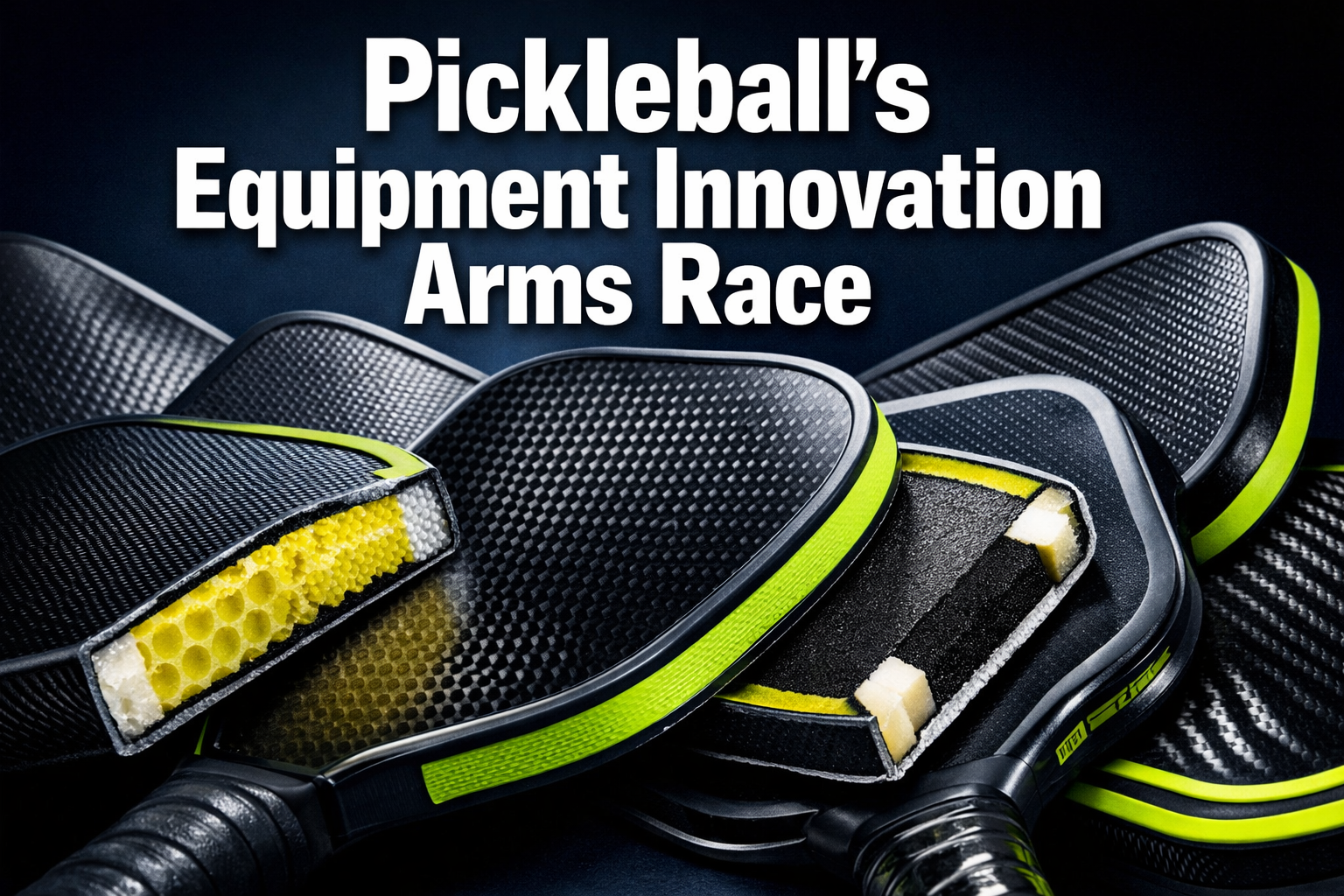
Pickleball’s Equipment Innovation Arms Race: How Paddle Technology and Materials Are Evolving Beyond the Boom
Last updated: April 12, 2026
Quick Answer: Pickleball’s equipment innovation arms race is well underway in 2026. Manufacturers are competing on thermoformed unibody construction, foam core materials, surface texture durability, and smart technology integration. The result is a market that has moved far beyond basic honeycomb paddles, offering players measurable gains in feel, spin, control, and arm comfort.
Key Takeaways 🎯
- Thermoformed unibody construction is now the standard for premium paddles, creating larger sweet spots and more consistent performance across the face [2]
- Foam cores are replacing traditional honeycomb in high-end models, reducing vibration and dead zones while improving energy return [1]
- Core thickness matters: 16mm cores favor control and touch; 13mm cores deliver more pop and power [2]
- Surface durability is a top priority, with ultra-high friction carbon surfaces designed to hold spin-generating texture longer [1]
- Smart paddles with embedded sensors are the next predicted frontier, offering real-time swing and stroke feedback [5]
- The market is consolidating around three design directions: thermoformed carbon all-court paddles, foam-enhanced power paddles, and spin-heavy control paddles [3]
- Major brands are shifting manufacturing overseas to access thermoforming technology not yet available domestically [6]
- Player priorities have shifted from raw power specs to feel, feedback, and reduced arm fatigue [1]
Why Paddle Technology Is Advancing So Fast Right Now
Pickleball’s equipment innovation arms race didn’t happen overnight. As the sport grew from a backyard pastime into a mainstream competitive game, manufacturers realized that players were ready to pay premium prices for measurable performance differences.
The boom years brought millions of new players to the court. Now, as growth stabilizes, brands are competing on quality and engineering rather than just availability. That shift has pushed paddle technology forward faster than most players realize.
Here’s what’s driving the pace:
- More serious players who demand better gear
- Increased investment from established sports equipment companies
- Global manufacturing access, especially to advanced thermoforming processes developed in Asia [6]
- Growing paddle testing culture, with reviewers and communities holding brands accountable on performance claims
For players just getting started, our beginner’s guide to choosing the right pickleball paddle is a great place to understand the basics before diving into advanced specs.
What Is Thermoformed Construction and Why Does It Matter?
Thermoformed unibody construction is the most significant manufacturing shift in pickleball paddle history. Instead of assembling separate components, thermoforming uses heat and pressure to mold the entire paddle as one continuous piece, with foam injected into the edges and all layers fused together [2].
The practical benefits are real:
- Larger, more consistent sweet spots across the full paddle face
- Better structural stability that holds up over time
- Fewer dead zones at the edges where traditional paddles lose energy
- More predictable response on off-center hits [2]
This is now the hallmark of premium paddles from brands like JOOLA, Selkirk, CRBN, and Six Zero [3]. If a paddle in 2026 is priced above $150, there’s a good chance thermoforming is part of the build.
Quick rule: Choose a thermoformed paddle if you play three or more times per week and want consistent performance that doesn’t degrade quickly. Stick with standard construction if you’re a casual player or budget-conscious beginner.

How Are Foam Cores Changing the Feel of Modern Paddles?
Foam cores are replacing traditional polymer honeycomb as the material of choice in high-performance pickleball paddles, and players are noticing the difference immediately [1].
Traditional honeycomb cores are lightweight and responsive, but they create inconsistent energy return across the face. Foam cores, whether floating or dense, deliver:
- More even energy return across the entire hitting surface
- Significantly reduced vibration, which directly lowers arm fatigue
- A broader, more forgiving sweet spot
- Greater durability that resists performance drop-off over time [1]
Early adopters like the Bread & Butter Loco and Ronbus Quanta R3 demonstrated that full-foam construction creates a more connected feel with fewer dead spots [1]. The Gearbox Pro Ultimate Elongated 16mm takes a similar approach with its patented SST Core and Powerband technology, designed to soften touch and expand the sweet spot for all-court play [3].
The shift away from power specs toward feel and comfort is a clear sign the market is maturing. Players are prioritizing intuitive response and reduced arm fatigue over peak power numbers [1].
Does Core Thickness Actually Affect How You Play?
Yes, and the difference is more noticeable than most players expect. Core thickness is one of the most practical specs to understand when shopping for a paddle.
| Core Thickness | Best For | Feel | Power |
|---|---|---|---|
| 13mm | Aggressive, power-focused players | Firmer, more pop | Higher |
| 16mm | Touch players, control-oriented | Softer, more muted | Lower |
A 16mm core gives you more dwell time on the ball, which translates to better placement and spin control. A 13mm core returns energy faster, which suits players who like to drive the ball and play aggressively at the baseline [2].
Common mistake: Many beginners assume thicker always means better. If you rely on speed and power, a 16mm paddle might actually slow your game down. Test both if possible before committing.
For players working on their fundamentals, pairing the right paddle with solid technique matters just as much as the gear itself. Check out these beginner-friendly pickleball drills to build the skills that make equipment upgrades worthwhile.
What’s Happening With Surface Textures and Spin Technology?
Surface texture is where pickleball’s equipment innovation arms race gets genuinely competitive. Spin performance depends heavily on how much friction the paddle face generates at contact, and that friction degrades over time with standard coatings.
In 2026, the focus has shifted to durability of texture rather than just peak grit. Ultra-high friction carbon and raw composite surfaces are engineered to maintain spin-generating texture through hundreds of hours of play [1].
Key developments include:
- Raw carbon fiber faces that hold texture without relying on surface coatings
- Grit-optimized weave patterns designed for consistent ball bite
- Composite surfaces that balance spin and control without sacrificing touch [1]
The practical takeaway: if spin is a core part of your game, look for paddles that specify raw carbon or textured composite surfaces, and check whether reviews mention texture longevity, not just initial performance.
How Is Pickleball’s Equipment Innovation Arms Race Reshaping Major Brands?
The manufacturing side of pickleball’s equipment innovation arms race is just as interesting as the technology itself. Brands that built their reputation on domestic production are having to make difficult decisions.
Engage Pickleball’s CEO acknowledged that Chinese manufacturers developed thermoforming technology that wasn’t available in the U.S., forcing a shift from domestic to overseas production. He noted he would have made that move “about a year earlier” given how fast innovation cycles are accelerating, and the company is investing millions to keep pace [6].
This isn’t unique to Engage. The broader market is consolidating around brands that can execute on three distinct design directions [3]:
- Thermoformed carbon paddles for all-court versatility
- Foam-enhanced power paddles for players who want more drive
- Plush control paddles that generate heavy spin with a softer touch
Leading brands driving this shift include JOOLA, Selkirk, CRBN, Six Zero, Franklin, Paddletek, Engage, and Gearbox [3]. The JOOLA Pro V line, for example, is among the most anticipated releases of 2026, featuring updated shapes and technology compared to the Pro IV generation [4].
What Does the Future of Pickleball Paddle Tech Look Like?
The next wave of innovation in pickleball’s equipment innovation arms race is moving toward two areas: smarter materials and smarter data.
Advanced materials on the horizon:
Top reviewers predict brands will experiment with MPP, Pebax, TPU, and silicone foam in varying densities, using strategic placement within the paddle to optimize weight distribution and expand sweet spot size [5].
Smart paddle technology:
Sensors including accelerometers and gyroscopes are predicted to be built into paddles or available as attachments. These would capture swing characteristics, impact consistency, and stroke mechanics, giving players granular feedback on what’s actually happening at contact [5].
Think of it as the equivalent of wearable fitness trackers, but for your paddle game. For players who love data-driven improvement, this could change how recreational players train and develop their skills.
For anyone curious about how equipment choices interact with on-court strategy, our guide on essential pickleball gear for beginners covers the practical side of building your kit.
How Should Players Choose a Paddle in This Evolving Market?
With so many options and so much marketing noise, the best approach is to focus on how a paddle feels during play, not just what the spec sheet says.
Choose a thermoformed carbon paddle if:
- You play competitively or several times per week
- You want consistent performance across the full paddle face
- Arm fatigue has been an issue with your current paddle
Choose a foam-core power paddle if:
- You play an aggressive, drive-heavy style
- You want more pop without sacrificing too much control
- Durability over time matters more than peak performance
Choose a control/spin paddle if:
- Your game is built around placement and spin
- You play at the kitchen line frequently
- Touch and feel matter more than raw power
Also consider: paddles with 16mm cores for touch-oriented play, and look for raw carbon or textured composite surfaces if spin is central to your game [1][2].
If you’re newer to the sport, don’t feel pressured to buy the most advanced paddle on the market. A solid mid-range paddle paired with good fundamentals will outperform an expensive paddle used with poor technique every time. Our guide to essential gear for new pickleball players can help you make a smart first purchase.
FAQ: Pickleball Paddle Technology in 2026
Q: What is thermoformed construction in a pickleball paddle? Thermoforming uses heat and pressure to mold a paddle as one continuous piece, fusing all layers together with foam-injected edges. This creates a more stable, durable paddle with a larger and more consistent sweet spot compared to traditionally assembled paddles [2].
Q: Are foam core paddles better than honeycomb core paddles? For most players, yes. Foam cores deliver more even energy return, lower vibration, and a more forgiving sweet spot. Honeycomb cores are lighter and can feel livelier, but they tend to have more dead zones and degrade faster [1].
Q: What core thickness should a beginner choose? A 16mm core is generally more forgiving for beginners because it offers a softer feel and better control. A 13mm core suits players who already have technique dialed in and want more pop [2].
Q: Why are premium paddles now made overseas? Thermoforming technology was developed by manufacturers in China and wasn’t available domestically in the U.S. Major brands like Engage shifted production overseas to access this manufacturing capability [6].
Q: What’s the difference between raw carbon and coated carbon surfaces? Raw carbon fiber surfaces hold their texture longer without relying on coatings that wear down. Coated surfaces may feel grippier initially but can lose spin performance faster with regular play [1].
Q: Will smart paddles with sensors actually be useful for recreational players? Potentially, yes. If sensor technology delivers clear, actionable feedback on swing patterns and impact consistency, it could help recreational players identify and fix technique issues faster than video review alone [5].
Q: How do I know if a paddle’s sweet spot claims are accurate? Look for independent reviews from paddle testing specialists rather than brand marketing. Reviewers who test paddles on court under real conditions are more reliable than spec sheets alone [3][4].
Q: Is it worth spending $150+ on a pickleball paddle? If you play regularly and want consistent, durable performance, yes. Premium paddles with thermoformed construction and foam cores hold up better over time and deliver more reliable feel. For casual or beginner players, a mid-range paddle is a smarter starting point.
Conclusion: Play Smarter, Choose Smarter
The pickleball paddle market in 2026 is genuinely exciting for players who care about gear. Thermoformed construction, foam cores, durable spin surfaces, and the coming wave of smart technology are all moving the sport forward in practical, measurable ways.
But the best paddle is still the one that fits your game and your budget, not the one with the most impressive spec sheet. Here’s what to do next:
- Identify your playing style (power, control, or all-court) before shopping
- Prioritize feel over specs when testing paddles, even if it means demoing before buying
- Check independent reviews from paddle testing specialists for honest performance data
- Match your paddle to your skill level, and upgrade as your game develops
- Don’t overlook the basics: solid footwork, consistent technique, and court time will always matter more than equipment
The racket sports community at Rally Racket is here to help you make smart decisions at every stage of your game. Whether you’re picking your first paddle or upgrading after years of play, focus on what helps you enjoy the court more, and the right gear will follow.
References
[1] 2026 Pickleball Paddle Report – https://www.empowerpickleball.com/blogs/2026-pickleball-paddle-report [2] Pickleball Paddle Tech 2025 Guide – https://heliospickleball.com/blogs/news/pickleball-paddle-tech-2025-guide [3] Top Pickleball Paddles 2026 Reviews And Detailed – https://padelspeed.com/blogs/news/top-pickleball-paddles-2026-reviews-and-detailed [4] Watch – https://www.youtube.com/watch?v=qSaSQ5WZBjs [5] We Asked Top Reviewers For Their 2026 Paddle Predictions – https://www.thedinkpickleball.com/we-asked-top-reviewers-for-their-2026-paddle-predictions/ [6] Engage Pickleball New Products 2026 Eric Oncins – https://thekitchenpickle.com/blogs/news/engage-pickleball-new-products-2026-eric-oncins


