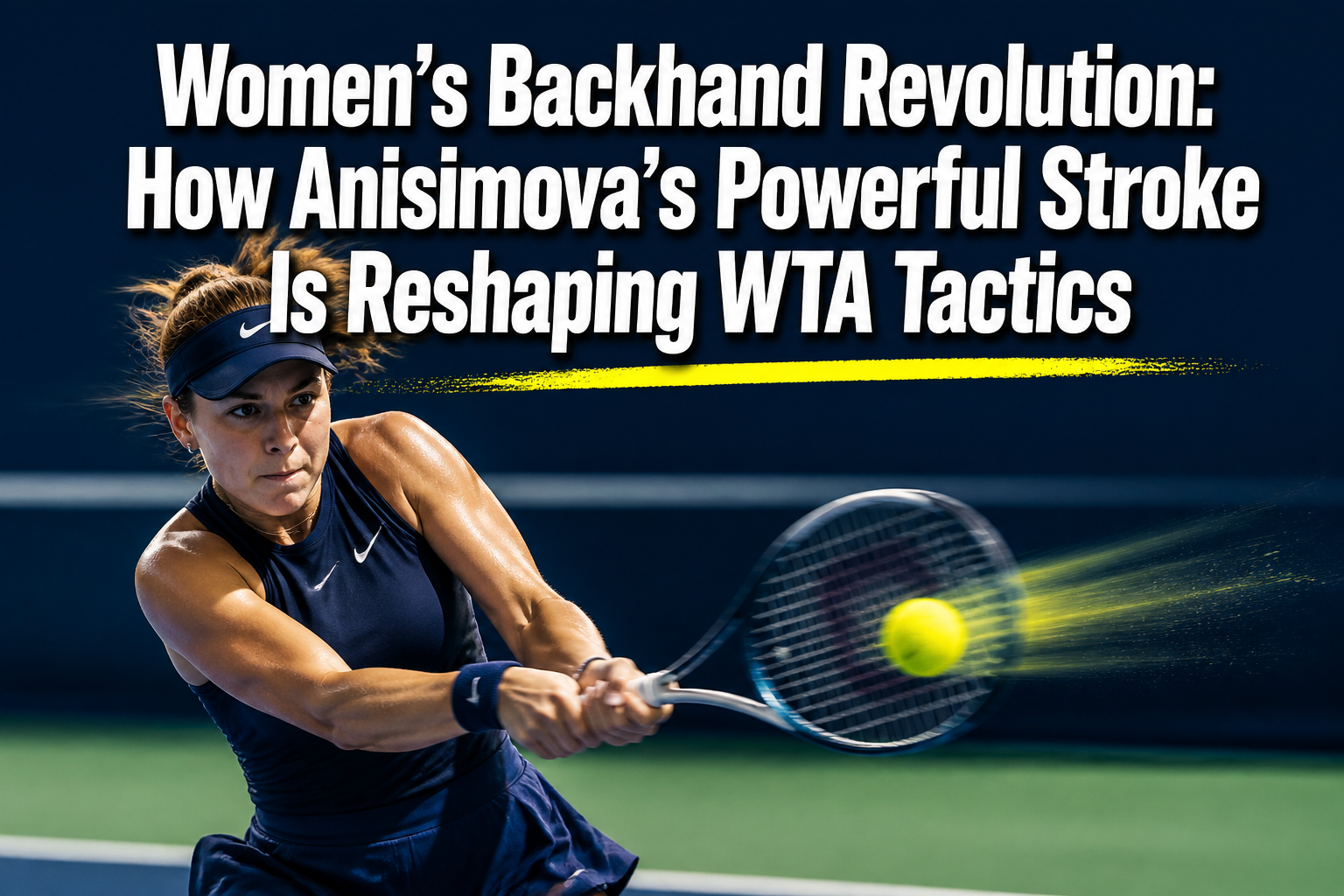
Women’s Backhand Revolution: How Amanda Anisimova’s Powerful Stroke Is Reshaping WTA Tactics
Last updated: May 4, 2026
Quick Answer: Amanda Anisimova’s two-handed backhand has become one of the most feared weapons on the WTA Tour in 2026, generating elite-level pace and disguise that forces opponents to rethink their serve placement, court positioning, and rally patterns. The Women’s Backhand Revolution: How Amanda Anisimova’s Powerful Stroke Is Reshaping WTA Tactics is a real, measurable shift — rivals are moving earlier, hitting wider, and changing their game plans specifically because of how Anisimova strikes the ball off that wing.
Key Takeaways 🎾
- Anisimova evolved from a “first-strike phenom” into a tactically disciplined all-court player, with her backhand as the engine of that change [3]
- Her 2025 backhand winner compilation — a full 30 minutes of highlights — signals just how consistently she’s converting from that side [2]
- The WTA documented her backhand progression throughout the 2025 season, confirming it as a deliberate, coached development [1]
- Opponents are now serving more to Anisimova’s forehand to avoid feeding her backhand — a tactical shift that opens up new court angles
- Her stroke combines flat power with heavy topspin, making it difficult to read and even harder to counter at the baseline
- Recreational players watching her technique can extract real lessons about contact point, unit turn, and follow-through
- The backhand revolution isn’t just about Anisimova — it’s pushing the entire WTA field to develop stronger two-handed backhands as a baseline requirement
- Video analysis of pro technique is one of the best ways for club players to study and apply these mechanics
What Makes Anisimova’s Backhand Technically Different?
Anisimova’s backhand stands out because of three things working together: an early unit turn, a low-to-high swing path, and exceptional contact point consistency. Most players have one or two of these. She has all three, and she executes them under pressure.
The key technical elements:
- Early preparation: She starts her shoulder rotation before the ball bounces, giving her more time to load and drive through the shot
- Contact point: She meets the ball in front of her body, slightly inside the baseline, which maximizes power transfer
- Swing path: Low-to-high with a pronounced follow-through over the left shoulder, generating topspin that keeps the ball in court even at high pace
- Grip: A firm two-handed grip with the non-dominant hand doing significant work, adding stability and disguise
“The backhand isn’t just a defensive tool for Anisimova — it’s a point-ending weapon she can deploy from anywhere on the court.”
The WTA’s own documentation of her backhand progression across the 2025 season shows this wasn’t accidental. It was built, rep by rep, through deliberate practice [1].
How Is the Women’s Backhand Revolution: How Amanda Anisimova’s Powerful Stroke Is Reshaping WTA Tactics Playing Out on Court?
The tactical ripple effects are visible in match data and opponent behavior. When a player’s backhand becomes a genuine threat, opponents stop targeting it — and that changes everything.

What rivals are doing differently against Anisimova:
| Tactical Adjustment | Why They’re Making It |
|---|---|
| Serving more to the forehand | Avoids feeding her backhand return |
| Hitting wider to the forehand side | Forces her to run and reduces backhand opportunities |
| Approaching net more often | Cuts off her backhand drive before she can wind up |
| Using more slice to her backhand | Tries to disrupt her swing rhythm with low balls |
The problem? Each of these adjustments creates its own opening. Serving wide to the forehand leaves the opposite court exposed. Slicing low balls to her backhand still gives her a target to drive through.
Anisimova’s evolution from a “first-strike phenom” into a “fluid machine with refined tactical discipline” — as WTA coverage described her heading into the Australian Open — means she now reads these adjustments and exploits them [3].
Why Did Anisimova’s Backhand Become So Dominant in 2025–2026?
The short answer: intentional development combined with physical maturity. Anisimova has always had natural ball-striking talent, but the 2025 season marked a clear turning point in how she used her backhand as a primary weapon rather than a secondary option.
The WTA released a full 30-minute compilation of her backhand winners from 2025 alone [2]. That volume of highlight-worthy moments from a single stroke tells you this wasn’t a fluke or a hot streak. It was consistent, repeatable, and match-deciding.
Factors behind the development:
- Physical maturity: More core and shoulder strength means more controlled power on the backhand side
- Tactical coaching: Shifting from reactive to proactive backhand use in rally construction
- Mental confidence: Trusting the stroke in high-pressure moments, not just when ahead in the score
- Match experience: Playing more high-level matches where the backhand gets tested and refined
For recreational players, this is a useful reminder: stroke development at any level is a long game. Structuring your practice sessions with specific shot goals — not just hitting balls — is how you build that kind of consistency.
How Does This Fit Into the Broader Women’s Backhand Revolution: How Amanda Anisimova’s Powerful Stroke Is Reshaping WTA Tactics Trend?
Anisimova isn’t the only player pushing the WTA’s backhand standards higher. But she’s currently the clearest example of how a dominant two-handed backhand reshapes an entire match dynamic.
The broader WTA backhand landscape in 2026:
- Aryna Sabalenka’s backhand has long been a tour benchmark for raw power — her backhand winner against Anisimova in their 2025 encounter showed both players trading at elite pace [5]
- Players like Iga Swiatek use heavy topspin on the backhand to build points rather than end them outright
- Anisimova’s version combines elements of both: power and topspin, with the ability to go flat when needed
The result is a new baseline standard. Young players coming up through the WTA development pathway are now expected to have a backhand that can both defend and attack. The days of hiding a weak backhand behind a dominant forehand are getting shorter.
What Can Club Players Learn From Anisimova’s Backhand Technique?
A lot — and most of it doesn’t require elite athleticism. The principles behind Anisimova’s backhand are the same ones any tennis training guide will teach at the club level. The difference is execution quality and consistency under pressure.
Practical takeaways for recreational players:
- Start your turn early. Don’t wait for the ball to bounce before preparing. Get your shoulders rotating as the ball leaves your opponent’s racket.
- Find your contact point. Hit the ball in front of your body. If you’re reaching back or letting it get too close, you lose power and control.
- Drive through, don’t poke. A full follow-through over your non-dominant shoulder generates topspin and keeps the ball in court.
- Use your non-dominant hand. On a two-handed backhand, the top hand does real work. Don’t let it be passive.
- Practice the backhand as an attacking shot. Most club players only use it defensively. Try hitting backhand crosscourt winners in practice rallies.
Watching pro technique through video analysis of the pros is one of the fastest ways to spot what you’re doing differently and fix it. Slow-motion footage of Anisimova’s backhand is particularly useful for checking contact point and swing path.
Also worth noting: the right footwear affects how well you can load into your backhand. Lateral stability in your shoes directly impacts how much power you can generate from the ground up.
How Are Coaches Responding to the Backhand Revolution in WTA Tennis?
Coaches at every level are taking notes. When a stroke becomes a match-deciding weapon at the top of the game, it filters down into coaching methodology within a few seasons.
What’s changing in coaching approaches:
- More emphasis on backhand-first rally construction, not just forehand dominance
- Drills that develop the backhand as an offensive weapon, not just a reset shot
- Serve placement strategies that account for a strong opponent backhand
- Return of serve patterns that use the backhand to dictate the first few shots of a rally
For players in the racket sports community who take lessons or attend clinics, ask your coach specifically about backhand attack patterns. If your coach only works on your backhand defensively, you’re missing half the shot’s potential.
This is also relevant across racket sports. In pickleball, for example, improving footwork and court positioning follows the same logic — you need to be set up to attack, not just react.
FAQ: Anisimova’s Backhand and the WTA Tactics Shift
Q: What grip does Anisimova use on her backhand? A: She uses a two-handed backhand grip, with the dominant hand in an Eastern or semi-Western grip and the non-dominant hand adding significant power and control.
Q: How fast is Anisimova’s backhand compared to other WTA players? A: Specific speed figures aren’t publicly verified for comparison, but WTA highlight content confirms her backhand generates elite-level pace consistently enough to produce a 30-minute winner compilation from a single season [2].
Q: Has Anisimova always had a strong backhand? A: She’s always had natural ball-striking ability, but the 2025 season marked a documented progression in backhand consistency and tactical use, as tracked by the WTA [1].
Q: Why do opponents serve to Anisimova’s forehand? A: To avoid giving her a backhand return she can attack. When a backhand becomes a weapon, opponents shift their serve patterns to the forehand side — which then opens up other court areas.
Q: Does Anisimova use her backhand differently on different surfaces? A: Like most pros, she adapts. On clay, she uses more topspin to build the point. On hard courts, she goes flatter and more aggressive for direct winners.
Q: Can recreational players realistically develop a backhand like Anisimova’s? A: The mechanics are learnable at any level. The pace won’t match a touring pro, but the technique — early turn, forward contact point, full follow-through — absolutely translates to club tennis.
Q: What’s the biggest tactical change Anisimova’s backhand forces on opponents? A: Serve placement. Opponents now have to think twice about serving to her backhand, which changes their entire service game strategy and opens up other weaknesses.
Q: How does this backhand revolution affect doubles tactics in WTA? A: In doubles, a strong backhand return forces the serving team to avoid the returner’s backhand side, which can crowd the net player and create predictable patterns for the returning team to exploit.
Q: Where can I watch Anisimova’s backhand technique in detail? A: The WTA’s official backhand winner compilation from 2025 is a great starting point [2], and the WTA’s documented progression video covers her development across the season [1].
Conclusion: What the Backhand Revolution Means for Players at Every Level
The Women’s Backhand Revolution: How Amanda Anisimova’s Powerful Stroke Is Reshaping WTA Tactics isn’t just a story about one elite player. It’s a signal about where women’s tennis is heading — and what skills matter most at every level of the game.
A dominant two-handed backhand is no longer optional at the top. It’s a requirement. And the principles that make Anisimova’s backhand so effective — early preparation, forward contact, full follow-through, tactical aggression — are the same ones that will make your backhand better at the club level.
Your next steps:
- Watch the footage. Study Anisimova’s backhand in slow motion and compare it to your own technique
- Practice attacking, not just defending. Add backhand crosscourt winner drills to your next session
- Check your footwear. Lateral stability is the foundation of a powerful backhand
- Ask your coach about backhand attack patterns — not just how to keep the ball in play, but how to end points with it
- Join your local racket sports community to find hitting partners who’ll push your backhand under pressure
The best players in the world are raising the bar. That’s good news for anyone who loves the game — because it gives you something worth working toward.
References
[1] Watch – https://www.youtube.com/watch?v=ITU6OrV6cYM [2] Anisimova 2025 Backhand Winners – https://www.wtatennis.com/videos/4422110/anisimova-2025-backhand-winners [3] The Architecture Of A Champion How Amanda Anisimova Is Leveling Up Her Game – https://www.wtatennis.com/news/4434016/the-architecture-of-a-champion-how-amanda-anisimova-is-leveling-up-her-game [5] Aryna Sabalenkas Backhand Winner Sets Up Game Point Vs Amanda Anisimova – https://www.wtatennis.com/videos/4409208/aryna-sabalenkas-backhand-winner-sets-up-game-point-vs-amanda-anisimova