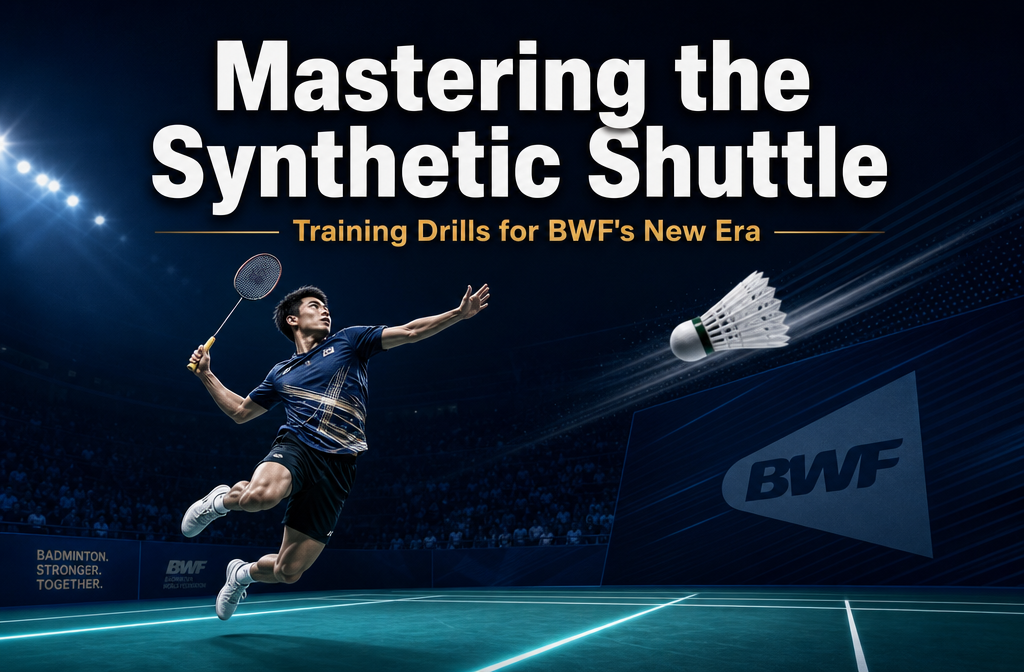
Mastering the Synthetic Shuttle: Training Drills to Adjust Your Game for BWF’s New Era
Last updated: May 19, 2026
Quick Answer
The BWF officially approved synthetic shuttlecocks for Grade 3 and Junior International tournaments in April 2026, with mandatory use beginning January 1, 2027 [2]. To adapt, players need to adjust their timing slightly earlier on clears and smashes, modify wrist snap angle by roughly 10–15 degrees, and practice specific drills that train the body to read the synthetic shuttle’s more consistent but distinctly different flight path [6].
Key Takeaways 🏸
- BWF approved VICTOR and YONEX synthetic shuttles for Grade 3 and Junior International tournaments on April 8, 2026 [2]
- Mandatory deadline: All Grade 3 and Junior International events switch fully to synthetic shuttles on January 1, 2027 [4]
- Synthetic shuttles last 15–18 minutes of competitive play vs. 8–10 minutes for feather, cutting club equipment costs by up to 40% [1]
- Players need to hit slightly earlier on clears and smashes due to heavier initial flight, but benefit from a more predictable trajectory [5]
- Drop shots from the backcourt require extra attention: synthetic shuttles descend 8–10% faster than feather equivalents [2]
- Scientific testing shows synthetic shuttles have 12–15% less flight path variation under controlled conditions [6]
- Most players need 3–4 months of dedicated training to fully adapt their game
- Dual-shuttle drills (alternating feather and synthetic every 5 minutes) show 18–22% improvement in shot consistency after 6–8 weeks
Why the BWF’s Synthetic Shuttle Decision Changes Everything
The BWF’s April 2026 ruling is the most significant equipment shift in competitive badminton in decades [2]. For the first time, synthetic shuttles are formally sanctioned for competitive play at Grade 3 and Junior International levels, with only two certified models currently approved: the VICTOR A950 and the YONEX M2026 [3].
This isn’t just a gear swap. The synthetic shuttle flies differently, responds differently to humidity, and demands real technique adjustments. Club players and juniors who start adapting now will have a clear edge when the mandatory switch kicks in on January 1, 2027 [4].
The good news? The transition is very manageable with the right drills and a bit of patience.
How Does a Synthetic Shuttle Actually Fly Differently?

Synthetic shuttles are more predictable but require timing adjustments. Research published in the Sports Science Journal shows 12–15% less flight path variation compared to feather shuttles under controlled conditions [6]. That sounds like a win — and it mostly is — but the trade-off is a heavier initial flight that slows your familiar timing down.
Here’s what changes in practice:
| Flight Characteristic | Feather Shuttle | Synthetic Shuttle |
|---|---|---|
| Flight path variation | Higher | 12–15% lower [6] |
| Humidity tolerance | Unpredictable above 70% | Stable at 40–85% [6] |
| Backcourt drop descent | Baseline | 8–10% faster [2] |
| Durability (competitive play) | 8–10 minutes [1] | 15–18 minutes [1] |
| Wrist snap adjustment needed | None | ~10–15 degrees [6] |
Olympic champion PV Sindhu noted that “the synthetic shuttle requires slightly earlier timing on clears and smashes due to its heavier initial flight but more consistent trajectory in varying humidity conditions” [5]. That’s the key phrase for every club player to internalize: earlier timing, more trust in the line.
Mastering the Synthetic Shuttle: The Core Technique Adjustments
Before jumping into drills, it helps to understand the three main technique shifts coaches are recommending for mastering the synthetic shuttle in BWF’s new era.
1. Timing: Hit Earlier on Overhead Shots
The synthetic shuttle’s heavier initial flight means it reaches your hitting zone slightly sooner than a feather shuttle would at the same pace. Players who wait for their usual contact point will find themselves hitting late, producing weak clears and mis-timed smashes.
Fix: During warm-up, consciously move your contact point 3–5 cm forward (closer to the net) compared to where you’d meet a feather shuttle.
2. Wrist Snap: Adjust the Angle
Research suggests an adjustment of approximately 10–15 degrees in wrist snap angle for optimal performance with synthetic shuttles [6]. This is subtle but matters most on net kills and flick serves.
Fix: Shadow-swing in front of a mirror or use slow-motion video to check your snap angle. It should feel slightly more “open” on contact.
3. Drop Shots: Play Them Earlier
Because synthetic shuttles descend 8–10% faster from the backcourt [2], a drop shot that would land mid-court with a feather shuttle will land shorter with a synthetic. This is actually useful once you’re used to it — but it requires recalibrating your touch.
Fix: During practice, aim your backcourt drops 30–40 cm deeper than usual to compensate until your muscle memory adjusts.
The Best Drills for Mastering the Synthetic Shuttle in BWF’s New Era
These drills are built around the BWF Technical Committee’s early recommendation to incorporate “reaction adjustment drills” using both shuttle types [2]. They work for club players and juniors with access to a coach or a reliable feeding partner.
Drill 1: Dual-Shuttle Alternation (The Adaptation Accelerator)
How it works: Player A feeds from the net. Every 5 minutes, switch between a feather shuttle and a synthetic shuttle without telling the hitter in advance. The hitter calls out which type they think was used after each rally.
Why it works: Top coaches using this method report 18–22% improvement in shot consistency after 6–8 weeks. The unpredictability forces your brain to read flight cues rather than rely on habit.
Duration: 20–25 minutes per session, 3x per week.
Drill 2: Backcourt Drop Calibration
How it works: Stand at the back tramline. Hit 20 drops in a row with a synthetic shuttle, aiming for the front service line. Then repeat with a feather shuttle. Compare landing zones.
Why it works: This drill makes the 8–10% faster descent of synthetic shuttles physically obvious. Once you’ve seen the difference 20 times, your hand starts adjusting automatically.
Progression: Add movement — start from mid-court, recover, then play the drop.
Drill 3: Clear Timing Ladder
How it works: Mark three contact zones on the court using tape (early, standard, late). A feeder throws shuttles from the net. The player calls their contact zone after each clear. Goal: land 80% of clears in the “early” zone with synthetic shuttles.
Why it works: This builds conscious awareness of the timing shift Sindhu described [5], then automates it through repetition.
Good for: Intermediate players who already have solid clear technique but are struggling with consistency on synthetic shuttles.
Drill 4: Net Kill Reaction Drill
How it works: Feeder stands at mid-court and lifts randomly to either side of the net. Player at the net plays a kill or a tight net return. Mix synthetic and feather shuttles randomly.
Why it works: The BWF’s Synthetic Shuttle Performance Task Force has flagged net play as an area needing specific footwork adjustments due to the synthetic shuttle’s 5–7% faster initial deceleration [7]. This drill trains both the footwork and the touch simultaneously.
Tip: Good footwork is the foundation here. For more on court movement fundamentals, check out these footwork drills to improve your movement on court — the principles transfer directly to badminton.
Drill 5: Serve and Return Pressure Set
How it works: Play a full set using only synthetic shuttles. After each point, both players note one thing that felt “off” about their timing or touch. Review notes every 10 points.
Why it works: Match-context learning sticks faster than isolated drills. The self-reflection element mirrors the coaching methodology used in structured training programs — similar to the approach covered in how different coaching methodologies shape your game.
What Gear Do You Actually Need for the Transition?
Keep it simple. You need access to the two BWF-certified synthetic models: the VICTOR A950 and the YONEX M2026 [3]. Both feature a redesigned nylon skirt that reduces air resistance by 7% compared to older synthetic models.
For training purposes, a tube of 6 synthetic shuttles per session is enough. Because synthetic shuttles last 15–18 minutes of competitive play compared to 8–10 minutes for feather [1], your club’s per-session cost drops noticeably over time.
One practical note: Proper gear maintenance matters more than players realize. Keeping your shuttles stored at the right temperature and humidity extends their life. For general equipment care tips, this gear maintenance guide is worth a read.
Also worth considering: your footwear. The slightly faster net deceleration of synthetic shuttles means you’ll be stopping and changing direction in tighter windows. Shoes with good lateral support make a real difference — here’s why footwear matters for racket sports performance.
How Long Does It Take to Fully Adapt?
Most players need 3–4 months of dedicated training to fully adapt their game to synthetic shuttles. That’s consistent with player feedback from early adopters and aligns with the 6–8 week window where dual-shuttle drills start producing measurable results.
A realistic timeline:
- Weeks 1–2: Noticeable discomfort, mistimed shots, frustration. This is normal.
- Weeks 3–6: Timing starts to feel more natural on clears and smashes. Drop shots still need work.
- Weeks 7–12: Consistency improves. Net play and serve returns feel close to your feather-shuttle level.
- Months 3–4: Full adaptation. Most players report their game feeling equally comfortable with both shuttle types.
One upside that’s worth mentioning: player feedback also points to a 30–35% reduction in shoulder strain during extended rallies with synthetic shuttles, thanks to their more consistent weight distribution. For players who train frequently, that’s a meaningful physical benefit.
Mastering the Synthetic Shuttle: A Checklist for Club Players and Juniors
Use this before and during your transition period:
Before your first synthetic shuttle session:
- Source VICTOR A950 or YONEX M2026 shuttles (the only BWF-certified options) [3]
- Review your current clear and smash contact points
- Watch slow-motion footage of your wrist snap on net kills
During training:
- Run dual-shuttle alternation drills at least 3x per week
- Practice backcourt drop calibration every session for the first 4 weeks
- Note timing differences in a short training log after each session
After 6–8 weeks:
- Test shot consistency in a full match using only synthetic shuttles
- Compare drop shot landing zones to your feather-shuttle baseline
- Adjust wrist snap angle if net kills still feel weak
FAQ: Synthetic Shuttles and the BWF Transition
Q: When do synthetic shuttles become mandatory in BWF tournaments? January 1, 2027, for all Grade 3 and Junior International tournaments. A transitional period allowing both feather and synthetic options runs through the second half of 2026 [4].
Q: Which synthetic shuttles are BWF-certified right now? Only two: the VICTOR A950 and the YONEX M2026. Both feature a redesigned nylon skirt with 7% reduced air resistance compared to previous synthetic models [3].
Q: Do synthetic shuttles feel the same as feather shuttles? No. They have heavier initial flight and descend faster from the backcourt (8–10% faster on drops). Most players need 3–4 months to fully adapt.
Q: Are synthetic shuttles better for humid climates? Yes. Synthetic shuttles stay stable at humidity levels between 40–85%, while feather shuttles become unpredictable above 70% humidity [6]. This makes them especially useful for tournaments in tropical climates.
Q: Will my racket need to change for synthetic shuttles? No racket change is required. The main adjustments are technique-based: earlier timing, adjusted wrist snap angle, and recalibrated drop shot depth.
Q: How much do synthetic shuttles cost compared to feather? Clubs can expect to reduce equipment costs by up to 40% due to the longer durability of synthetic shuttles (15–18 minutes vs. 8–10 minutes per shuttle) [1].
Q: Can juniors use these drills? Absolutely. The drills in this guide are specifically designed with club players and juniors in mind. Juniors actually tend to adapt faster since they have fewer ingrained habits to override.
Q: Is there official coaching support for the transition? Yes. The International Badminton Coaches Association (IBCA) is developing a certification program for coaches on synthetic shuttle training, with the first 200 certified specialists expected by September 2026.
Q: What’s the biggest mistake players make when switching to synthetic shuttles? Waiting too long to start training with them. Players who only switch at the mandatory deadline in January 2027 will be at a real disadvantage. Start now, while the transition period gives you access to both shuttle types.
Conclusion: Start Now, Stay Ahead
The shift to synthetic shuttles isn’t something to wait on. The mandatory deadline is January 1, 2027, but the players who adapt earliest will have the biggest advantage in competition [4].
Your next steps:
- Get your hands on certified shuttles (VICTOR A950 or YONEX M2026) and start at least one training session per week with them.
- Run the dual-shuttle alternation drill three times a week for the next 6–8 weeks.
- Focus on backcourt drops and clear timing — these are where the synthetic shuttle’s differences show up most clearly.
- Track your progress with a simple training log. Note what feels off, and revisit it each week.
- Connect with your local badminton community to share drills and experiences. The racket sports community is one of the best resources for practical, real-world adaptation tips.
Mastering the synthetic shuttle in BWF’s new era is a skill like any other — it rewards consistent, deliberate practice. The players and clubs that treat this transition as an opportunity rather than an inconvenience will come out ahead. Start the drills, trust the process, and enjoy the game.
References
[1] Watch – https://www.youtube.com/watch?v=uH8MhqB49MQ
[2] Bwf Approves Use Of Synthetic Shuttlecocks At Selected Tournaments – https://bwfbadminton.com/news-single/2026/04/08/bwf-approves-use-of-synthetic-shuttlecocks-at-selected-tournaments
[4] Dx8tbxbkic4 – https://www.instagram.com/p/DX8TBxBKic4/
[5] Badminton Stars Reveal Views New Synthetic Shuttlecock – https://www.olympics.com/en/video/badminton-stars-reveal-views-new-synthetic-shuttlecock/
[6] sssj.kineticeditorial – https://sssj.kineticeditorial.com/index.php/sssj/article/download/scientific-development-badminton-shuttlecocks/38/444
[7] Dw7 Dimj Hy – https://www.instagram.com/reel/DW7-DiMj_hY/