Pickleball’s Speed Revolution in 2026: Drills to Boost Agility, Precision, and Net Dominance
Last updated: May 6, 2026
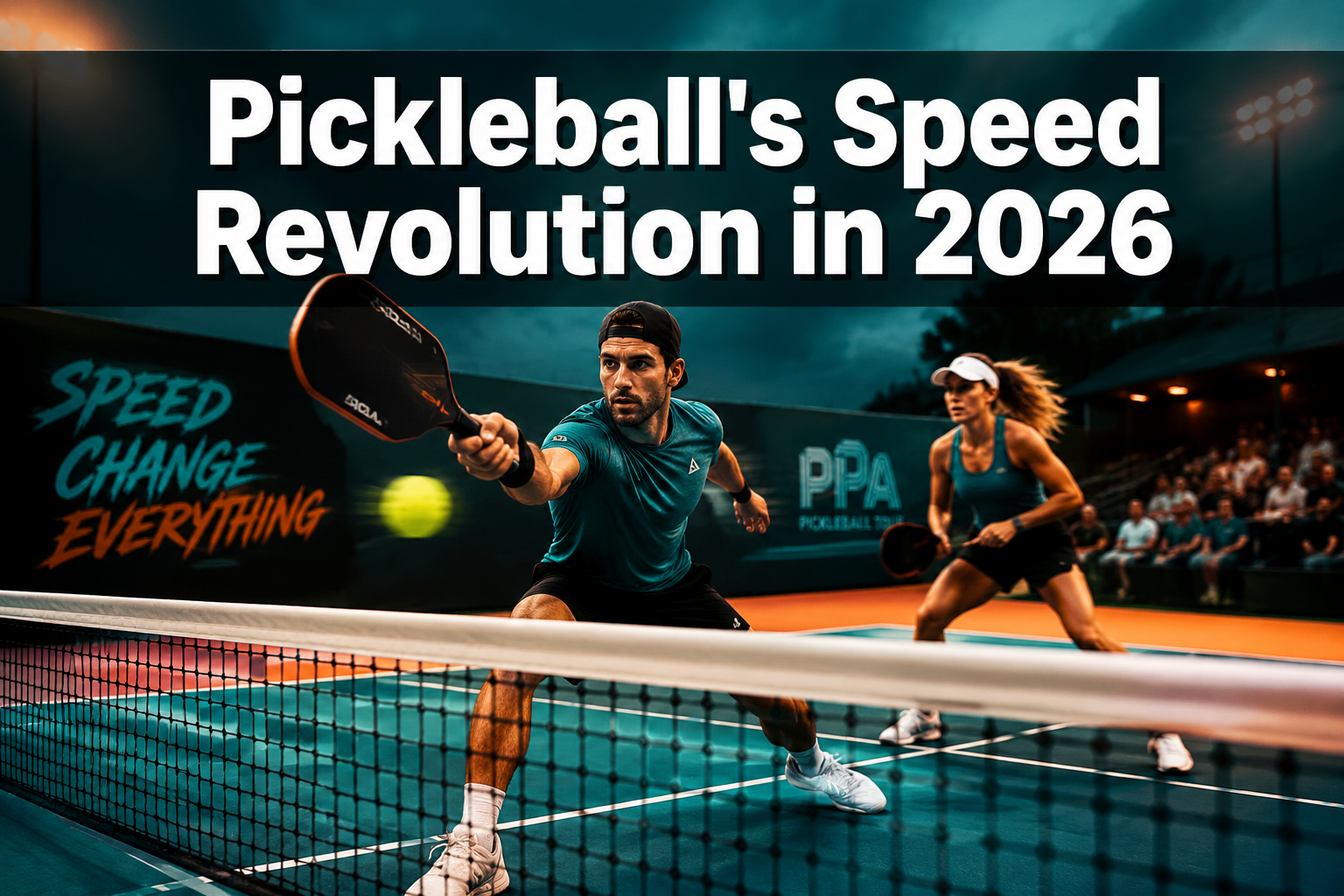
Quick Answer: Pickleball in 2026 is faster, more athletic, and more technically demanding than ever before. Paddle technology now sends balls 5–15 mph harder than just a few years ago, rallies are compressing in time even as they grow in complexity, and hand speed at the net has become the single biggest separator between recreational and competitive players [4]. To keep up, players need targeted drills that build agility, sharpen reaction time, and lock in precise shot placement — not just more court time.
Key Takeaways
- 🏓 Game pace has accelerated roughly 10% year-over-year, driven by foam-core paddle technology that delivers more power with less effort [3][4]
- ⚡ Faster hands at the net now matter more than raw power — strategic placement wins points in 2026 [1]
- 🏃 Cross-training for footwork, balance, and reaction time is no longer optional for competitive players [1]
- 📋 USA Pickleball updated its 2026 rulebook to keep match momentum fluid, including changes to how the match-winning point can be scored [2]
- 🎯 A control-over-power philosophy now dominates paddle design, favoring consistency and precision over brute force [3]
- 🔄 Specific drills — ladder work, shadowing, dink exchanges, and reflex training — directly translate to better court performance
- 🤝 Training with a partner or group accelerates improvement faster than solo practice alone
- ✅ Beginners and intermediates can benefit from the same drill frameworks as competitive players — just scaled to their level
Why Is Pickleball So Much Faster in 2026?
Pickleball’s speed revolution in 2026 didn’t happen overnight. Three forces combined to change the game: better paddles, more athletic players, and rule updates that keep rallies moving.
Paddle technology is the biggest driver. Foam-core and full-foam paddle designs now dominate the market, delivering more consistent energy return, broader sweet spots, and less vibration. Early standouts like the Bread & Butter Loco and Ronbus Quanta R3 set the template, and the market followed fast. Balls now leave paddles 5–15 mph faster than previous generations, with overall rally pace climbing roughly 10% per year [4][3].
Players are training differently, too. The casual “just show up and play” approach is giving way to purpose-driven training — footwork ladders, reaction drills, and cross-training borrowed from tennis and badminton. The athleticism gap between recreational and competitive players has widened noticeably [1].
Rule changes are keeping pace fluid. As of January 1, 2026, USA Pickleball updated its rulebook so that either the serving or receiving team can score the match-winning point. This eliminates the “freeze” scenarios that used to stall games at critical moments [2]. Serve rules have also tightened — borderline volley serves are now called faults rather than given the benefit of the doubt in officiated matches [2].
“Strategic shot placement now matters more than raw power — the players winning points in 2026 are the ones who control the rally, not just the ones who hit hardest.” [1]

What Drills Actually Improve Agility for Pickleball?
Agility for pickleball means moving quickly, stopping cleanly, and recovering fast — not just being generally fit. The best drills mimic real court movement patterns.
Lateral Shuffle Drill
Set up two cones about 10–12 feet apart along the baseline. Shuffle side to side, touching each cone, for 30-second intervals. Keep your knees bent and your weight forward. This mirrors the lateral movement needed during baseline exchanges and wide dinks.
Common mistake: Players stand too upright. Stay low — your center of gravity should feel like you’re sitting in a shallow chair.
Agility Ladder Work
A simple 6-rung agility ladder placed parallel to the net trains quick foot turnover and coordination. Run through these patterns:
- In-in-out-out (standard two-foot pattern)
- Lateral shuffle through each rung
- Single-leg hops for balance and ankle stability
Do 3–4 passes per pattern, rest 30 seconds, repeat. This kind of footwork training is a cornerstone of improving your footwork for pickleball.
Split-Step Practice
Before every shot your partner hits, practice a small split-step — both feet leave the ground briefly as the opponent contacts the ball. This primes your legs to move in any direction instantly. Drill it by having a partner feed balls randomly left, right, and center while you split-step and react.
Choose this drill if: You’re consistently late getting to the ball. It’s almost always a split-step problem, not a speed problem.
How Do You Build Faster Hands at the Net?
Hand speed at the net is now the defining skill in competitive pickleball [1]. Longer rallies and faster incoming balls mean reaction time has to be trained, not just hoped for.
Wall Reflex Drill
Stand 5–6 feet from a solid wall and hit the ball continuously, alternating forehand and backhand. Start slow, then gradually increase pace. This forces your hands to react without time to think. Aim for 30-second sets with 20-second rest.
Partner Rapid-Fire Exchange
Two players stand at opposite kitchen lines and exchange dinks as fast as possible while keeping the ball in play. The goal isn’t power — it’s controlled speed. Start with 10-shot rallies and build up. This drill directly trains the quick-hands game that separates good players from great ones.
For more on the shot types involved, the guide to dinks, drives, and smashes breaks down the mechanics behind each one.
Reflex Ball Training
A small reflex ball (the kind that bounces unpredictably) trains hand-eye coordination in ways a standard ball can’t. Bounce it off the ground and react with your paddle. Even 5 minutes of this before a session sharpens your reflexes noticeably over time.
What Drills Build Precision and Shot Placement?
Power without placement loses points. In 2026, the control-over-power philosophy has shifted even paddle design toward consistency [3]. Drills that train placement give you an edge at every skill level.
Target Dinking
Place three small targets (cones, tape squares, or water bottles) in the kitchen — one near each sideline and one in the middle. Dink from the kitchen line and aim for each target in rotation. Track your hit rate over 10-minute sessions. Aim to improve your percentage week over week.
Cross-Court Consistency Drill
Two players dink cross-court for 3-minute stretches, focusing on keeping the ball low and landing it within 12 inches of the sideline. This trains the precise angle and pace control needed to set up winning third-shot drops.
Third-Shot Drop Practice
The third-shot drop is still one of the highest-leverage shots in the game. Practice it this way:
- Start at the baseline
- Have a partner stand at the kitchen line and feed you a return
- Drop the ball softly into the kitchen — aim for the middle third
- Repeat 20 times, then switch roles
Edge case: If your drops keep sailing long, check your grip pressure. A tight grip at contact is the most common culprit.
How Can You Train Net Dominance Specifically?
Net dominance in pickleball means winning the kitchen battle — controlling the non-volley zone, cutting off angles, and finishing points with authority. Pickleball’s speed revolution in 2026 has made this zone even more critical.
Poaching Drill (Doubles)
In a doubles rally, the net player practices cutting across to intercept balls aimed at their partner. Signal with a paddle tap before moving. This builds communication and trains the aggressive net positioning that competitive doubles teams use constantly.
Overhead Smash Approach
Have a partner lob the ball while you practice:
- Tracking the ball with your non-paddle hand
- Moving back to set your feet
- Hitting a controlled overhead — not a wild swing
Precision matters more than power here. A placed smash beats a wild one every time.
Erne Practice
The Erne — jumping around the kitchen post to volley — is a high-reward play when executed cleanly. Practice the footwork pattern slowly first: step wide, plant outside the kitchen, and volley. Speed it up only after the footwork is automatic.
For players newer to these advanced positions, reviewing basic positioning and court movement first is a smart starting point.
How Should Beginners Approach These Drills?
Beginners benefit from the same drill frameworks — just at a slower pace and with simpler targets. Pickleball’s speed revolution in 2026 doesn’t mean beginners need to train like pros. It means having a plan matters more than ever.
Start here:
| Drill | Beginner Version | Intermediate Version |
|---|---|---|
| Lateral Shuffle | Slow, 5-foot cone gap | Fast, 10-foot cone gap |
| Dink Exchange | 5-shot rally target | 20-shot rally target |
| Third-Shot Drop | From mid-court | From baseline |
| Wall Reflex | Slow, forehand only | Fast, alternating hands |
| Split-Step | Practice stationary | Practice during live rally |
The key for beginners is consistency over intensity. Fifteen focused minutes of dink practice beats an hour of unstructured play for skill development. If you’re just getting started, check out essential gear for new pickleball players before diving into drills — the right paddle makes a real difference in how these exercises feel.
Also worth noting: pickleball’s physical demands are real but manageable. The cardiovascular benefits of regular play are well documented, and structured drill sessions add to those benefits by keeping your heart rate elevated throughout.
What’s the Best Weekly Drill Schedule?
A simple weekly structure works better than random practice. Here’s a practical framework for recreational players:
3-day-per-week plan:
- Day 1 — Footwork & Agility: Ladder work, lateral shuffles, split-step practice (20–25 min)
- Day 2 — Net Game: Rapid-fire dink exchanges, Erne footwork, overhead smash approach (20–25 min)
- Day 3 — Placement & Strategy: Target dinking, third-shot drops, cross-court consistency (20–25 min)
Round out each session with 10 minutes of open play to apply what you’ve drilled. The combination of structured drills and free play is where improvement compounds fastest.
For players who want to weigh solo vs. group practice, the breakdown of group play vs. solo practice is worth reading — it covers the social and skill benefits of both approaches.
Conclusion: Train Smart, Play Faster
The game has changed. Pickleball’s speed revolution in 2026 means that showing up and rallying casually will only take you so far. The players improving fastest are the ones treating practice with intention — working on agility, sharpening their hands at the net, and drilling placement until it’s automatic.
Your next steps:
- Pick one drill category (agility, net game, or placement) and commit to it for two weeks
- Track a simple metric — hit percentage on target dinks, or rally length in rapid-fire exchanges
- Add a partner when you can — partner drills accelerate progress faster than solo work
- Review the 2026 rule changes so your game stays legal under the new serve standards [2]
- Upgrade your gear if your paddle is more than two years old — foam-core technology genuinely changes how the ball responds [3]
The racket sports community at Rally Racket is here to help at every step. Whether you’re picking up a paddle for the first time or chasing a tournament win, the drills above give you a clear path forward. Play smart, train with purpose, and enjoy every rally.
Frequently Asked Questions
Q: How much faster is pickleball in 2026 compared to a few years ago? Paddle technology now enables balls to be hit 5–15 mph harder than previous generations, with overall rally pace increasing roughly 10% per year based on 2025 analysis [4].
Q: What’s the single most important skill to train for 2026 pickleball? Hand speed at the net. Faster rallies mean reaction time at the kitchen line separates recreational from competitive players more than any other skill [1].
Q: Do beginners need to do these drills, or are they just for advanced players? Beginners benefit from the same drills at a slower pace and with simpler targets. Structured practice builds good habits early and prevents bad ones from becoming permanent.
Q: What changed in the 2026 USA Pickleball rules? Two key changes: either team (serving or receiving) can now score the match-winning point, and borderline volley serves are now called faults rather than given the benefit of the doubt in officiated matches [2].
Q: How long should a drill session be? Twenty to thirty focused minutes is enough for most recreational players. Quality of attention matters more than duration. Short, consistent sessions beat long, unfocused ones.
Q: Is foam-core paddle technology worth the upgrade? For most players, yes. Foam-core designs provide broader sweet spots, more consistent energy return, and less vibration — which directly supports the precision-over-power approach that’s winning in 2026 [3].
Q: Can cross-training from other racket sports help pickleball performance? Absolutely. Footwork patterns from badminton, reaction drills from tennis, and balance work from padel all transfer well. The athleticism-driven training model now dominates competitive pickleball [1].
Q: How do I know if my footwork needs work? If you’re consistently late to the ball or off-balance at contact, footwork is almost always the issue. Start with split-step practice and lateral shuffle drills before anything else.
Q: What’s the best drill for improving dink consistency? Target dinking — placing small markers in the kitchen and tracking your hit rate over time — gives you measurable feedback and trains the precise placement that wins kitchen battles.
Q: Is solo practice or partner practice better for improvement? Partner practice accelerates skill development faster because it simulates real rally conditions. Solo drills (wall work, ladder training) are valuable supplements, not replacements.
References
[1] What Pickleball Looks Like In 2026 – https://www.onixpickleball.com/blogs/learn-pickleball/what-pickleball-looks-like-in-2026 [2] 2026 USA Pickleball Rule Changes: What’s Changing This Year – https://www.playpickleball.com/2026-usa-pickleball-rule-changes-whats-changing-this-year/ [3] 2026 Pickleball Paddle Report – https://empowerpickleball.com/2026-pickleball-paddle-report/ [4] Everything Will Change In 2026 (YouTube) – https://www.youtube.com/watch?v=IrhkRWKnGHg [5] Future of Pickleball: Insights on 2026 – https://dilldinkers.com/blog/future-of-pickleball-insights-on-2026/