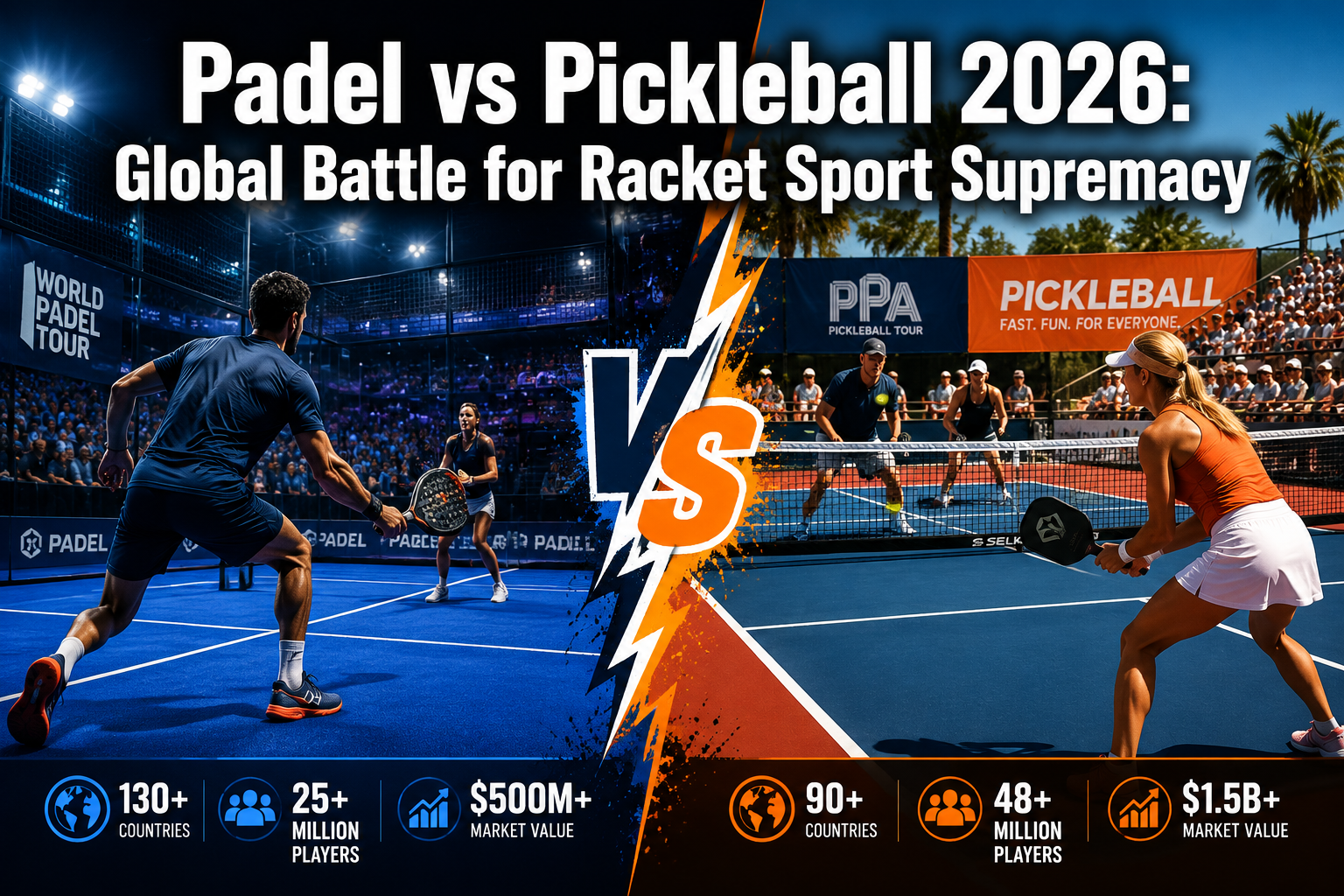
Padel vs Pickleball 2026: Global Battle for Racket Sport Supremacy and US Market Insights
Last updated: May 10, 2026
Quick Answer: Padel leads pickleball in global geographic reach, active in 90+ countries versus pickleball’s 70+, but pickleball dominates the US market by a massive margin — roughly 19.8 million American players compared to padel’s still-emerging US base. In 2026, both sports are growing fast, but they’re doing it in very different ways and for very different audiences. [1][3]
Key Takeaways
- 🌍 Padel is the global footprint leader — present in 90+ countries, with deep roots in Europe, Latin America, and the Middle East [1]
- 🇺🇸 Pickleball owns the US market — 19.8 million US players in 2024, growing 45.8% year-over-year [3]
- 📈 Padel’s US growth is accelerating — from fewer than 30 courts to 600+ between 2020 and 2024 [3]
- 💰 Pickleball is far more affordable — free public courts vs. padel’s €10–€25/hour rental fees [1]
- 🏋️ Padel demands more athleticism — higher physical intensity suits performance-oriented players [1]
- 🎯 Both sports are chasing Olympic inclusion — padel has a more unified governance structure through the International Padel Federation (FIP) [3]
- 🤝 Hybrid venues are emerging — a new trend that could help padel close the gap in the US [3]
- 📊 Pickleball is at mass-participation stage — padel is still building its US ecosystem [3]
How Do Padel and Pickleball Actually Compare in 2026?
Padel and pickleball share a racket sports DNA but appeal to different players for different reasons. Padel is a doubles-only game played inside a glass-walled court, blending elements of tennis and squash. Pickleball uses a smaller court, a perforated plastic ball, and solid paddles — and it’s built for accessibility above all else.
| Feature | Padel | Pickleball |
|---|---|---|
| Court type | Enclosed glass walls | Open court (indoor/outdoor) |
| Players | Doubles only | Singles or doubles |
| Equipment cost | Higher (racket + balls + court fees) | Lower (paddle + balls, free courts available) |
| Physical intensity | High intensity, low-moderate joint impact | Moderate intensity, low joint impact |
| Global reach | 90+ countries | 70+ countries |
| Global players | 25+ million | 36+ million |
| US players (2024) | Emerging (USPA: 1,900+ members) | ~19.8 million |
Choose padel if you’re a competitive doubles player who wants a high-intensity athletic challenge with a global community. Choose pickleball if you want low-cost, easy access, and a massive local player pool — especially in the US.
Why Does Pickleball Dominate the US While Padel Leads Globally?
Pickleball’s US dominance comes down to infrastructure, cost, and timing. It’s been the fastest-growing sport by registered US players for five consecutive years, and that momentum compounds [1]. Public parks across the country converted tennis courts to pickleball courts, making the sport essentially free to try. That zero-barrier entry is hard to compete with.
Padel, by contrast, requires a purpose-built enclosed court — an expensive infrastructure investment. The US went from fewer than 30 padel courts to over 600 between 2020 and 2024, which sounds impressive until you compare it to pickleball’s thousands of public courts [3].
Globally, the story flips. Padel has deep cultural roots in Spain, Argentina, Mexico, and across the Middle East. In those markets, padel courts are as common as tennis courts. Pickleball is newer to those regions and hasn’t matched padel’s grassroots penetration yet.
The gap in plain numbers: US pickleball interest outpaces padel by roughly 10x in search volume and participation data — but padel is active in 20 more countries worldwide. [1][3]
For more on how pickleball spread across different regions, see this breakdown of the regional growth of pickleball across the globe.
What’s Driving Padel’s Rapid Growth in the US Right Now?

Padel’s US growth is real, even if it starts from a small base. The US Padel Association (USPA) grew its membership from just a few hundred in 2020 to over 1,900 by 2024 — roughly an 85% compound annual growth rate [3]. That’s not a niche hobby anymore.
Three factors are pushing padel forward in the US:
- Celebrity and investor attention — High-profile investors and athletes have backed padel facilities in major US cities, bringing media visibility
- The “tennis crossover” effect — Padel is easier to pick up for tennis players than pickleball, so tennis clubs converting courts are pulling in an existing athletic audience
- Hybrid venues — New facilities offering both padel and pickleball courts under one roof are lowering the discovery barrier for both sports [3]
Scott Colebourne, Executive Director of the US Padel Association, put it clearly: “The padel community is newer, more global, and attracts players who value the athletic challenge of a fast-paced doubles game.” [3]
That’s a distinct audience from pickleball’s recreational base — and it’s one that’s willing to pay premium court fees.
How Does the Cost Difference Affect Who Plays Each Sport?
Cost is one of the biggest factors separating these two sports’ audiences. Pickleball wins on affordability by a wide margin.
Pickleball costs:
- Paddle: $30–$150 for beginners (see essential pickleball gear for new players)
- Balls: Under $20 for a pack
- Court fees: Often free at public parks
Padel costs:
- Racket: $80–$300+
- Court rental: €10–€25 per person per hour, plus membership fees at most clubs [1]
- Balls: Comparable to tennis balls
That cost gap shapes who plays each sport. Pickleball attracts retirees, families, casual players, and anyone who wants to get active without a budget commitment. Padel skews toward urban professionals and performance-oriented players who see the court fee as part of the experience.
This isn’t a flaw in padel’s model — it’s just a different market. But it does explain why padel’s US membership numbers look small next to pickleball’s millions. The entry friction is simply much higher.
Which Sport Is Better for Different Types of Players?
Both sports reward smart play over raw power, but they suit different athletic profiles. Understanding court positioning strategies matters in both games, but the physical demands differ significantly.
Padel is a better fit if you:
- Already play tennis and want a faster, more social alternative
- Prefer structured club environments
- Enjoy high-intensity rallies and wall play
- Are comfortable with a steeper learning curve
Pickleball is a better fit if you:
- Are new to racket sports or returning after a break
- Want to play multiple times a week without high costs
- Have joint concerns (lower impact than padel)
- Want to find games quickly in your local area
Pickleball’s accessibility across age groups is well-documented — the sport genuinely works for players from their teens to their 80s. For a deeper look at why, check out why pickleball appeals across all age groups.
Padel’s higher physical intensity makes it better suited to players who want a genuine workout. It’s not just more intense — it’s a different kind of challenge, with wall rebounds requiring quick spatial thinking and explosive movement.
What’s the Olympic Outlook for Padel and Pickleball?
Both sports have Olympic ambitions, but padel is further along the path. The International Padel Federation (FIP) provides unified governance across 90+ countries, which is exactly the kind of structure the International Olympic Committee looks for [3]. Padel has been actively campaigning for Olympic inclusion.
Pickleball’s situation is more complicated. The sport has made significant strides in international recognition, but its governance structure across multiple competing organizations has historically been a barrier. Progress is happening, but pickleball is not yet officially recognized for Olympic inclusion [1].
For players in the racket sports community, Olympic inclusion matters because it drives investment, media coverage, and youth participation programs. Whichever sport gets there first will likely see a significant boost in global growth.
How Can Padel Close the US Gap Against Pickleball?
The Padel vs Pickleball 2026 dynamic in the US is not a zero-sum competition — both sports can grow simultaneously. But for padel to meaningfully close the participation gap, a few strategies stand out:
- Invest in hybrid venues — Facilities offering both sports reduce the barrier for curious pickleball players to try padel [3]
- Target tennis club conversions — Tennis players are padel’s most natural crossover audience
- Develop introductory pricing models — Subsidized trial sessions lower the cost barrier for first-timers
- Build community events — Padel’s social doubles format is a natural fit for league play and corporate events
- Leverage digital content — Padel strategies and training content online are still far less developed than pickleball’s ecosystem, leaving a gap to fill
The racket sports community benefits when both sports thrive. More players across all formats means more investment in courts, coaching, and gear — which lifts every sport in the category.
FAQ: Padel vs Pickleball 2026
Q: Which sport has more players globally in 2026? Pickleball has the larger global player base at 36+ million, compared to padel’s 25+ million — though padel is active in more countries (90+ vs. 70+). [1]
Q: Which sport is growing faster in the US? Both are growing, but pickleball is far ahead in absolute numbers. Padel’s percentage growth rate is higher from a smaller base. [3]
Q: Is padel harder to learn than pickleball? Yes, generally. Padel’s wall play and court dynamics add complexity. Pickleball is widely considered one of the easiest racket sports to start. For beginners, check out essential pickleball rules for new players.
Q: Can you play pickleball and padel with the same skills? There’s some overlap — both reward soft hands and smart positioning — but the games feel quite different. Tennis players often find padel more intuitive.
Q: Which sport is cheaper to get into? Pickleball, by a significant margin. Public courts are free in many areas, and starter paddles cost under $50. Padel requires court rental fees and pricier equipment. [1]
Q: Is padel an Olympic sport yet? Not as of 2026, but padel has an active campaign for inclusion with strong international governance through the FIP. Pickleball is also pursuing Olympic recognition. [1][3]
Q: Which sport is better for older players? Pickleball’s lower joint impact makes it more accessible for older adults. That said, padel can be adapted for different fitness levels in a doubles format.
Q: Are there courts where you can play both sports? Yes — hybrid pickleball-padel venues are a growing trend in the US as of 2026. [3]
Q: What’s the best way to find local courts for either sport? For pickleball, start with how to find local pickleball courts near you. For padel, check the USPA’s club finder.
Q: Which sport has better professional opportunities? Padel’s professional circuit (World Padel Tour) is more established globally. Pickleball’s pro scene is growing rapidly in the US with multiple competing leagues.
Conclusion: Which Sport Wins in 2026 — and What Should You Do Next?
The Padel vs Pickleball 2026 global battle for racket sport supremacy doesn’t have a single winner — it has two very different success stories playing out in parallel.
Pickleball owns the US market and it’s not giving that up anytime soon. Its combination of free courts, low equipment costs, and a welcoming community makes it the default entry point for millions of American players. If you haven’t tried it yet, the history of pickleball shows just how far it’s come — and where it’s headed.
Padel is the global sport to watch. With presence in 90+ countries, a unified international federation, and accelerating US growth, it’s building the infrastructure to challenge pickleball’s dominance over the next decade. The question isn’t whether padel will grow in the US — it’s how fast.
Your next steps:
- Try both sports before picking a side — many hybrid venues now offer both
- Check your local area for padel courts using the USPA finder, or find pickleball courts near you
- Start with pickleball if cost and accessibility are priorities
- Start with padel if you’re a tennis player looking for a new challenge
- Follow both sports — the racket sports community is stronger when more people are playing more games
The racket sports world in 2026 has room for both. Get on a court and find out which one you love.
References
[1] Padel Vs Pickleball – https://www.padelfast.com/blog/padel-vs-pickleball [2] Padel Tennis Vs Pickleball 2026 Usa – https://cricproz.com/padel-tennis-vs-pickleball-2026-usa/ [3] Pickleball Vs Padel Growth Us 2025 – https://empowerpickleball.com/pickleball-vs-padel-growth-us-2025/ [4] Compare Padel Vs Pickleball Growth – https://thepadelschool.com/post/compare-padel-vs-pickleball-growth