The Racquet Sports Boom in 2026: What Tennis, Padel, Pickleball, and Racquetball Can Learn from Each Other
Last updated: June 5, 2026
Quick Answer: The racquet sports boom in 2026 is real, measurable, and still accelerating. Pickleball has roughly 19.8 million U.S. players, padel just crossed one million American players (up 250% since 2022), tennis equipment sales are on track for $15.64 billion by 2030, and racquetball is finding new life through shared facilities. These four sports are far more interconnected than they are competitive — and the ones growing fastest are borrowing the best ideas from each other.
Key Takeaways
- 🎾 Pickleball leads U.S. participation with ~19.8 million players and 45.8% year-over-year growth as of 2024.
- 🏓 Padel is the fastest-growing sport globally, with 19.4 million players across 90+ countries and a global market valued at ~€6 billion in 2026.
- 🏸 Tennis remains the anchor of the racquet sports ecosystem, with equipment sales alone valued at $10.35 billion in 2026.
- 🔵 Racquetball is leveraging shared court infrastructure to stay relevant in the multi-sport facility era.
- All four sports share overlapping player profiles, especially among adults 35–65.
- Cross-sport transitions are common: tennis players move to padel or pickleball; racquetball players often try both.
- The biggest growth driver across all four sports is social play — not elite competition.
- Facility operators who build for multiple racquet sports are seeing stronger ROI than single-sport venues.
- Professional leagues now exist for pickleball and padel, raising the visibility of both sports significantly.
- Beginner accessibility — low cost, short learning curve — is the single biggest predictor of growth in any racquet sport right now.

What Exactly Is Padel and How Is It Different from Tennis?
Padel is a racquet sport played on an enclosed court about one-third the size of a tennis court, with walls that are part of the game. Players use a solid, stringless racquet and a pressurized ball similar to a tennis ball — but the walls allow for bank shots, which makes rallies longer and more forgiving for beginners.
Key differences from tennis at a glance:
| Feature | Tennis | Padel |
|---|---|---|
| Court size | Full-size open court | Enclosed, ~20m x 10m |
| Racquet | Strung frame | Solid with holes |
| Walls | No | Yes — part of play |
| Serve | Overhead allowed | Underhand only |
| Scoring | Standard (love/15/30) | Same as tennis |
| Doubles | Optional | Almost always doubles |
Padel is now played in over 90 countries, and the global market is valued at approximately €6 billion in 2026 — up from €2 billion in 2022. [10] In the U.S. alone, the sport surpassed one million players by April 2026, a 250% increase since 2022. [2]
Choose padel if: you enjoy the social nature of doubles tennis but want a shorter learning curve and more wall-play creativity.
Which Racquet Sport Is Growing the Fastest Right Now?
Padel holds the title for fastest global growth, while pickleball leads in U.S.-specific growth. Globally, padel added 16% more players year-over-year and now has over 19.4 million players with 58,300 courts worldwide (nearly 8,000 added in 2025 alone). [1] In the U.S., pickleball’s 45.8% year-over-year growth rate as of 2024 makes it the domestic growth leader. [3]
Racquetball is stable rather than shrinking — it benefits from shared infrastructure at gyms and multi-sport facilities. Tennis, meanwhile, is growing in revenue and equipment sales even if raw participation numbers are more modest.
💡 The real story in 2026 isn’t which sport is “winning” — it’s that all four are growing together, often sharing the same players and facilities.
The racquet sports boom in 2026 reflects a broader shift: people want active, social, skill-based recreation, and racquet sports deliver all three better than most alternatives.
How Much Does It Cost to Start Playing Pickleball?
Pickleball is one of the most affordable ways to get into racquet sports. A beginner can get started for well under $100, which is a major reason for its explosive growth.
Estimated starter costs:
- Paddle: $30–$80 for a solid beginner option (composite or graphite)
- Balls: $10–$15 for a pack of outdoor or indoor balls
- Court shoes: $50–$100 (court-specific shoes reduce ankle injury risk)
- Court access: Often free at public parks; $5–$15/session at indoor facilities
Total startup cost: roughly $90–$200, compared to $300–$600+ for tennis (racquet, balls, lessons, court fees).
For more on choosing your first gear, see this guide to essential gear for beginners. Many community centers also offer local pickleball courts at no charge.
Common mistake: Buying a cheap $20 paddle from a big-box store. It’ll work, but the lack of grip and control makes the learning curve steeper. Spend at least $40–$50 for a noticeable improvement in feel.
What Are the Most Common Mistakes Beginners Make in Racquetball?
Racquetball beginners most often struggle with court positioning and shot selection — specifically, standing too far back and hitting the ball too hard instead of placing it strategically.
Top beginner mistakes in racquetball:
- Hitting everything as hard as possible. Power is less useful than placement in racquetball. A well-placed kill shot beats a hard drive every time.
- Ignoring the front wall. New players often aim for the back wall. The front wall is where points are won.
- Poor footwork. Not getting into position early leads to awkward swings and shoulder strain.
- Skipping eye protection. This is a safety issue, not just a performance one — eye injuries are the most common serious injury in racquetball.
- Not learning the “Z-serve.” This is one of the most effective serves in the game, and beginners rarely use it.
Edge case: Players coming from tennis often over-swing in racquetball because the enclosed court feels like it demands power. The opposite is true — finesse wins in a small court.
Which Racquet Sport Is Best for People Over 50?
Pickleball is the top choice for players over 50, followed closely by padel. Both sports have smaller courts, slower ball speeds, and a lower injury risk than tennis or racquetball. Pickleball’s kitchen rule (no volleys near the net) naturally slows the game and reduces explosive movement demands.
Research consistently links racquet sports to improved cardiovascular health, balance, and coordination in older adults. Pickleball in particular has been embraced by the 50+ demographic because of its social structure — most games are doubles, which means more conversation and less solo running. Learn more about adapting pickleball for seniors.
Choose by priority:
- Low impact + social: Pickleball
- Skill ceiling + strategy: Padel
- Intense cardio: Racquetball (with proper warm-up)
- Lifelong sport with global community: Tennis
Why Are Younger People Suddenly Interested in Pickleball?
Pickleball’s appeal to younger players (18–35) comes down to three things: it’s easy to start, it’s social, and it’s genuinely fun within the first session. Unlike tennis, which can take months before rallies feel satisfying, pickleball delivers immediate reward.
Social media has amplified this. Clips of fast kitchen exchanges and trick shots perform well on short-form video platforms, which has driven awareness among younger demographics. Celebrity involvement (several NBA and NFL players have invested in pickleball leagues) has also raised its profile.
The sport’s history stretches back to the 1960s, but its current moment is unmistakably youth-driven. The unique features of pickleball — particularly the non-volley zone and underhand serve — create a tactical depth that keeps competitive younger players engaged long-term.
What Equipment Do You Need for Padel That’s Different from Tennis?
Padel requires a solid racquet (no strings), a slightly depressurized ball, and court shoes with herringbone soles. Everything else — grip tape, sweat bands, athletic wear — is interchangeable with tennis.
Padel-specific gear checklist:
- ✅ Solid padel racquet (foam core with carbon or fiberglass face)
- ✅ Padel balls (slightly less pressurized than tennis balls)
- ✅ Court shoes with herringbone grip (same as tennis clay-court shoes work well)
- ✅ Wrist strap (mandatory in most clubs — the racquet has a safety cord)
What you don’t need: a stringing machine, overgrip tape (most padel grips are pre-wrapped), or a ball hopper (courts are small enough to pick up by hand).
Cost to equip for padel: roughly $150–$350 for a beginner setup, which is comparable to pickleball once you factor in court fees.
Are There Professional Leagues for Pickleball Yet?
Yes — professional pickleball now has multiple competing league structures. The Major League Pickleball (MLP) and the Professional Pickleball Association (PPA) Tour are the two primary circuits in the U.S. as of 2026, featuring team-based and individual tournament formats respectively.
On the padel side, the Pro Padel League raised $15 million in March 2026 for facility development and relocated its Matrix team to Washington D.C. in April 2026, marking the city’s first professional padel franchise. [6] [8]
Professional leagues matter for growth because they:
- Create aspirational pathways for recreational players
- Attract media coverage and sponsorship dollars
- Drive equipment innovation through professional feedback loops
The racquet sports boom in 2026 is being partly fueled by this professionalizing of formerly recreational sports.
What Health Benefits Do Racquet Sports Offer Compared to Other Exercises?
Racquet sports deliver cardiovascular, cognitive, and social benefits in a single session — a combination that’s hard to match with gym-based exercise. Studies have consistently ranked racquet sports among the top activities for longevity and mental health.
Benefits across all four sports:
- Cardio: Interval-style movement (bursts of effort + recovery) is highly effective for heart health
- Coordination: Hand-eye coordination improves measurably with regular play
- Cognitive load: Tracking a ball, reading opponents, and planning shots engages the brain actively
- Social connection: Doubles formats in pickleball and padel reduce isolation, which is a significant health factor for adults over 50
- Balance and agility: Lateral movement and quick direction changes build functional fitness
For a deeper look at how regular play affects coordination and fitness, see how pickleball improves coordination and explore incorporating pickleball into a weekly fitness routine.
Which Racquet Sport Is the Hardest to Learn?
Tennis has the steepest learning curve of the four, primarily because of the full-size court, complex stroke mechanics, and the overhead serve. Racquetball is second — the enclosed court and fast ball speed require quick spatial adjustment.
Learning curve comparison (beginner to “fun” level):
| Sport | Time to Basic Fun | Key Challenge |
|---|---|---|
| Pickleball | 1–3 sessions | Kitchen rules, dinking |
| Padel | 2–5 sessions | Wall reads, court positioning |
| Racquetball | 3–8 sessions | Ball speed, court geometry |
| Tennis | 5–20+ sessions | Serve mechanics, footwork |
Can tennis players easily transition to pickleball? Yes — and it’s one of the most common crossovers in 2026. Tennis players already understand court geometry, spin, and shot placement. The main adjustment is the smaller court, the underhand serve, and the kitchen rule. Most tennis players can play a competitive pickleball game within two or three sessions. The appeal of pickleball for all ages and backgrounds makes it a natural landing spot for tennis players looking for something more social and accessible.
What Injuries Are Most Common in Racquet Sports?
Elbow injuries (tennis elbow), ankle sprains, and shoulder strain are the most common across all four sports. Each sport also has its own specific risk profile.
By sport:
- Tennis: Tennis elbow (lateral epicondylitis), shoulder impingement, knee strain
- Padel: Ankle sprains from lateral movement on enclosed courts, wrist injuries
- Pickleball: Elbow strain (“pickleball elbow”), knee pain from quick stops, Achilles issues in older players
- Racquetball: Eye injuries (most serious), shoulder strain, ankle rolls
Prevention basics that apply to all four:
- Warm up for at least 5–10 minutes before play
- Wear sport-specific shoes with lateral support
- Use proper grip size — too small or too large increases elbow stress
- Stretch wrists and shoulders after every session
How Do Racquet Sport Rules Differ Across These Four Games?
The four sports share a common DNA — a racquet, a ball, a court, and a net — but their rules create very different games.
Key rule differences:
| Rule Element | Tennis | Padel | Pickleball | Racquetball |
|---|---|---|---|---|
| Serve type | Overhead | Underhand | Underhand | Overhead or sidearm |
| Walls in play | No | Yes | No | Yes (all 4 walls) |
| Net height | 3 ft (center) | 3.3 ft | 34 in (center) | No net |
| Non-volley zone | No | No | Yes (kitchen) | No |
| Scoring | 15/30/40/game | Same as tennis | Rally scoring to 11 | Rally scoring to 15 |
| Court | Open outdoor | Enclosed glass/mesh | Open, smaller | Fully enclosed |
The biggest conceptual shift between sports is the non-volley zone in pickleball (the kitchen) and the wall play in padel and racquetball. Players who understand these two mechanics can adapt to any of the four sports more quickly.
Conclusion: What Each Sport Can Learn from the Others
The racquet sports boom in 2026 is not a zero-sum competition. Tennis, padel, pickleball, and racquetball are growing together — and the data shows they share players, facilities, and audiences far more than they compete for them. [4] [5]
Actionable next steps depending on where you are:
- New to racquet sports? Start with pickleball. Low cost, fast fun, and a huge community waiting to welcome you. Find local courts near you and show up.
- Tennis player looking for variety? Try padel for wall strategy or pickleball for a social doubles game. Both transitions are smooth.
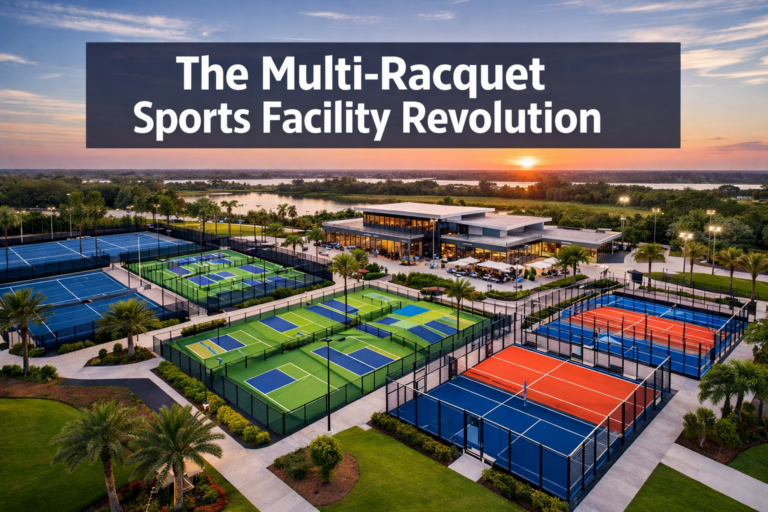
- Facility operator or coach? Build for multiple sports. The convergence of player profiles means a padel court, two pickleball courts, and a racquetball court in the same facility will serve a wide, overlapping audience.
- Racquetball player feeling isolated? Your skills transfer well to padel. The wall-reading instincts you’ve built are a genuine advantage.
- Over 50 and just getting started? Pickleball and padel were practically designed for you. The social structure, manageable court size, and community culture make both sports genuinely life-changing for active adults.
The sports that grow fastest in 2026 and beyond will be the ones that borrow the best ideas from each other — community-building from pickleball, global infrastructure thinking from padel, technical depth from tennis, and court efficiency from racquetball. The boom is real. The only question is which court you’ll step onto first. 🎾
FAQ
Q: Can I use a tennis racquet to play padel? No. Padel requires a solid racquet without strings. Using a tennis racquet on a padel court is not allowed and would damage both the racquet and the ball.
Q: Is pickleball easier than tennis for complete beginners? Yes. Pickleball has a smaller court, slower ball, and simpler serve mechanics. Most beginners can enjoy a real rally within their first session, which takes much longer in tennis.
Q: How long does a typical pickleball game take? A standard game to 11 points (win by 2) takes roughly 15–25 minutes. Most recreational sessions involve multiple games over 60–90 minutes.
Q: Do padel courts cost more to build than tennis courts? Yes. Padel courts require enclosed glass or mesh walls, which makes them more expensive to build — typically $30,000–$60,000 per court versus $20,000–$40,000 for a basic tennis court. This is why the Pro Padel League’s $15 million infrastructure investment in 2026 was significant. [6]
Q: Is racquetball dying? No — but it has declined from its 1980s peak. Racquetball is stabilizing as a niche sport within multi-sport facilities, where its courts are increasingly shared with pickleball and other activities.
Q: What’s the best racquet sport for pure cardio? Racquetball. The enclosed court, fast ball, and constant movement make it one of the highest-intensity racquet sports. A 30-minute game can burn as many calories as a 45-minute run.
Q: Can kids play all four of these sports? Yes. Pickleball is particularly popular with kids because of its smaller court and lighter equipment. Tennis has strong junior programs globally. Padel and racquetball are less common for children but fully accessible.
Q: What is rally scoring in pickleball? Rally scoring means a point is awarded on every serve, regardless of who served. Games go to 11 (win by 2). This differs from traditional tennis scoring where only the server can win a point.
Q: Are there outdoor padel courts? Yes, though most padel courts are covered or semi-enclosed to protect the glass walls. Outdoor open-air padel courts exist, particularly in warmer climates like Florida and Spain.
Q: How does the kitchen rule work in pickleball? The kitchen (non-volley zone) is a 7-foot area on each side of the net. Players cannot volley (hit the ball in the air) while standing in this zone. It prevents players from dominating at the net and creates the strategic dinking game that defines pickleball. See common fouls and violations in pickleball for a full breakdown.
References
[1] Playtomic Releases 2026 Global Padel Report Highlighting Padel’s Growth In The U.S. – https://clubandresortbusiness.com/playtomic-releases-2026-global-padel-report-highlighting-padels-growth-in-the-u-s/?utm_source=openai
[2] Padel Surpasses One Million Players In The United States – https://padelusa.org/padel-surpasses-one-million-players-in-the-united-states/?utm_source=openai
[3] Padel Vs Pickleball 2026 Global Battle For Racket Sport Supremacy And US Market Insights – https://rallyracket.com/padel-vs-pickleball-2026-global-battle-for-racket-sport-supremacy-and-us-market-insights/?utm_source=openai
[4] The Racquet Sports Equipment Boom Why 10 Billion In Global Sales Is Reshaping Gear Innovation In 2026 – https://rallyracket.com/the-racquet-sports-equipment-boom-why-10-billion-in-global-sales-is-reshaping-gear-innovation-in-2026/?utm_source=openai
[5] Padel Emerges As Global Transformation Driver In Racquet Sports According To SGI – https://www.clusterpadel.com/en/padel-news/20260421/padel-emerges-as-global-transformation-driver-in-racquet-sports-according-to-sgi.aspx?utm_source=openai
[6] Padel Vs Pickleball Complete Comparison Guide – https://thesportsrise.com/padel/analysis/padel-vs-pickleball-complete-comparison-guide?utm_source=openai
[8] DC Pro Padel Team Matrix – https://www.axios.com/local/washington-dc/2026/04/29/dc-pro-padel-team-matrix?utm_source=openai
[10] Padel Market Size Growth Statistics 2026 – https://thepadelbrief.com/en/blog/padel-market-size-growth-statistics-2026?utm_source=openai