
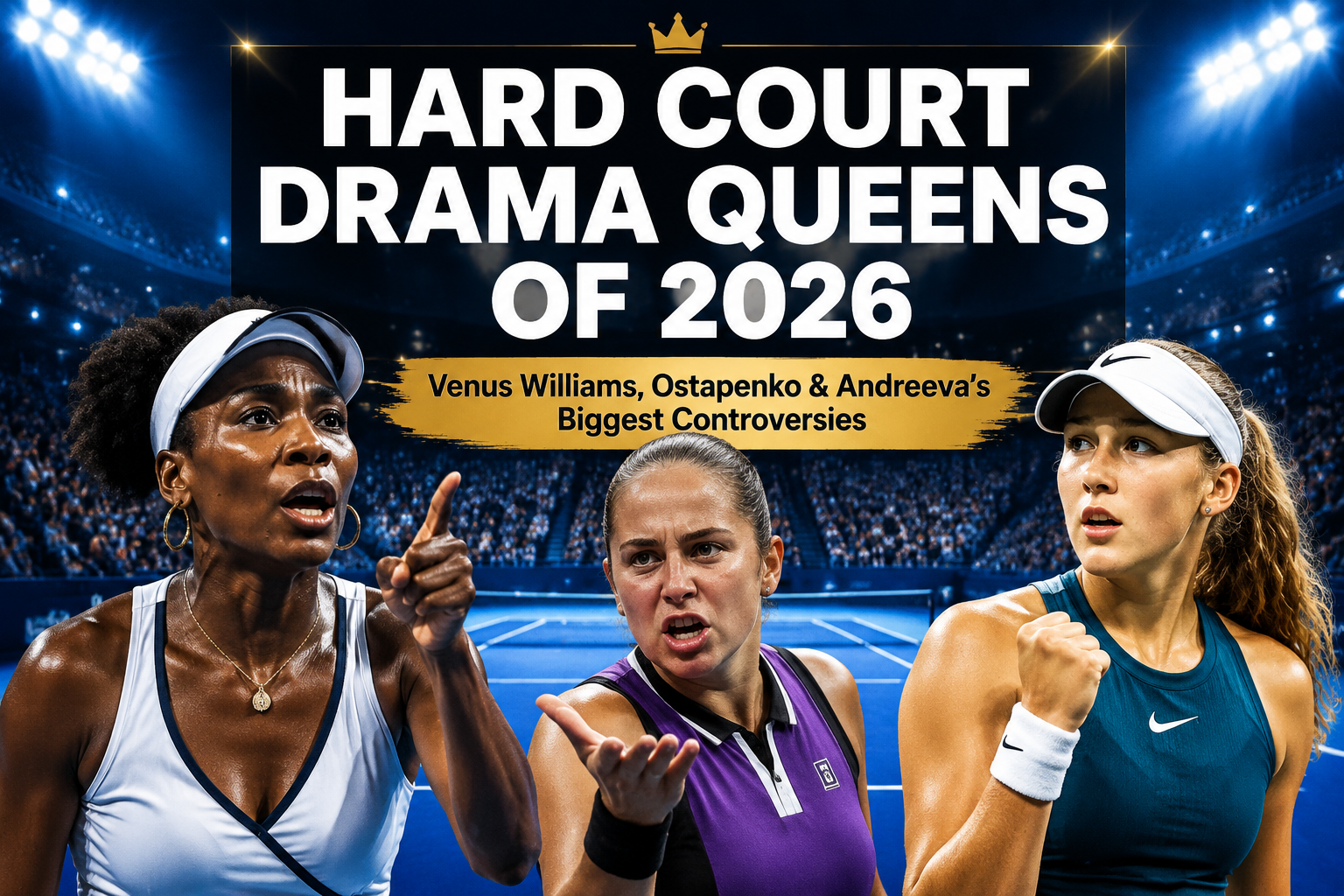
Hard Court Drama Queens of 2026: Venus Williams, Ostapenko, and Andreeva’s Controversies
Last updated: June 8, 2026
Quick Answer: The Hard Court Drama Queens of 2026 — Venus Williams, Jelena Ostapenko, and Mirra Andreeva — have each sparked significant on-court controversies through heated umpire disputes, post-match outbursts, and behavioral incidents that have put women’s tennis under a spotlight. These controversies range from fines and public apologies to broader debates about player conduct, mental pressure, and the unwritten rules of the sport.
Key Takeaways
- Venus Williams has a documented history of umpire confrontations and media refusals dating back years, and her 2026 hard court appearances have reignited those conversations.
- Jelena Ostapenko is known for explosive on-court behavior, including a 2025 US Open incident where she publicly insulted an opponent and later apologized. [1]
- Mirra Andreeva, one of the youngest top-10 players, has drawn attention for emotional outbursts and on-court conduct that critics say crosses the line.
- None of these players have faced outright bans — fines and warnings remain the standard disciplinary response.
- Tennis fans are divided: some see passion and competitiveness, others see poor sportsmanship.
- The WTA has clear misconduct codes, but enforcement is often inconsistent.
- Understanding court behavior — good and bad — is genuinely useful for recreational players who want to improve their own mental strategies for high-stakes matches.
- These controversies have not significantly damaged women’s tennis commercially, but they do shape public perception.

Who Are the Main Drama Queens in Tennis Right Now?
In 2026, the players most consistently linked to on-court controversy in women’s tennis are Venus Williams, Jelena Ostapenko, and Mirra Andreeva. Each brings a different flavor of drama — veteran defiance, explosive temperament, and youthful frustration respectively.
These three represent different generations of the sport, which makes the pattern interesting. It’s not just a youth problem or a veteran problem. Competitive pressure affects players across age groups, and the hard court swing — with its fast surfaces and loud crowds — tends to amplify emotions.
Quick comparison:
| Player | Age (2026) | Known For | Recent Incident |
|---|---|---|---|
| Venus Williams | 45 | Umpire disputes, media refusals | Hard court umpire confrontation, 2026 |
| Jelena Ostapenko | 29 | Post-match outbursts, opponent comments | US Open “no class” comments, 2025 [1] |
| Mirra Andreeva | 18 | Emotional on-court behavior | US Open third-round exit, 2025 [7] |
What Exactly Happened with Venus Williams in 2026?
Venus Williams’ 2026 hard court swing brought renewed scrutiny to her long-running friction with officials and media. While specific 2026 incidents continue to develop, her pattern is well-established and consistent with past behavior.
Her history includes being fined $7,500 at Wimbledon 2017 for refusing post-match interviews with the BBC and ESPN after beating Ostapenko in the quarterfinals. [2] At the 2016 French Open, she had a sharp public dispute with chair umpire Carlos Ramos over alleged coaching signals — a claim she firmly rejected. [3]
In 2026, Williams has continued competing on the hard court circuit at age 45, and any confrontation she has with officials is now filtered through the lens of a legend who still refuses to be pushed around. That combination of legacy and defiance keeps her in the conversation.
“Don’t mess with Venus Williams” — the headline from tennis.com after her 2016 umpire confrontation [3] — still captures her on-court personality perfectly.
Why Is Ostapenko Considered a Drama Queen on Court?
Jelena Ostapenko has earned her reputation through a combination of aggressive play and equally aggressive words. She’s not shy about expressing frustration — with opponents, officials, or the crowd.
The clearest recent example: at the 2025 US Open, Ostapenko made “no class” comments directed at Taylor Townsend after Townsend upset her in the third round. Ostapenko later apologized publicly. [1] Townsend had defeated the fifth-seeded Andreeva 7-5, 6-2 in that same tournament. [7]
This wasn’t an isolated moment. Ostapenko previously defeated Venus Williams at the 2023 Rothesay Classic in Birmingham in a three-set match (6-3, 5-7, 6-3), and the rivalry between these two has always carried an edge. [6]
Why fans find her polarizing:
- Her aggressive baseline game means she plays with high emotional intensity.
- She rarely hides frustration, which reads as authentic to some fans and unsportsmanlike to others.
- Her apologies, when they come, tend to be genuine — which earns some goodwill back.
What Makes Andreeva Controversial in Tennis?
Mirra Andreeva is controversial because of the gap between her talent and her emotional control. At just 18 years old in 2026, she’s already a top-10 player — but her on-court behavior has drawn criticism from commentators and opponents alike.
Her 2025 US Open third-round loss to Taylor Townsend (7-5, 6-2) was notable not just for the scoreline but for Andreeva’s visible frustration throughout the match. [7] Critics pointed to body language, racket behavior, and interactions with officials as areas needing maturity.
The key context: Andreeva is still developing. Many great players went through similar phases — the question is whether the WTA’s support structures help her channel that intensity productively rather than destructively.
For recreational players watching this unfold, there’s a real lesson here about emotional management. Even at the club level, visualization techniques for performance and mental preparation make a measurable difference in how you handle pressure points.
What Are the Biggest Tennis Controversies of 2026?
The Hard Court Drama Queens of 2026 — Venus Williams, Ostapenko, and Andreeva’s controversies — sit within a broader pattern of behavioral incidents that have defined this year’s hard court season.
Top incidents drawing attention in 2026:
- Venus Williams’ umpire confrontations during the hard court swing, echoing her 2016 dispute with Carlos Ramos [3]
- Ostapenko’s continued pattern of post-match verbal incidents, following her 2025 US Open apology [1]
- Andreeva’s emotional on-court behavior as she adjusts to top-10 pressure [7]
- The ongoing debate about whether the WTA enforces its code of conduct consistently
One older but still-relevant controversy worth noting: commentator Doug Adler was fired by ESPN in 2017 after describing Venus Williams’ playing style as “guerrilla tactics” — a comment he insisted referred to her aggressive net approach. He later sued ESPN for wrongful termination. [4] That incident showed how controversies around Venus can extend well beyond the court itself.
Are These Drama Queens Getting Banned or Just Fined?
No player in this group has faced a ban. Fines and warnings are the standard response to misconduct in professional tennis, and that’s unlikely to change unless behavior escalates significantly.
Venus Williams’ $7,500 fine for refusing interviews at Wimbledon 2017 [2] is a good benchmark — it’s a meaningful sum but not career-altering for a player of her earning power. Ostapenko’s verbal incidents have resulted in apologies rather than formal sanctions in most cases. [1]
How the WTA typically handles misconduct:
- Verbal warning from the chair umpire
- Point penalty
- Game penalty
- Default (match loss) — rare, reserved for serious violations
- Post-match fines for code violations or media refusals
Bans are extremely rare in tennis and typically reserved for doping violations or match-fixing, not behavioral incidents.
How Do Tennis Fans React to Player Drama?
Fan reactions split pretty cleanly along two lines: those who see passion and those who see poor sportsmanship. Social media amplifies both camps significantly.
Venus Williams has a large, loyal fanbase that tends to frame her confrontations as a veteran standing her ground. Ostapenko’s fans often defend her intensity as part of what makes her exciting to watch. Andreeva’s youth gives her more goodwill — fans are more likely to frame her behavior as a work in progress.
The broader racket sports community — including players across pickleball, padel, and badminton — often uses professional tennis controversies as a reference point for discussions about court etiquette and sportsmanship at every level.
How Do Tennis Tournaments Handle Player Misconduct?
Tournaments handle misconduct through a layered system that starts with the chair umpire and escalates to tournament supervisors and WTA officials. The process is designed to address incidents in real time without disrupting the match unnecessarily.
Key mechanisms:
- Chair umpires issue warnings and penalties during matches
- Tournament supervisors can be called onto court for disputes
- WTA officials review incidents post-match for potential fines
- Grand Slam committees have additional authority at major events
The challenge is consistency. Fans and analysts frequently note that similar behaviors get different responses depending on the match stakes, the player’s profile, or the official involved. Understanding shot selection and decision-making under pressure is relevant here — both for players managing their own reactions and for fans understanding why pressure moments trigger outbursts.
Is Venus Williams Still Competitive at Her Age?
Yes — Venus Williams remains competitive at 45, though she’s no longer a consistent title contender at the top level. Her presence on the hard court circuit in 2026 is a testament to extraordinary longevity and physical conditioning.
She beat Ostapenko at Wimbledon 2017 to reach her 10th Wimbledon semifinal [5], and Ostapenko returned the favor at the 2023 Rothesay Classic [6]. Their rivalry across nearly a decade shows that Venus can still push elite players on her best days.
Her continued participation also means continued controversy potential — because Venus has never been the type to stay quiet when she disagrees with an official or a media obligation.
What Are the Unwritten Rules of Tennis Behavior?
Beyond the official code of conduct, tennis has strong unwritten norms that players are expected to follow. Violating these is often what generates the most fan backlash — even when no formal rule is broken.
Unwritten rules that matter:
- Don’t celebrate opponents’ errors excessively
- Acknowledge good shots from your opponent
- Keep racket abuse to a minimum (even when not penalized)
- Be respectful in post-match interviews, win or lose
- Don’t stall excessively between points when you’re struggling
These norms apply at every level of the sport. Whether you’re watching the pros or playing in a local doubles match with a partner, how you carry yourself on court shapes the experience for everyone involved.
How Do These Controversies Impact Women’s Tennis Reputation?
The controversies around the Hard Court Drama Queens of 2026 — Venus Williams, Ostapenko, and Andreeva — create short-term noise but haven’t caused lasting damage to women’s tennis as a whole.
If anything, drama drives engagement. Viewership spikes around controversial matches, and social media coverage of incidents like Ostapenko’s “no class” comments [1] generates more reach than a straightforward match recap.
The longer-term concern is whether repeated behavioral incidents normalize poor sportsmanship — especially for younger players and fans watching from the stands or at home. The sport’s governing bodies walk a line between protecting competitive intensity and maintaining standards that make tennis worth watching and playing.
FAQ
Q: Has Venus Williams ever been suspended from a tournament? A: No. Her disciplinary history includes fines (such as the $7,500 Wimbledon fine for refusing interviews [2]) and warnings, but no suspensions.
Q: What did Ostapenko say at the 2025 US Open that caused controversy? A: She made “no class” comments directed at Taylor Townsend after losing to her in the third round. She later issued a public apology. [1]
Q: Why was Mirra Andreeva at the center of controversy at the 2025 US Open? A: Andreeva, seeded fifth, lost 7-5, 6-2 to Taylor Townsend in the third round. Her on-court behavior and visible frustration during the match drew criticism. [7]
Q: How much money do controversial tennis players still make? A: Top-10 players earn millions annually through prize money and endorsements. Fines like Venus’ $7,500 media refusal penalty [2] represent a tiny fraction of their income and rarely act as a meaningful deterrent.
Q: Can a tennis player be banned for on-court behavior? A: Defaults (match losses) can be issued for serious in-match violations. Tournament bans for behavioral issues are extremely rare. Most incidents result in fines or warnings.
Q: Which tennis player gets in the most arguments with umpires? A: Among active players, Venus Williams and Jelena Ostapenko have the most documented histories of umpire confrontations, though many players across the tour have notable incidents.
Q: Does drama hurt a player’s endorsement deals? A: It depends on the severity. Minor controversies often have little impact. Repeated or severe incidents can affect brand partnerships, but high-profile players with strong fanbases tend to weather most storms.
Q: What’s the difference between a code violation and a default in tennis? A: A code violation is a warning or penalty point/game issued during a match. A default ends the match as a loss for the offending player and is reserved for serious violations.
Q: Are younger players like Andreeva held to different standards? A: Officially, no — the WTA code applies equally. In practice, younger players often receive more leniency from fans and commentators, who frame incidents as part of a learning curve.
Q: How do recreational players benefit from watching these controversies? A: They serve as clear examples of what not to do under pressure. Learning from pro mistakes — whether in a tennis match or a competitive pickleball game — helps recreational players build better mental habits on court.
Conclusion
The Hard Court Drama Queens of 2026 — Venus Williams, Ostapenko, and Andreeva’s controversies — tell a story about competitive pressure, human emotion, and the fine line between passion and poor conduct.
Venus brings decades of defiance and a legacy that makes every confrontation feel loaded with history. Ostapenko brings raw intensity that occasionally spills over into something she later regrets. Andreeva brings the volatility of extraordinary talent still finding its emotional footing.
None of this is unique to 2026, and none of it is going away. But it does offer something useful for every player in the racket sports community:
Actionable next steps for players at every level:
- Study how top players recover mentally after a bad call or a tough game — it’s a skill you can practice.
- Work on mental strategies for high-pressure moments before you need them in a match.
- Review court etiquette basics to make sure your own behavior adds to the game rather than detracting from it.
- Use these controversies as a reminder that emotional control is as much a competitive skill as footwork or shot selection.
The drama is entertaining. The lessons are practical. Both are worth paying attention to. 🎾
References
[2] sportinglife – https://www.sportinglife.com/tennis/news/venus-fined-at-wimbledon/87475?utm_source=openai
[3] Don T Mess With Venus Williams Refutes Chair Umpire In Commanding Fashion – https://www.tennis.com/news/articles/don-t-mess-with-venus-williams-refutes-chair-umpire-in-commanding-fashion?utm_source=openai
[4] Fired For Venus Williams Remark Ex Commentator Doug Adler Sues Espn – https://www.tennis.com/news/articles/fired-for-venus-williams-remark-ex-commentator-doug-adler-sues-espn?utm_source=openai
[5] Venus Williams Blows Past Jelena Ostapenko For Her 10th Wimbledon Semifinal – https://www.washingtonpost.com/news/sports/wp/2017/07/11/venus-williams-blows-past-jelena-ostapenko-for-her-10th-wimbledon-semifinal/?utm_source=openai
[6] Venus Williams Beaten By Jelena Ostapenko In Second Round Of Rothesay Classic In Birmingham – https://www.skysports.com/tennis/news/12110/12907805/venus-williams-beaten-by-jelena-ostapenko-in-second-round-of-rothesay-classic-in-birmingham?utm_source=openai
[7] Taylor Townsend Upsets Mirra Andreeva Us Open – https://www.tennis.com/news/articles/taylor-townsend-upsets-mirra-andreeva-us-open?utm_source=openai