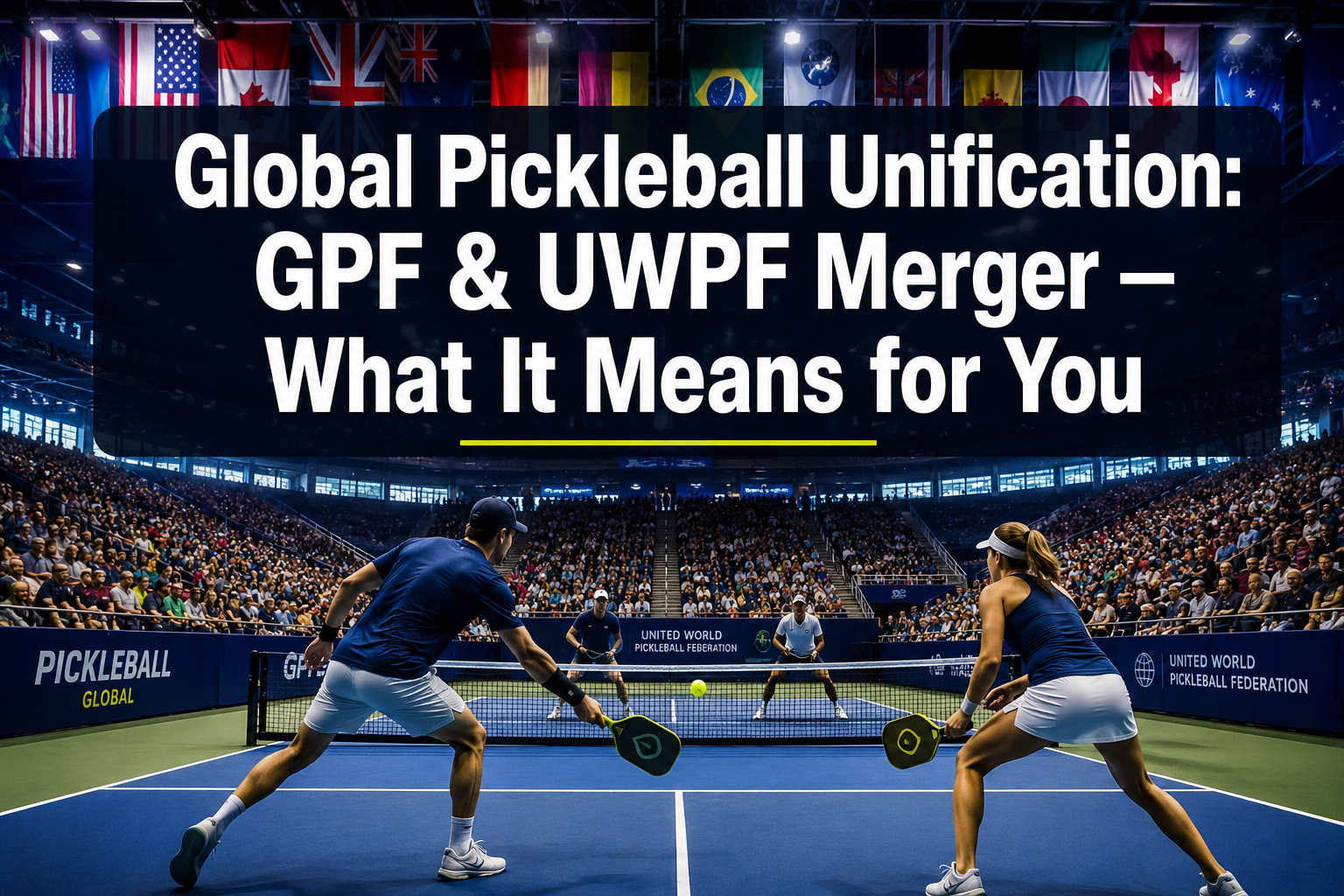
Global Pickleball Unification: GPF and UWPF Merger Plans and What It Means for Pros and Amateurs
Last updated: July 1, 2026
Quick Answer: The Global Pickleball Federation (GPF) and the Universal Pickleball Association (UWPF) have announced a formal joint initiative to merge into a single international governing body for pickleball. The goal is to meet International Olympic Committee (IOC) standards, unify rankings and rules, and give the sport a credible path to the Olympics. As of mid-2026, the merger is in progress but has not been publicly confirmed as complete.
Key Takeaways
- 🏓 The GPF and UWPF announced a joint initiative to form one unified global governing body for pickleball [2]
- 🎯 A joint Unification Committee (task force) was established to manage the transition
- 📅 The target timeline is mid-2026, though the merger is not yet confirmed as finalized
- 🏅 The unified body is being structured to meet IOC recognition standards, a key step toward Olympic inclusion
- 💰 Professional rankings, prize money structures, and sanctioned event lists are all under review
- 🌍 Amateur players and local clubs are unlikely to face immediate fee changes, but membership structures will eventually align
- ⚠️ Concerns exist around governance transparency, power distribution, and whether smaller national federations will have a voice
- ✅ Most pickleball community members see unification as a net positive for the sport’s long-term growth
What Is the Difference Between GPF and UWPF Pickleball?
The GPF (Global Pickleball Federation) and UWPF (United World Pickleball Federation) are two separate international bodies that have both claimed authority over global pickleball governance. The GPF has focused heavily on international expansion and Olympic pathway development, while the UWPF built its network through regional affiliations and grassroots competition structures.
The split between the two organizations created real problems: conflicting rankings, duplicate sanctioned events, and confusion for players trying to compete internationally. For context on how the sport grew into this situation, the history of pickleball’s rise helps explain why multiple governing bodies emerged in the first place.
Key differences at a glance:
| Feature | GPF | UWPF |
|---|---|---|
| Primary focus | Olympic pathway, international standards | Regional networks, grassroots competition |
| Geographic strength | Asia, Europe, Americas | Americas, Oceania, parts of Europe |
| Ranking system | GPF world rankings | UWPF global standings |
| Event calendar | GPF-sanctioned international events | UWPF-sanctioned tour events |
When Is the GPF-UWPF Merger Happening?
The two organizations announced their joint initiative in early 2025, with a target timeline of mid-2026 for establishing the unified body [2]. As of the publication of this article, the merger process is actively underway but has not been publicly confirmed as complete.
The Unification Committee — a joint task force drawn from both organizations — has been meeting regularly to align governance structures, membership frameworks, and competition rules. Early actions included auditing existing membership databases and reviewing both organizations’ sanctioned event calendars [1].
What “mid-2026 target” actually means:
- Structural agreements (governance documents, bylaws) are being drafted
- National federation affiliations are being reviewed and consolidated
- IOC recognition requirements are shaping the new body’s design
- Final ratification by both boards is still pending as of this writing

How Will the Merger Affect Professional Pickleball Rankings?
Professional rankings will need to be unified into a single system, which is one of the most complex parts of the merger. Currently, top pros may hold different standings under each organization, and those rankings affect seeding, sponsorship value, and event eligibility.
The Unification Committee is expected to create a combined ranking algorithm that accounts for results across both former systems. Pros who competed primarily in GPF-sanctioned events and those who focused on UWPF events will have their histories weighted and merged [9].
What pros should watch for:
- A transition period where dual rankings may coexist temporarily
- New minimum event requirements to maintain world ranking status
- Potential re-seeding at major international events once the unified system launches
- Clearer pathways to international team selection for multi-nation competitions
What Does Pickleball Unification Mean for Amateur Players?
For most recreational and amateur players, the day-to-day experience on court won’t change overnight. The global pickleball unification between GPF and UWPF primarily affects international governance — but the downstream effects on local play are real and worth understanding.
Over time, a unified body means:
- One set of official rules that all affiliated clubs and tournaments follow
- Standardized rating systems that are more portable across regions and countries
- More internationally recognized amateur tournaments, giving competitive club players a clearer ladder to climb
If you’re just getting started, check out our guide on essential pickleball equipment — the rules around approved gear may also standardize further post-merger.
Will Merger Fees Apply to Local Pickleball Clubs?
Local clubs and recreational players are unlikely to face new direct fees as an immediate result of the merger. The unification is focused on the international governance layer, not on restructuring grassroots membership costs [2].
That said, national federations affiliated with either the GPF or UWPF may eventually adjust their own membership structures to align with the new unified body’s requirements. This could trickle down to club-level affiliation fees — but any changes are expected to be gradual and communicated well in advance.
Practical advice for club organizers:
- Stay connected with your national pickleball federation for updates
- Don’t make major structural changes to club affiliations until the merger is finalized
- If your club runs sanctioned tournaments, confirm which body’s rules currently apply and watch for transition guidance
For help finding and connecting with your local pickleball community, this guide on finding local pickleball communities is a solid starting point.
Which Pickleball Organization Should You Join Right Now?
Join whichever organization currently sanctions the tournaments and events you want to play in. During the transition period, both GPF and UWPF memberships remain valid, and the Unification Committee has indicated that existing memberships will be honored in the new structure [2].
Choose based on your goals:
- Competing internationally or aiming for world rankings? Follow GPF-sanctioned events closely, as the new unified body is being built largely around GPF’s IOC-aligned framework [1]
- Playing in regional or national tournaments? Check which body your national federation is affiliated with
- Recreational play only? Your local club membership is all you need for now
How Does Global Pickleball Unification Compare to Other Sports Mergers?
Pickleball isn’t the first sport to consolidate competing international bodies. Similar unification processes happened in sports like squash (where multiple world bodies merged to strengthen Olympic bids) and early-stage martial arts disciplines.
The common pattern: fragmented governing bodies weaken a sport’s Olympic case, because the IOC requires a single recognized international federation. The GPF-UWPF merger follows this exact playbook — unify first, then pursue IOC recognition as a credible single voice for the sport [1][9].
What pickleball can learn from other sports:
- Mergers that prioritize Olympic inclusion over internal politics tend to succeed faster
- Athlete representation in the new governance structure is critical for long-term buy-in
- Transparent communication during the transition prevents community fracture
The regional growth of pickleball worldwide shows just how fast the sport has scaled — and why a unified governing body has become urgent.
What Are the Concerns About the GPF-UWPF Merger?
Not everyone in the pickleball community is celebrating. Legitimate concerns exist, and it’s worth taking them seriously rather than dismissing them.
Main concerns raised by players and administrators:
- Governance concentration: Will the new body be dominated by a small group of founding nations, leaving smaller pickleball markets with little influence?
- Transparency: Both organizations have operated with limited public disclosure of financial and decision-making processes
- Rule changes: Some players worry that unification will lead to rule modifications that favor one style of play or equipment standard over another
- Existing event contracts: Tournament organizers who signed multi-year deals with either the GPF or UWPF face uncertainty about contract validity during the transition [9]
- Speed of transition: Moving too fast risks alienating affiliated national federations; moving too slow keeps the sport fragmented
These are fair questions. The Unification Committee’s credibility will depend on how openly it addresses them.
Will Pickleball Rules Change After Unification?
A full rules overhaul is not expected immediately, but some standardization is likely. The two organizations have operated under rules that are mostly compatible but differ in specific areas — particularly around equipment certification, serve rules, and scoring formats for international events.
The unified body will need one official rulebook to meet IOC standards. Expect a public comment period before any rule changes are finalized, giving players and national federations a chance to weigh in [2].
For players who want to brush up on current rules before any changes land, the beginner’s guide to pickleball rules covers the core framework clearly.
How Will Prize Money Be Affected by the Merger?
Prize money at the professional level is expected to grow over time as a result of unification, not shrink. A single governing body creates a more attractive commercial package for sponsors and broadcasters — the same logic that drove prize money growth in other unified sports.
In the short term, some existing tour events may be restructured or rebranded as the unified calendar takes shape. Pros competing in 2026 should monitor official announcements closely, as event status and prize allocations may shift during the transition period [9].
What Happens to Existing GPF and UWPF Memberships?
Existing memberships from both organizations will be recognized under the new unified structure. The Unification Committee has confirmed that no current member — individual, club, or national federation — will be required to re-register or pay additional fees solely because of the merger [2].
When the new unified body formally launches, members will receive guidance on how their existing credentials map to the new system. Most are expected to transfer automatically.
Is Global Pickleball Unification Good or Bad for the Sport?
On balance, the GPF and UWPF merger is a positive development for pickleball — especially for its long-term credibility and Olympic ambitions. A fragmented governance structure has held the sport back from IOC recognition, limited international prize money growth, and confused players about which rankings and rules actually matter [1][9].
Who benefits most:
- Professional players seeking clearer international career pathways
- National federations that want a single point of contact for global competition
- Sponsors and broadcasters looking for a unified commercial structure
- Amateur players in countries where pickleball is still emerging, who gain access to a more organized international framework
Who faces the most adjustment:
- Tournament organizers with existing contracts tied to one body
- National federations that have invested heavily in one organization’s systems
- Players whose rankings were built primarily in one system and may need recalibration
The sport has come a long way since its backyard origins — as covered in our piece on key milestones in pickleball history. Unification feels like the next logical milestone.
Common Misconceptions About the Pickleball Merger
Misconception 1: “The merger is already done.” Not yet. As of mid-2026, the joint initiative is underway and the Unification Committee is active, but the formal unified body has not been publicly confirmed as launched [2].
Misconception 2: “Amateur players will have to re-register and pay new fees.” No evidence supports this. Existing memberships are expected to transfer automatically.
Misconception 3: “The rules are changing immediately.” Rule standardization will happen gradually, with a public process before any changes take effect.
Misconception 4: “One organization is absorbing the other.” This is framed as a joint initiative, not an acquisition. Both boards are involved in designing the new structure [1][2].
Misconception 5: “This guarantees pickleball in the Olympics.” Unification is a necessary step toward IOC recognition, but it doesn’t guarantee Olympic inclusion. That requires a separate IOC recognition process after the unified body is established.
FAQ
Q: What is the GPF in pickleball? The Global Pickleball Federation (GPF) is one of two major international governing bodies for pickleball. It has focused on building an Olympic-pathway structure and international competition standards.
Q: What is the UWPF? The United World Pickleball Federation (UWPF) is the other major international body, with strong regional affiliate networks and its own sanctioned competition calendar.
Q: Why are GPF and UWPF merging? To create a single international governing body that meets IOC recognition requirements — a prerequisite for pickleball’s inclusion in the Olympic Games [1][2].
Q: When will the merger be complete? The target is mid-2026, but as of this article’s publication date, it has not been confirmed as finalized.
Q: Will my current pickleball membership still be valid? Yes. Both organizations have indicated existing memberships will be honored under the new unified structure [2].
Q: Will pickleball rules change after the merger? Some standardization is expected, but not immediately. Any rule changes will go through a formal review process.
Q: Does unification mean pickleball is in the Olympics? Not automatically. Unification is a required step toward IOC recognition, but Olympic inclusion requires a separate application and approval process.
Q: How will professional rankings be handled? A unified ranking system will be developed, likely merging historical results from both organizations. A transition period with dual rankings is possible.
Q: Should I wait to join a pickleball organization until after the merger? No need to wait. Join whichever organization sanctions the events you want to play in now. Memberships will transfer to the new structure.
Q: Who is running the merger process? A joint Unification Committee drawn from both the GPF and UWPF boards is overseeing the transition [2].
Q: Will local tournament formats change? Local and recreational tournaments are unlikely to change significantly in the short term. Changes will filter down from the international level gradually.
Q: Is this merger similar to what happened in other sports? Yes. It closely mirrors unification processes in squash and early martial arts disciplines, where competing international bodies merged to strengthen Olympic bids [9].
Conclusion
The global pickleball unification between GPF and UWPF is one of the most significant structural developments in the sport’s short history. For pros, it means a cleaner path to international rankings, bigger prize pools, and a realistic shot at Olympic inclusion. For amateurs and recreational players, the immediate impact is modest — but the long-term benefits of a single rulebook, standardized ratings, and a more organized global community are real.
Actionable next steps:
- Stay informed — follow official GPF and UWPF channels for merger updates, especially around membership transitions and rule changes
- Keep your current membership — no need to switch or re-register until the unified body formally launches
- Connect locally — your local pickleball community is the best place to hear how national federations are adapting; use our guide to finding local pickleball courts and clubs to stay plugged in
- If you’re a tournament organizer, review your existing sanctioning agreements and seek clarification from your national federation before the transition is complete
- Keep playing — the governance changes happening at the top don’t change how good a well-placed dink feels
The racket sports community is watching pickleball’s next chapter closely. This merger, if handled well, could be the moment pickleball steps fully onto the world stage.
References
[1] One Step Closer To Pickleball In The Olympics The Gpf And Uwpf Move To Establish A Single Global Governing Body – https://www.thedinkpickleball.com/one-step-closer-to-pickleball-in-the-olympics-the-gpf-and-uwpf-move-to-establish-a-single-global-governing-body/
[2] Gpf And Uwpf Announce Joint Initiative To Establish A Single International Governing Body For Pickleball – https://globalpickleballfederation.org/news/gpf-and-uwpf-announce-joint-initiative-to-establish-a-single-international-governing-body-for-pickleball/
[9] Global Pickleball Merger Olympics Explained – https://empowerpickleball.com/global-pickleball-merger-olympics-explained/


