
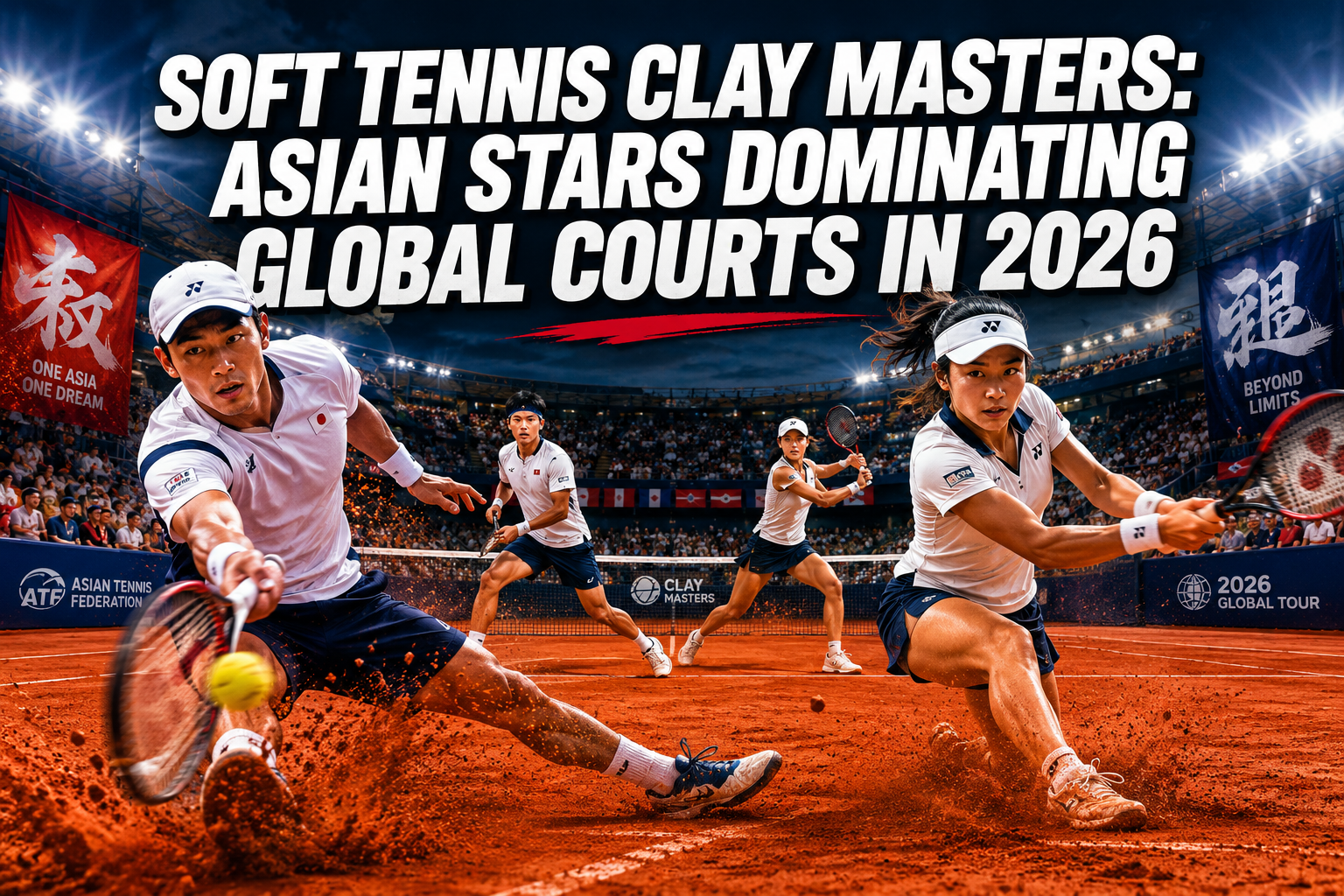
Soft Tennis Clay Masters: Asian Stars Dominating Global Courts in 2026
Last updated: July 6, 2026
Quick Answer: Soft Tennis Clay Masters: Asian Stars Dominating Global Courts in 2026 refers to the ongoing dominance of Japanese and other Asian players in competitive soft tennis, particularly on clay-style surfaces at national and international tournaments. Japan leads the world in soft tennis development, with athletes like Toshitaka Uematsu and Reina Tianma setting records in 2026. If you want to understand the sport, follow the top players, or get started yourself, this guide covers everything.
Key Takeaways
- 🎾 Soft tennis uses a rubber ball instead of a pressurized felt ball, making it easier on joints and more accessible for beginners
- 🏆 Toshitaka Uematsu won his fifth consecutive All Japan Singles title in May 2026 [1]
- 🌟 Reina Tianma claimed her second national singles title in the same event [1]
- 🌏 Japan, South Korea, and Taiwan are the three dominant nations in global soft tennis
- 📅 The Korea Cup 2026 in Incheon saw Japanese players reach the top eight in both singles draws [2]
- 🧢 The Asian Juniors Soft Tennis Championships in February 2026 included U21, U18, and U15 divisions [5]
- 🏅 Soft tennis prize structures are modest compared to ATP/WTA tennis, but national prestige is high
- 🎯 Beginners can pick up soft tennis faster than hard-ball tennis because the softer ball is more forgiving
- 📺 Most major soft tennis events stream via Japanese sports platforms and YouTube channels run by national federations
What Is Soft Tennis and How Is It Different from Regular Tennis?
Soft tennis is a racket sport played with a hollow rubber ball instead of the pressurized felt ball used in standard tennis. It originated in Japan in the late 19th century and remains most popular across East and Southeast Asia.
Here are the key differences at a glance:
| Feature | Soft Tennis | Regular Tennis |
|---|---|---|
| Ball | Hollow rubber, soft | Pressurized felt |
| Racket weight | Lighter (avg. 240-270g) | Heavier (avg. 280-340g) |
| Court size | Same as tennis | Standard |
| Scoring | 7-point games, best of 5 | 15/30/40/deuce format |
| Serve style | Underarm or overarm | Overarm only |
| Primary regions | Japan, Korea, Taiwan | Global |
The softer ball produces longer rallies and rewards touch and placement over raw power. That makes soft tennis a great entry point for racket sports beginners, and it also means clay-style surfaces (which slow the ball further) suit the sport’s natural rhythm perfectly.

Who Are the Top Asian Soft Tennis Players in 2026?
Japan’s top players are setting the pace in 2026, and a few names stand out clearly.
Toshitaka Uematsu (NTT West) is the most decorated active men’s player in Japan. On May 17, 2026, he secured his fifth consecutive All Japan Singles Soft Tennis Championship title in Gifu Prefecture [1]. That kind of consistency over five straight years puts him in a class of his own domestically.
Reina Tianma (Nippon Sport Science University) is the standout on the women’s side. She won her second All Japan Singles title on the same day [1], and earlier in 2026 she also took the women’s singles title at the Kanto Student Soft Tennis Singles Championships in Saitama, as a first-year student [3].
Rion Ueda (Waseda University) won the men’s Kanto Student title in May 2026, also as a first-year [3]. That’s a strong signal that Japan’s next generation is already performing at the top level.
In doubles, Kohei Kawasaki and Takuya Kurosaka (both from Nippon Sport Science University) claimed the men’s doubles title at the Kanto Open in Tokyo on April 29, 2026 [4].
At the international level, Japanese national team members reached the top eight in both men’s and women’s singles at the Korea Cup 2026 in Incheon [2], confirming Japan’s position at the top of the global rankings.
Soft Tennis Clay Court Rules and Scoring Explained
Soft tennis uses a 7-point game system, which is different from standard tennis scoring and easier to follow for newcomers.
How scoring works:
- Each game is played to 7 points
- A match is typically best of 5 games (first to 3 games wins)
- At 6-6 within a game, a tiebreak decides the winner
- Serves alternate every two points (similar to tiebreak rules in regular tennis)
Clay court specifics:
Clay surfaces slow the ball down and produce a higher bounce. In soft tennis, this effect is amplified because the rubber ball already has less pace than a felt ball. The result is longer, more tactical rallies where court positioning and spin control matter more than serving power.
Good footwork and court positioning become especially important on clay. Players who can slide into position and recover quickly have a clear advantage.
Why Are Asian Countries Dominating Soft Tennis?
Japan, South Korea, and Taiwan dominate soft tennis because the sport was invented and developed almost entirely within those countries. Japan introduced soft tennis in the 1880s as a more accessible version of lawn tennis, and it spread through school physical education programs across East Asia.
Key reasons for Asian dominance:
- School integration: Soft tennis is a compulsory or widely offered school sport in Japan and South Korea, creating a massive talent pipeline
- Club infrastructure: Japan has thousands of registered soft tennis clubs at junior, university, and professional levels
- National federation support: The Japan Soft Tennis Federation runs structured leagues, ranking systems, and international programs
- Junior development: The 2026 Asian Juniors Soft Tennis Championships (held in Ludhiana, India, February 3-8) included Japanese players across U21, U18, and U15 age groups [5], showing deep investment in youth talent
Outside Asia, the sport has limited infrastructure, which means Asian nations face little serious international competition, for now.
Soft Tennis Clay Masters 2026: Tournament Schedule and Key Results
The Soft Tennis Clay Masters: Asian Stars Dominating Global Courts in 2026 story has been shaped by several key events this year.
2026 highlights so far:
| Event | Date | Location | Key Result |
|---|---|---|---|
| Asian Juniors Soft Tennis Championships | Feb 3-8, 2026 | Ludhiana, India | Japan fielded U21/U18/U15 teams [5] |
| Kanto Open Soft Tennis Tournament | Apr 29, 2026 | Tokyo, Japan | Kawasaki/Kurosaka win men’s doubles [4] |
| Kanto Student Singles Championships | May 4, 2026 | Saitama, Japan | Ueda (M) and Tianma (W) win [3] |
| All Japan Singles Championships | May 17, 2026 | Gifu, Japan | Uematsu (M) 5th title; Tianma (W) 2nd title [1] |
| Korea Cup 2026 | Jun 17, 2026 | Incheon, South Korea | Japan reaches top 8 in both draws [2] |
The Korea Cup result is particularly notable because it shows Japanese players competing successfully on international soil, not just domestically.
How to Watch Soft Tennis Clay Masters Live Online
Most soft tennis events are not broadcast on mainstream sports networks, but they are accessible if you know where to look.
Best options for watching in 2026:
- YouTube: The Japan Soft Tennis Federation and affiliated university clubs post match footage regularly. Search “全日本ソフトテニス” (All Japan Soft Tennis) for official uploads
- NHK Sports streaming: Some national-level events in Japan are covered by NHK’s online sports platform
- Social media: Follow @jsta_softtennis on social platforms for live updates and highlight clips
- Zutto Sports: This platform covers Asian soft tennis events and publishes results and video summaries [5]
- Softtennis-navi.com: Japan’s leading soft tennis news site posts results, schedules, and player profiles
Tip: If you’re new to watching racket sports and want to understand strategy, check out understanding shot selection on the court, the same principles apply across soft tennis, regular tennis, and other racket sports.
Best Soft Tennis Rackets and Equipment for Clay Courts
For clay court soft tennis, you want a racket that gives you control and spin rather than raw power.
What to look for:
- Weight: 240-260g is the sweet spot for most players. Lighter rackets suit beginners; slightly heavier frames give more stability for advanced players
- String tension: Lower tension (around 40-45 lbs) suits clay because it adds dwell time and spin
- Frame shape: Oval or round frames offer more consistent contact, which helps on clay’s uneven bounce
- Grip size: Match your grip size carefully, blisters and wrist strain are common mistakes beginners make when the grip is too small or too large
Top brands for soft tennis equipment in 2026:
- Yonex, the most widely used brand at elite level, known for lightweight frames
- Mizuno, popular in Japanese school and university programs
- Gosen, strong reputation for soft tennis strings specifically
For beginners choosing their first racket, the same logic that applies to choosing the right pickleball paddle holds here: start with something forgiving and mid-range before investing in a specialist frame.
Soft Tennis vs. Hard Court Tennis: Which Is Easier to Learn?
Soft tennis is generally easier for beginners to pick up than hard-ball tennis. The rubber ball moves slower, bounces more predictably on most surfaces, and is more forgiving on off-center hits.
Choose soft tennis if:
- You’re new to racket sports and want faster early progress
- You prefer longer rallies over power-based points
- You have access to a soft tennis club or school program
Choose hard court tennis if:
- You want to compete in globally recognized tournaments (ATP, WTA, ITF)
- You enjoy the variety of court surfaces (hard, clay, grass)
- You’re already comfortable with racket sports
That said, skills transfer well between the two. Players who develop strong footwork fundamentals in soft tennis often adapt quickly to regular tennis, and vice versa.
Countries That Play Soft Tennis: Most Popular Regions
Soft tennis is played in roughly 50 countries, but participation is heavily concentrated in Asia.
Top nations by participation and competitive strength:
- Japan, birthplace of the sport; highest participation and strongest competitive infrastructure
- South Korea, strong national program; hosts major events like the Korea Cup
- Taiwan, consistent international presence, especially in junior categories
- India, growing fast; hosted the 2026 Asian Juniors Championships [5]
- Thailand and Philippines, active Southeast Asian programs with growing junior bases
Outside Asia, soft tennis has small but dedicated communities in parts of Europe and South America, but it has not yet broken into mainstream racket sports culture in North America or Western Europe.
How to Get Started Playing Soft Tennis: Beginner’s Guide
Getting into soft tennis is straightforward, especially if you already play another racket sport.
Step-by-step for beginners:
- Find a club or court: Search for soft tennis clubs through your national sports federation website. In countries with smaller communities, university sports clubs are often the best entry point
- Get basic equipment: A beginner soft tennis racket costs roughly $30,$80. You’ll also need soft tennis balls (sold in sets of 3-6)
- Learn the scoring: The 7-point game system is simple. Play a few practice games before worrying about tournament rules
- Focus on consistency first: Long rallies are the heart of soft tennis. Work on keeping the ball in play before adding spin or pace
- Join a community: The racket sports community is welcoming at every level. Finding local courts and groups is a skill that applies across all racket sports, the same approach works for soft tennis
Common beginner mistakes:
- Gripping the racket too tightly (causes arm fatigue and reduces feel)
- Swinging too hard (the soft ball doesn’t need power, it needs placement)
- Ignoring footwork (most errors come from being out of position, not from bad technique)
Soft Tennis Clay Masters Prize Money and Rankings
Soft tennis does not operate on a global prize money circuit comparable to ATP or WTA tennis. Most competitions are amateur or semi-professional, with prestige and national ranking points as the primary rewards.
How rankings work:
- Japan’s national ranking system is managed by the Japan Soft Tennis Federation (JSTA)
- Points are earned at designated national and regional tournaments
- University and corporate team affiliations (like NTT West, which sponsors Uematsu) provide athlete support in lieu of direct prize money
International level:
The World Soft Tennis Championships (held every four years) and the Asian Soft Tennis Championships are the highest-profile international events. Medal results at these events carry the most prestige for players and national federations.
Prize money at individual events is modest by global sports standards, most national championships offer trophies, certificates, and ranking points rather than significant cash prizes.
Is Soft Tennis Popular Outside of Asia?
Outside Asia, soft tennis remains a niche sport. It has a presence in roughly 50 countries through the International Soft Tennis Federation (ISTF), but participation numbers and competitive infrastructure are thin compared to Japan and South Korea.
Where it’s growing:
- India is the fastest-growing market right now. Hosting the 2026 Asian Juniors Championships in Ludhiana [5] signals real investment in the sport’s development there
- Southeast Asia (Thailand, Philippines, Malaysia) has active junior programs
- Europe has small pockets of activity, mainly through university and community clubs
Why it hasn’t gone global yet:
The sport competes directly with regular tennis for court time, funding, and player attention. In countries where tennis infrastructure already exists, there’s little incentive for clubs or schools to add a parallel sport. That’s the main barrier to wider adoption.
For players curious about how niche racket sports grow into mainstream ones, the history of pickleball’s rise is a useful parallel, community-driven growth and grassroots adoption are what move the needle.
FAQ
What ball is used in soft tennis? Soft tennis uses a hollow rubber ball, not a pressurized felt ball. It’s softer, lighter, and slower than a standard tennis ball, which makes rallies longer and more touch-based.
Is soft tennis an Olympic sport? No. Soft tennis is not currently an Olympic sport. It is included in the Asian Games, where Japan and South Korea regularly compete for medals.
How long is a soft tennis match? A standard match (best of 5 games, each to 7 points) typically lasts 45-75 minutes, depending on rally length and player level.
Can regular tennis players switch to soft tennis easily? Yes. The court dimensions are the same and the racket technique is similar. The main adjustment is learning to control the softer ball, which requires less power and more spin and placement.
Who is the best soft tennis player in the world in 2026? Based on 2026 results, Toshitaka Uematsu (Japan) is the strongest men’s player, having won five consecutive national singles titles [1]. On the women’s side, Reina Tianma (Japan) is the top performer after winning her second national title [1].
What is the difference between soft tennis and padel? Padel uses a solid paddle (no strings), an enclosed court with walls, and a pressurized ball. Soft tennis uses a strung racket, an open court identical to regular tennis, and a rubber ball. They are very different sports despite both being racket games.
Where can I buy soft tennis equipment outside Japan? Yonex and Mizuno products are available through international sports retailers and online marketplaces like Amazon. Specialist soft tennis retailers also ship internationally.
Is soft tennis good for kids? Yes. The lighter ball and racket reduce the risk of strain injuries, and the slower pace makes it easier for children to develop technique before worrying about speed or power.
Conclusion
The story of Soft Tennis Clay Masters: Asian Stars Dominating Global Courts in 2026 is really a story about deep infrastructure, long-term player development, and a sport that rewards skill over strength. Japan leads the way with players like Uematsu and Tianma setting new standards, while South Korea and India are pushing the sport’s international footprint further than ever before.
Actionable next steps for readers:
- 🎾 Curious about soft tennis? Search for a local club through your national sports federation, India, Japan, and South Korea all have active finder tools online
- 🏋️ Want to improve your racket sports movement? Work on court movement and footwork drills, they transfer directly to soft tennis
- 📺 Want to follow the action? Bookmark softtennis-navi.com for the most up-to-date results and tournament news
- 🤝 New to racket sports generally? The racket sports community is one of the most welcoming in sport, jump in at whatever level you’re at and build from there
Soft tennis may not have the global profile of regular tennis yet, but in 2026, its Asian stars are playing at a level that deserves far more attention from the wider racket sports world.
References
[1] softtennis-navi, https://softtennis-navi.com/news/260517/?utm_source=openai [2] 260617 2, https://softtennis-navi.com/news/260617-2/?utm_source=openai [3] softtennis-navi, https://softtennis-navi.com/news/260504/?utm_source=openai [4] softtennis-navi, https://softtennis-navi.com/news/260429/?utm_source=openai [5] Asian Juniors Soft Tennis Championships Results, https://zutto-sports.com/asian-juniors-soft-tennis-championships-results?utm_source=openai