
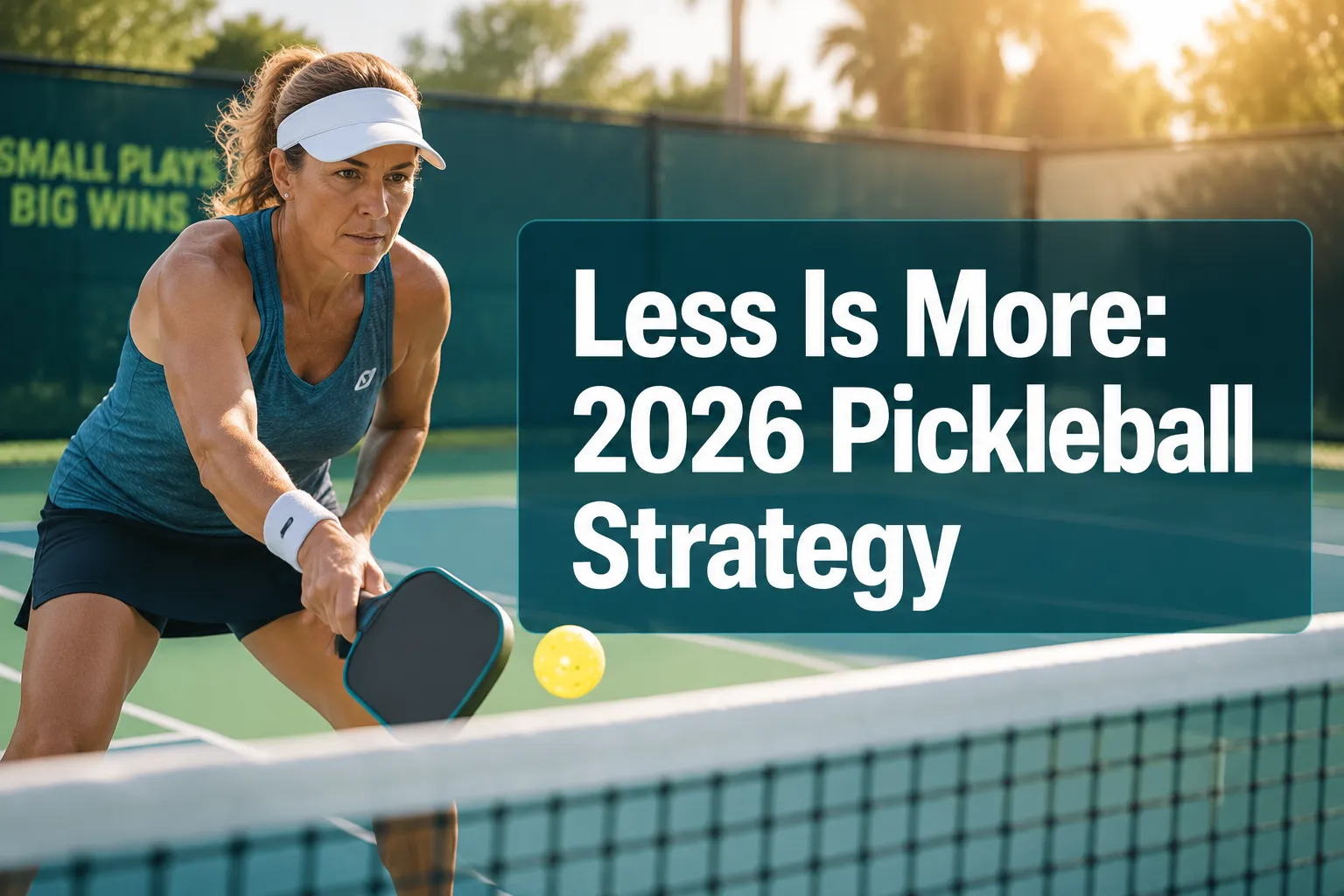
Less is More: The 2026 Pickleball Strategy of Simplifying Mechanics for Consistent Wins
Last updated: July 22, 2026
Quick Answer: Less is More: The 2026 Pickleball Strategy of Simplifying Mechanics for Consistent Wins is built on one core idea, most players lose not because they lack skill, but because they try to do too much. The fix isn’t adding new shots. It’s stripping back to a small set of reliable mechanics and executing them consistently under pressure. [1]
Key Takeaways
- Most recreational players lose points by overcomplicating shots, not by lacking variety. [1]
- The “less is more” framework focuses on three pillars: mechanical simplicity, strategic clarity, and efficient movement.
- You only need one reliable groundstroke, two volley mechanics (block and punch), and clean footwork to compete at most levels. [1]
- Advanced players use simpler shots because consistency beats brilliance in long matches.
- Resetting softly into the kitchen beats trying to counter-punch under pressure. [8]
- A simple drive, drop pattern in transition reduces errors and raises your floor. [9]
- Stopping overthinking starts with committing to one game plan per match, not adjusting shot-by-shot. [1]
- Simplified mechanics apply to both recreational and competitive players, the approach just looks slightly different.
- Footwork efficiency (getting there in fewer steps) is as important as stroke mechanics. [1]
- The goal for 2026: “Do less. Do it better. Do it more often.” [1]
What Does “Less is More” Mean in Pickleball Strategy?
“Less is more” in pickleball means narrowing your shot selection and decision-making to a small set of high-percentage mechanics you can execute reliably, especially under match pressure. It’s the opposite of trying to win with variety and complexity.
Better Pickleball’s widely cited 2026 framework puts it plainly: most players are losing because they’re trying to do too much. The fix is fewer mechanics executed more reliably, one groundstroke, two volley mechanics (block and punch), and efficient footwork. [1] The tagline for 2026 is direct: “Do less. Do it better. Do it more often.” [1]
This isn’t about playing boring pickleball. It’s about building a game that holds up when the score is tight and nerves are high.
Why Do Advanced Players Use Simpler Shots?
Advanced players default to simpler shots because consistency wins more points than creativity. A well-placed, compact dink beats an ambitious speed-up that lands in the net.
At higher levels, players understand that the calmer player who does less usually wins more. [8] Empower Pickleball’s 2026 analysis frames winning as neutralizing opponents first and attacking second, the exact opposite of how most beginners approach the game. [8]
Why simplicity works at advanced levels:
- Fewer variables mean fewer errors under pressure
- Simple shots are easier to repeat across a full match
- A compact swing is harder for opponents to read and time
- High-percentage plays compound, one safe shot leads to the next
“The calmer player who does less usually wins more.”, Empower Pickleball [8]
Best Basic Pickleball Mechanics for Beginners
For beginners, the three mechanics worth mastering first are: a consistent serve, a reliable return, and a soft dink at the kitchen line. Everything else builds from there.
If you’re just starting out, check out this beginner’s overview of basic pickleball strategies before adding complexity to your game.
The three-pillar foundation:
| Pillar | What to Focus On | What to Avoid Early |
|---|---|---|
| Mechanical | One groundstroke, block volley, punch volley | Spin serves, trick shots, overhead smashes |
| Strategic | Serve deep, return deep, get to the kitchen | Complicated game plans, shot-by-shot adjustments |
| Athletic | Two-step positioning, balanced ready stance | Overrunning balls, reaching instead of moving |
The Night Train Pickleball 4-step system for 3.5-4.5 players reinforces this: deep consistent serves and returns, one high-percentage third shot chosen by position, and reset principles that prioritize height and margin over perfection. [5]
How to Simplify Your Pickleball Swing for Better Consistency

A simplified swing uses a compact backswing, a stable contact point in front of the body, and a controlled follow-through, no big looping motion, no wrist flick.
Here’s what that looks like in practice:
- Shorten the backswing. Most errors come from taking the paddle too far back. Keep it tight.
- Contact the ball in front of your body. This gives you control and reduces timing errors.
- Keep the paddle face open on soft shots. This helps clear the net with margin.
- Follow through toward your target. Short, directed follow-through beats a big swing every time.
- Reset before the next shot. Return to a neutral ready position after every stroke.
Pickleball Globe’s 2026 consistency guide recommends defaulting to a simple drive, drop pattern in transition and avoiding razor-thin net margins on third shots. [9] That’s simplified swing mechanics applied directly to match situations.
For a deeper look at shot variety once you’ve got the basics locked in, the guide to shot types from dinks to smashes is a great next step.
Common Pickleball Mistakes from Overcomplicating Your Game
The most common mistake is trying to win points with a single brilliant shot instead of building pressure through consistency. This leads to unforced errors, not winners.
Top mistakes caused by overcomplicating:
- Swinging at reset balls instead of blocking them softly back into the kitchen [8]
- Attempting speed-ups off the bounce on big points when confidence is low [9]
- Changing game plans mid-match based on one or two lost points [1]
- Reaching for difficult balls instead of repositioning feet first
- Using too many shot types before mastering any of them
- Trying to attack from a defensive position rather than resetting first [8]
Third Shot Sports’ coaching analysis makes a similar point from the instructor’s side: coaches who simplify their teaching cues get faster results than those who layer on technical detail. [2] The same logic applies to players, fewer cues, cleaner execution.
For a full breakdown of errors to watch for, the common pickleball mistakes guide covers fixes for the most frequent issues at every level.
How to Stop Overthinking During Pickleball Matches
Overthinking during a match usually means you’re making too many decisions per point. The fix is to pre-decide your strategy before you walk on court, then trust it.
Better Pickleball’s 2026 framework recommends running one clear game plan, defining just one or two strategic priorities per match, and avoiding over-managing point-by-point tactics. [1] When you’ve already decided “I’m going to serve deep, return deep, and reset anything I’m not sure about,” there’s nothing left to think about mid-rally.
Practical steps to reduce in-match overthinking:
- Write down one or two tactical priorities before each match
- Commit to a default shot for each situation (e.g., “when in doubt, reset to the kitchen”)
- Use a short reset phrase between points (“reset, breathe, serve”)
- Stop analyzing errors mid-match, save that for after
The mental pitfalls in pickleball guide goes deeper on staying focused and confident when the pressure is on.
What Are the Most Effective Simple Pickleball Shots?
The five shots that deliver the highest return for the least complexity are: the deep serve, the deep return, the third-shot drop, the kitchen dink, and the block volley.
These shots appear in every simplified strategy framework for 2026 because they’re reliable, repeatable, and hard for opponents to attack. [1][5][9]
Why each one matters:
- Deep serve: Pushes opponents back, limits their return angles
- Deep return: Forces a difficult third shot, gives you time to advance
- Third-shot drop: Gets you to the kitchen safely without gifting an easy attack [5]
- Kitchen dink: Keeps the rally neutral and forces opponents to make decisions
- Block volley: Neutralizes speed-ups without adding pace or risk [1][8]
Choose X if: you’re a 3.5 player or below, master these five before adding anything else. At 4.0+, you can layer in a punch volley and an occasional speed-up, but only when your position and confidence are both high. [9]
Pickleball Strategy 2026 Trends and Updates
The dominant 2026 trend in pickleball strategy is “raise your floor”, meaning reduce your error rate before trying to raise your ceiling with aggressive play. [9]
Several coaching frameworks published in early 2026 converge on the same message: [1][5][8][9]
- Simplify mechanics to two or three core shots per situation
- Prioritize reset and neutralize over attack
- Use a monitor, flow, watch, crash decision system in rallies [5]
- Default to push and slice dinks when tight at the NVZ [9]
- Avoid speed-ups off the bounce on high-pressure points [9]
This shift reflects what coaches are seeing at the 3.5-4.5 level: players who try to play like pros at the wrong moments lose far more than players who play boring, consistent pickleball. [7]
Does Simplifying Mechanics Actually Improve Win Rate?
Yes, and the reasoning is straightforward. Fewer mechanics mean fewer decisions, fewer errors, and more repeatable execution under pressure. All three of those factors directly reduce unforced errors, which is the single biggest driver of lost points at recreational and intermediate levels.
Empower Pickleball’s 2026 analysis frames it this way: the player who neutralizes first and attacks second wins more consistently than the player who attacks from the start. [8] Pickleball Globe’s consistency guide adds that defaulting to a simple drive, drop pattern and avoiding thin net margins raises a player’s floor, meaning their worst points get better, even if their best points stay the same. [9]
Choose simplification if:
- You’re losing more to your own errors than to opponent winners
- You feel rushed or panicked during fast exchanges
- Your game falls apart in close matches or under pressure
Consider adding complexity if:
- You’ve mastered the five core shots and they’re no longer being challenged
- You’re competing at 4.5+ and opponents are reading your patterns easily
How Many Shots Do You Really Need to Master Pickleball?
Most players need to master five to seven shots to compete effectively at recreational and intermediate levels. You don’t need ten.
Better Pickleball’s framework puts it at: one groundstroke, two volley mechanics (block and punch), a third-shot drop, a deep serve, and a deep return. [1] That’s six shots. Add a reset dink and you have a complete game for most situations.
The advanced strategies guide breaks down when and how to deploy each fundamental skill once you’ve built that base.
Pickleball Footwork Basics for Consistent Play
Good footwork means getting to the ball in fewer steps, staying balanced at contact, and recovering to a ready position quickly. It’s the athletic pillar of the “less is more” framework.
Better Pickleball specifically highlights efficient footwork, getting there in fewer steps, as one of the three core elements of simplified mechanics alongside stroke reduction. [1]
Simple footwork rules:
- Split step before your opponent contacts the ball
- Move to the ball, not at the ball, position your feet so the ball is in your strike zone
- Stay low, a lower stance gives you more stability and faster lateral movement [8]
- Recover after every shot, don’t admire your shot, reset your feet
For drills that build this movement foundation, the footwork importance and drills guide has practical exercises for every level.
When Should You Use Complex vs. Simple Pickleball Techniques?
Use simple techniques as your default and complex techniques only when you’re in a strong position with high confidence. The rule: if you’re not sure, go simple.
Pickleball Globe’s 2026 guide is explicit: avoid speed-ups off the bounce on big points or when confidence is low. [9] The Night Train system adds that low-percentage risks should be avoided until late-point situations where the risk is worth taking. [5]
Decision rule:
- Simple shot: You’re off-balance, under pressure, or the score matters
- Complex shot: You’re in an offensive position, the ball is high, and you’ve been executing well
This isn’t about playing scared, it’s about playing smart. Saving your risky shots for the right moments makes them far more effective.
Is “Less is More” Better for Competitive or Recreational Players?
Less is more works for both, but the application looks different. Recreational players benefit most from mechanical simplicity. Competitive players benefit most from strategic simplicity.
For recreational players, the biggest gains come from cutting shot variety and focusing on executing a small set of strokes cleanly. For competitive players at 4.0+, the gains come from pre-deciding a clear game plan and trusting it under pressure rather than improvising. [1]
The short answer: if you’re losing more points than you’re winning, simplifying is almost always the right move regardless of your level.
How to Practice Simplified Pickleball Mechanics
The best way to practice simplified mechanics is to isolate one shot or one situation per session and repeat it until it becomes automatic, not to run through your whole game in every drill.
A practical simplified practice structure:
- Warm-up (10 min): Cross-court dinks, focusing on height and margin over the net
- Serve + return (10 min): Deep serves only, deep returns only, no trick shots
- Third-shot drops (15 min): Drop from both sides, aiming for the kitchen
- Reset drills (10 min): Partner feeds fast balls, you block softly into the kitchen [8]
- Point play (15 min): Play points using only your five core shots, no speed-ups
For structured beginner drills that build this foundation, the essential drills for beginners guide is a great starting point. And if you want to accelerate your development, training camps for pickleball skill development can fast-track your progress with focused coaching.
Frequently Asked Questions
Q: What is the “less is more” pickleball strategy in simple terms? It means cutting your shot selection and game plan down to a small set of reliable mechanics, one groundstroke, two volleys, efficient footwork, and executing those consistently instead of trying to win with variety. [1]
Q: How many shots should a beginner focus on in pickleball? Five to six: a deep serve, a deep return, a third-shot drop, a kitchen dink, and a block volley. Master those before adding anything else. [1][5]
Q: Does simplifying your pickleball game actually help you win more? Yes. Most recreational losses come from unforced errors, not from opponents hitting winners. Fewer mechanics mean fewer errors and more consistent execution under pressure. [8][9]
Q: What is the most important simple shot in pickleball? The third-shot drop. It gets you to the kitchen safely without giving opponents an easy attack, and it’s the foundation of almost every simplified strategy framework for 2026. [5]
Q: How do I stop overthinking during pickleball matches? Pre-decide one or two tactical priorities before the match, commit to a default shot for uncertain situations, and stop adjusting your game plan mid-match based on individual points. [1]
Q: Is “less is more” only for beginners? No. Advanced players use it too, especially for strategic clarity, committing to one game plan and trusting it under pressure rather than improvising shot-by-shot. [1][8]
Q: What does “raise your floor” mean in 2026 pickleball strategy? It means reducing your error rate so your worst points get better, even before your best points improve. Defaulting to simple, high-margin shots is the primary way to do this. [9]
Q: When is it okay to use a more complex shot? When you’re in an offensive position, the ball is high, and you’ve been executing well. Avoid risky shots when you’re off-balance, under pressure, or the score is close. [9]
Q: What’s the best way to practice simplified mechanics? Isolate one shot per session and repeat it until it’s automatic. Use a structured drill sequence: dinks, serves, returns, third-shot drops, reset drills, then point play using only your core shots. [5][8]
Q: Does footwork fit into the “less is more” approach? Absolutely. Efficient footwork, getting to the ball in fewer steps and recovering quickly, is one of the three core pillars of simplified mechanics alongside stroke reduction and strategic clarity. [1]
Conclusion
Less is More: The 2026 Pickleball Strategy of Simplifying Mechanics for Consistent Wins isn’t a shortcut, it’s a smarter way to build a game that holds up when it counts. The players winning more in 2026 aren’t the ones with the most shots. They’re the ones who’ve committed to fewer mechanics, cleaner decisions, and more consistent execution.
Your action steps starting today:
- Pick one groundstroke and commit to it as your default
- Practice your block volley and third-shot drop until they’re automatic
- Write down one or two tactical priorities before your next match, and stick to them
- In your next session, drill resets: block soft balls back into the kitchen instead of counter-punching
- When in doubt on court, go simple
The pickleball community at Rally Racket is full of players at every level working through exactly this kind of improvement. Whether you’re just getting started with pickleball or pushing toward a higher rating, the path forward is almost always the same: do less, do it better, do it more often.
References
[1] The Surprising 2026 Pickleball Goal Playing Less To Win More – https://betterpickleball.com/the-surprising-2026-pickleball-goal-playing-less-to-win-more/
[2] Keep It Simple Coach Less Is More Especially In The Coaching World – https://www.thirdshotsports.com/articles/2025/6/24/keep-it-simple-coach-less-is-more-especially-in-the-coaching-world
[5] 4 Step System To Win More Pickleball Games In 2026 – https://nighttrainpickleball.com/4-step-system-to-win-more-pickleball-games-in-2026/
[7] Pickleball 3 5 To 4 0 – https://maincourt.com/2026/05/19/pickleball-3-5-to-4-0/
[8] Pickleball Strategy Doing Less – https://www.empowerpickleball.com/blogs/pickleball-strategy-doing-less
[9] How To Raise Your Pickleball Floor And Stop Playing Inconsistently – https://pickleballglobe.com/2026/04/25/how-to-raise-your-pickleball-floor-and-stop-playing-inconsistently/


