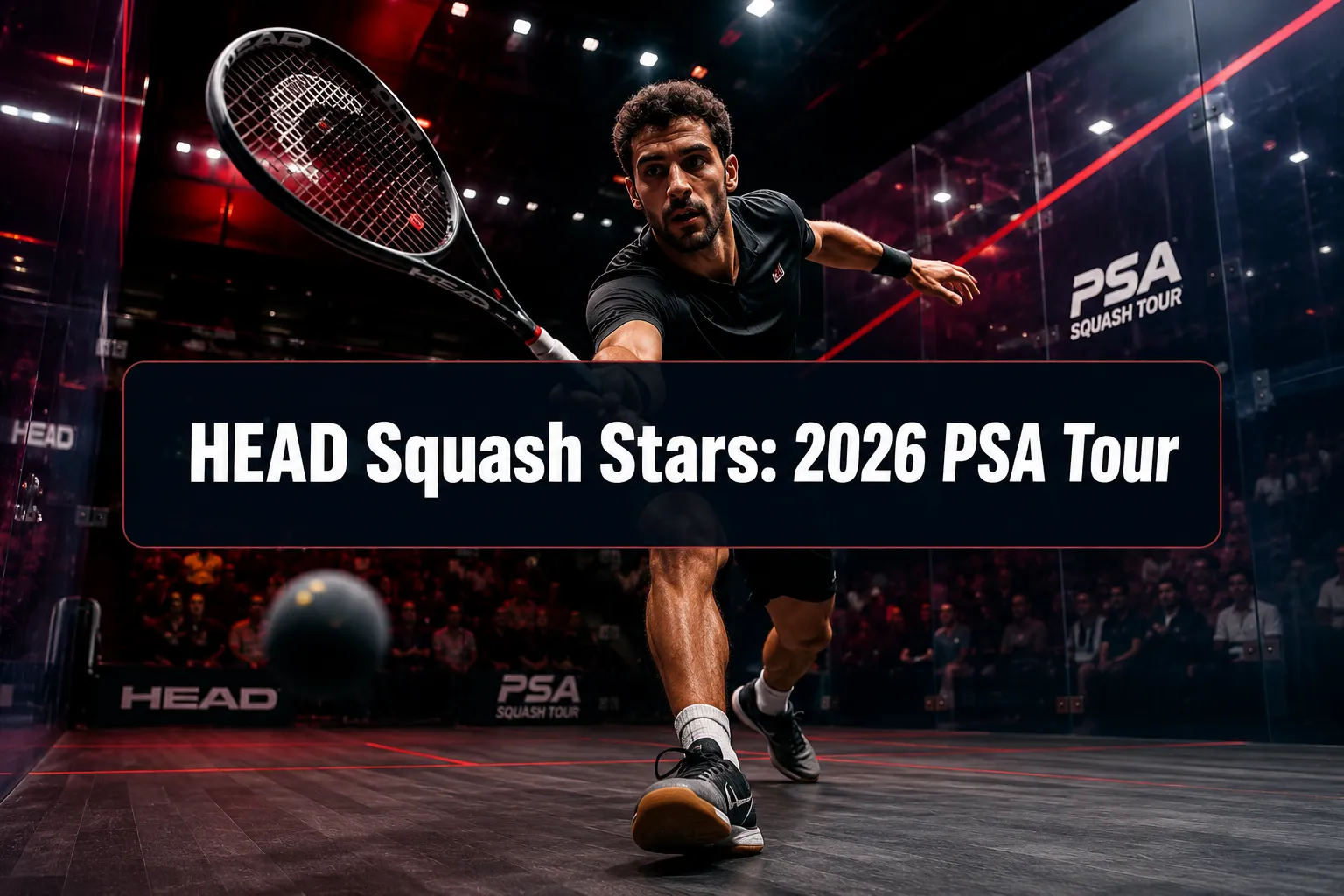
HEAD Squash Stars Dominating the 2026 PSA Tour: Gear, Technique, and Early Season Wins
Last updated: July 18, 2026
Quick Answer: HEAD-sponsored athletes are leading the 2026 PSA Tour with standout performances, including Hania El Hammamy’s stunning comeback victory at the Tournament of Champions in New York. Their success comes down to a combination of HEAD’s precision-engineered racket technology, elite fitness routines, and sharp match tactics. For recreational players watching from the sidelines, there’s a lot to learn, and apply, from what these pros are doing right now.
Key Takeaways
- 🏆 Hania El Hammamy won the 2026 Tournament of Champions after overcoming a 9-3 deficit in the fifth game against fellow HEAD athlete Olivia Weaver [1]
- HEAD sponsors multiple top-ranked PSA Tour players in 2026, making it one of the most visible brands on the professional circuit [1]
- HEAD’s racket lineup includes the Radical (control), Speed (fast play), and Extreme (playability) series, each suited to a different playing style [2]
- Professional HEAD rackets typically retail between $150,$250 USD, with beginner-friendly options starting under $80
- Top pros combine ghosting drills, high-intensity interval training, and court-specific movement work to stay competitive
- Common beginner mistakes with HEAD rackets include using too heavy a frame and over-gripping under pressure
- The PSA World Tour runs year-round across multiple continents, with prize money events ranging from Challenger to Platinum tier
- Choosing the right HEAD racket depends on your swing speed, experience level, and whether you prioritize control or power
What Is the PSA Squash Tour and How Does It Work?
The Professional Squash Association (PSA) World Tour is the top level of competitive squash globally. It runs year-round, with tournaments held across multiple continents, from North America and Europe to Asia and the Middle East.
Events are tiered by prize money and prestige:
- PSA Challenger, entry-level pro events
- PSA World Series, mid-tier international events
- PSA Platinum, top-tier events with the largest prize pools
- PSA World Championships, the sport’s biggest annual title
Players earn ranking points at each event, and those points determine their world ranking. The higher the ranking, the more direct entries a player gets into major draws. Both men’s and women’s tours run simultaneously, with separate world rankings for each.
For anyone who follows competitive racket sports, the PSA Tour offers the same drama and tactical depth you’d find in tennis or badminton, just at a much faster pace inside a four-walled court.
Which HEAD Squash Players Are Ranked Highest in 2026?
HEAD-sponsored athletes are among the most competitive players on the 2026 PSA Tour. Hania El Hammamy (Egypt) and Olivia Weaver are two of the most prominent HEAD athletes on the women’s side, with both reaching the final of the 2026 Tournament of Champions in New York [1].
El Hammamy’s performance at that event, coming back from 3-9 down in the fifth game to win, is already being called one of the greatest comebacks in squash history [1]. That kind of mental resilience, combined with technical excellence, is exactly what separates top PSA players from the rest of the field.
HEAD’s roster demonstrates the brand’s commitment to supporting players at the very top of the sport, with multiple athletes competing at Platinum-level events throughout the 2026 season [1].
Best HEAD Squash Rackets for Professional Players
HEAD’s 2026 squash racket lineup is built around three core series, each targeting a specific playing need [2]:
| Series | Best For | Key Feature |
|---|---|---|
| Radical | Control-focused players | Optimized precision and feel |
| Speed | Attacking, fast-swing players | Lightweight, quick through the air |
| Extreme | All-round playability | Balanced power and touch |
Professional players on the PSA Tour typically choose based on their playing style. A player who relies on tight rail shots and drop shots will gravitate toward the Radical series. A hard-hitting, aggressive baseliner will often prefer the Speed series.
Choose the Radical if: you want pinpoint accuracy and play a controlled, tactical game. Choose the Speed if: you have a fast swing and play an attacking style. Choose the Extreme if: you’re still developing your game and want a forgiving, all-round frame.

How Do HEAD Squash Rackets Compare to Wilson and Dunlop?
HEAD, Wilson, and Dunlop are the three dominant brands on the professional squash circuit. Each has a loyal following among PSA Tour players.
- HEAD is known for its stiff frames and precise string beds, which suit players who want direct feedback and control [2]
- Wilson rackets tend to offer a slightly more powerful feel, popular with players who rely on pace
- Dunlop has a long heritage in squash and is favored for its comfortable, arm-friendly flex
The key difference for recreational players: HEAD rackets reward good technique. If your swing mechanics are solid, you’ll feel the control benefit immediately. If you’re still developing your stroke, a more forgiving Dunlop or Wilson frame might suit you better while you build consistency.
What Technique Do Top Squash Players Use to Win Matches?
Elite PSA players win matches through a combination of shot variety, court positioning, and mental composure, not just raw power. Here’s what HEAD-sponsored pros consistently do well:
1. Tight rail shots: Keeping the ball close to the side wall limits the opponent’s angle and forces weak returns.
2. Deceptive drops: A well-disguised drop shot from the back of the court can end a rally instantly. The preparation looks identical to a drive.
3. Court geometry: Top players always aim to return to the T (the center of the court) after each shot. Controlling the T controls the match.
4. Varying pace: Mixing hard drives with slow, floaty lobs disrupts the opponent’s rhythm and forces errors.
5. Mental reset: El Hammamy’s comeback from 3-9 in the fifth game at the 2026 Tournament of Champions is a masterclass in staying composed when the scoreline looks impossible [1].
For recreational players working on their own game, these principles apply at every level. If you enjoy learning from elite technique, the same approach works in other racket sports, check out these insights from top coaches on effective techniques for skill improvement for a cross-sport perspective.
HEAD Squash Gear Sponsorships on the 2026 PSA Tour
HEAD’s sponsorship presence on the 2026 PSA Tour is significant. The brand supports players competing at the highest levels of both the men’s and women’s tours, providing rackets, strings, and accessories [1].
Sponsorship deals at the professional level typically include:
- Custom-spec rackets (weight, balance, and string tension adjusted to the player’s preference)
- String and grip supply throughout the season
- Apparel and footwear in some cases
- Technical support from HEAD’s equipment team
For HEAD, having players like El Hammamy and Weaver competing in high-profile finals at events like the Tournament of Champions in Grand Central Terminal, New York, is powerful brand exposure [1]. It puts HEAD rackets in front of millions of squash fans globally.
How Much Does Professional HEAD Squash Equipment Cost?
Professional-grade HEAD squash rackets typically retail between $150 and $250 USD. Custom-spec pro versions used by sponsored athletes are not sold directly to the public, but the retail equivalents perform at a very high level.
Here’s a rough breakdown by tier:
- Entry-level HEAD squash rackets: $50,$80, good for beginners, more forgiving flex
- Intermediate HEAD rackets: $80,$150, better materials, more control
- Advanced/Pro HEAD rackets: $150,$250, stiff frames, precision string beds, used by PSA players
Strings are a separate cost. Professional players restring frequently, sometimes every few matches. A quality string job costs $15,$40 depending on the string type and labor.
For recreational players, spending $100,$150 on a mid-range HEAD racket and getting it restrung once or twice a year is a smart investment. You don’t need a pro-spec frame to improve your game, you need the right frame for your current level.
Why Are HEAD Rackets Popular on the Professional Squash Circuit?
HEAD rackets are popular on the PSA Tour because they deliver consistent, predictable performance at high swing speeds [2]. Professional players hit the ball harder and more accurately than recreational players, so they need a frame that responds precisely, not one that absorbs energy unpredictably.
Key reasons pros choose HEAD:
- Stiff frame construction provides direct power transfer
- Precise string bed geometry gives reliable shot feedback
- Lightweight options in the Speed series allow fast swing speeds without fatigue
- Strong brand support including technical customization for sponsored players [1]
The brand’s visibility at major events also creates a feedback loop, younger players see their idols using HEAD rackets and gravitate toward the brand as they develop.
Common Mistakes Beginner Squash Players Make with HEAD Rackets
HEAD’s advanced rackets are designed for players with developed technique. Beginners who pick up a pro-spec HEAD frame often run into these problems:
1. Using too heavy a frame: Pro rackets can feel cumbersome for beginners. Start with a lighter option (under 130g) to build swing speed.
2. Over-gripping under pressure: Squeezing the handle tightens the forearm and kills touch. Keep a relaxed grip until the moment of impact.
3. Choosing the wrong series: Beginners often buy the Radical (control-focused) when they’d benefit more from the Extreme (forgiving and all-round) [2].
4. Ignoring string tension: A racket strung too tightly for your swing speed reduces power and feel. Ask your stringer for a recommendation based on your level.
5. Skipping warm-up swings: HEAD’s stiff frames need a warmed-up arm. Cold muscles and a stiff racket is a recipe for elbow discomfort.
Just like in other racket sports, the right gear for your level matters enormously. The same principle applies whether you’re choosing a squash racket or looking at essential gear for getting started in another racket sport.
What Squash Racket Should You Buy If You’re Not a Professional?
If you’re a recreational or club-level player, you don’t need a PSA-spec racket. Here’s a simple decision guide:
- Complete beginner: Look at HEAD’s entry-level Extreme series. Lightweight, forgiving, under $80.
- Improving club player: A mid-range Radical or Extreme in the $100,$150 range gives you better feel without overwhelming your technique.
- Competitive amateur: The full Radical or Speed series at $150,$200 will match your developing game well.
The most important factor isn’t brand, it’s weight and balance. A head-light racket suits control players; a head-heavy racket adds power. Most intermediate players do best with an even-balance frame around 125-130g.
HEAD Squash Player Training Routine and Fitness Tips
PSA Tour players train 4-6 hours per day, combining on-court work with gym sessions and recovery protocols. HEAD-sponsored athletes follow structured programs that include:
On-court training:
- Ghosting drills (moving to all six court positions without a ball) for footwork and fitness
- Solo hitting for stroke mechanics
- Conditioned games with specific tactical constraints
Off-court fitness:
- High-intensity interval training (HIIT) for court-specific endurance
- Strength work focused on legs, core, and rotator cuff stability
- Flexibility and mobility sessions to prevent injury
For recreational players, even 20-30 minutes of ghosting practice before a match session makes a noticeable difference. Your footwork improves, your recovery time between shots shortens, and you’ll feel more in control of the court.
Staying fit for racket sports isn’t just about squash-specific training either. Cross-training with other sports builds athleticism that transfers directly to the court. For ideas on building a balanced fitness routine, see this guide on incorporating racket sports into a healthy lifestyle.
2026 PSA Squash Tour Schedule and Tournament Results
The 2026 PSA Tour is running a full international calendar. Key early-season highlights include:
- Tournament of Champions (New York, April 2026): Hania El Hammamy defeated fellow HEAD athlete Olivia Weaver in a five-game final, coming back from 3-9 in the deciding game, one of the most dramatic finishes in recent PSA history [1]
- Multiple Platinum-level events are scheduled across Europe, Asia, and the Middle East throughout the year
- The PSA World Championships remain the season’s most prestigious title
The PSA publishes its full schedule and live results at psaworldtour.com. For fans who enjoy the competitive side of racket sports, following the PSA Tour is a great way to stay motivated and learn from the best. The competitive culture in squash shares a lot with the role tournaments play in other racket sports communities.
How to Choose the Right HEAD Squash Racket for Your Playing Style
Choosing the right HEAD racket comes down to three questions:
1. How fast is your swing? Fast swing speed → Speed series (lightweight, responsive) Controlled swing → Radical series (precision, stiff frame) Still developing → Extreme series (forgiving, all-round)
2. What’s your playing style? Tactical, patient player → Radical Aggressive, attacking player → Speed All-court player → Extreme
3. What’s your experience level? Beginner → Extreme, entry-level weight Intermediate → Radical or Extreme, mid-range Advanced → Speed or Radical, pro-spec weight
Don’t overlook grip size either. A grip that’s too small causes over-gripping; too large reduces wrist snap. Most adults use a size 3 or 4 grip in squash.
Squash Equipment Maintenance for HEAD Rackets and Strings
A well-maintained HEAD racket lasts longer and performs more consistently. Here’s what to do:
Strings:
- Restring every 3-6 months if you play regularly (or when strings feel dead)
- Store your racket away from extreme heat, car boots in summer will warp strings and frames
- Use a string saver if you play on abrasive walls
Frame:
- Wipe down the frame after play to remove sweat and grit
- Check the grommet strip regularly, cracked grommets cause string breakage
- Use a racket cover or bag to prevent accidental impact damage
Grip:
- Replace the overgrip every 4-6 sessions or when it loses tackiness
- A fresh grip improves control and reduces the tendency to over-squeeze
Gear maintenance is a habit worth building early in any racket sport. The same attention to detail that keeps a squash racket performing well applies to all your equipment, for practical tips that cross over, see this guide on maintaining your racket sports gear in top shape.
FAQ
Q: Who are the top HEAD-sponsored squash players in 2026? Hania El Hammamy and Olivia Weaver are among the most prominent HEAD athletes on the 2026 PSA Tour, with both reaching the final of the Tournament of Champions in New York [1].
Q: What HEAD squash racket do PSA professionals use? PSA professionals typically use custom-spec versions of HEAD’s Radical and Speed series rackets, adjusted for their preferred weight, balance, and string tension [2].
Q: Is HEAD better than Dunlop for squash? Neither brand is universally better, it depends on your playing style. HEAD suits players who want stiff, precise frames. Dunlop suits players who prefer a more flexible, arm-friendly feel.
Q: How much does a HEAD squash racket cost? Entry-level HEAD squash rackets start around $50,$80. Intermediate models run $80,$150, and advanced pro-spec frames cost $150,$250.
Q: What is the PSA Tour? The PSA (Professional Squash Association) World Tour is the top tier of professional squash, running year-round with events across multiple continents and separate men’s and women’s rankings.
Q: What was the biggest squash result in early 2026? Hania El Hammamy’s comeback win at the 2026 Tournament of Champions, overcoming a 9-3 deficit in the fifth game against Olivia Weaver, is widely considered the standout result of the early 2026 season [1].
Q: What HEAD racket series is best for beginners? The HEAD Extreme series is the best starting point for beginners. It’s forgiving, all-round, and available at accessible price points [2].
Q: How often do professional squash players restring their rackets? Professional players often restring after every few matches. Recreational players should restring every 3-6 months depending on how often they play.
Q: Can watching PSA Tour players improve my own game? Yes. Watching how professionals control the T, vary pace, and recover between shots gives recreational players clear models to imitate in their own practice sessions.
Q: Does HEAD sponsor both men’s and women’s PSA players? Yes. HEAD supports players on both tours, with notable women’s athletes like El Hammamy and Weaver representing the brand at the highest level in 2026 [1].
Conclusion
The story of HEAD squash stars dominating the 2026 PSA Tour is about more than just results, it’s about what happens when elite athletes combine the right equipment, smart technique, and serious physical preparation. Hania El Hammamy’s comeback at the Tournament of Champions is a reminder that gear alone doesn’t win matches, but having the right racket in your hand absolutely matters [1].
Here’s what to do next:
- Watch PSA Tour matches, even 20 minutes of watching professionals move and hit will sharpen your tactical awareness
- Audit your current racket, make sure the weight, balance, and string tension match your playing level
- Add ghosting to your warm-up, 10 minutes of footwork drills before court time pays off fast
- Restring if it’s been more than six months, dead strings kill feel and control
- Match your HEAD racket series to your style, Radical for control, Speed for attack, Extreme for all-round play
Whether you’re a squash player, or you’re exploring racket sports more broadly, the principles here, smart gear choices, consistent technique work, and learning from the best, apply everywhere. The racket sports community is full of players at every level who are getting better by doing exactly this.
References
[1] Dominant Start 2026 Psa Tour – https://www.head.com/en_SK/rs/stories/dominant-start-2026-psa-tour?utm_source=openai
[2] Squash – https://www.head.com/squash?utm_source=openai