
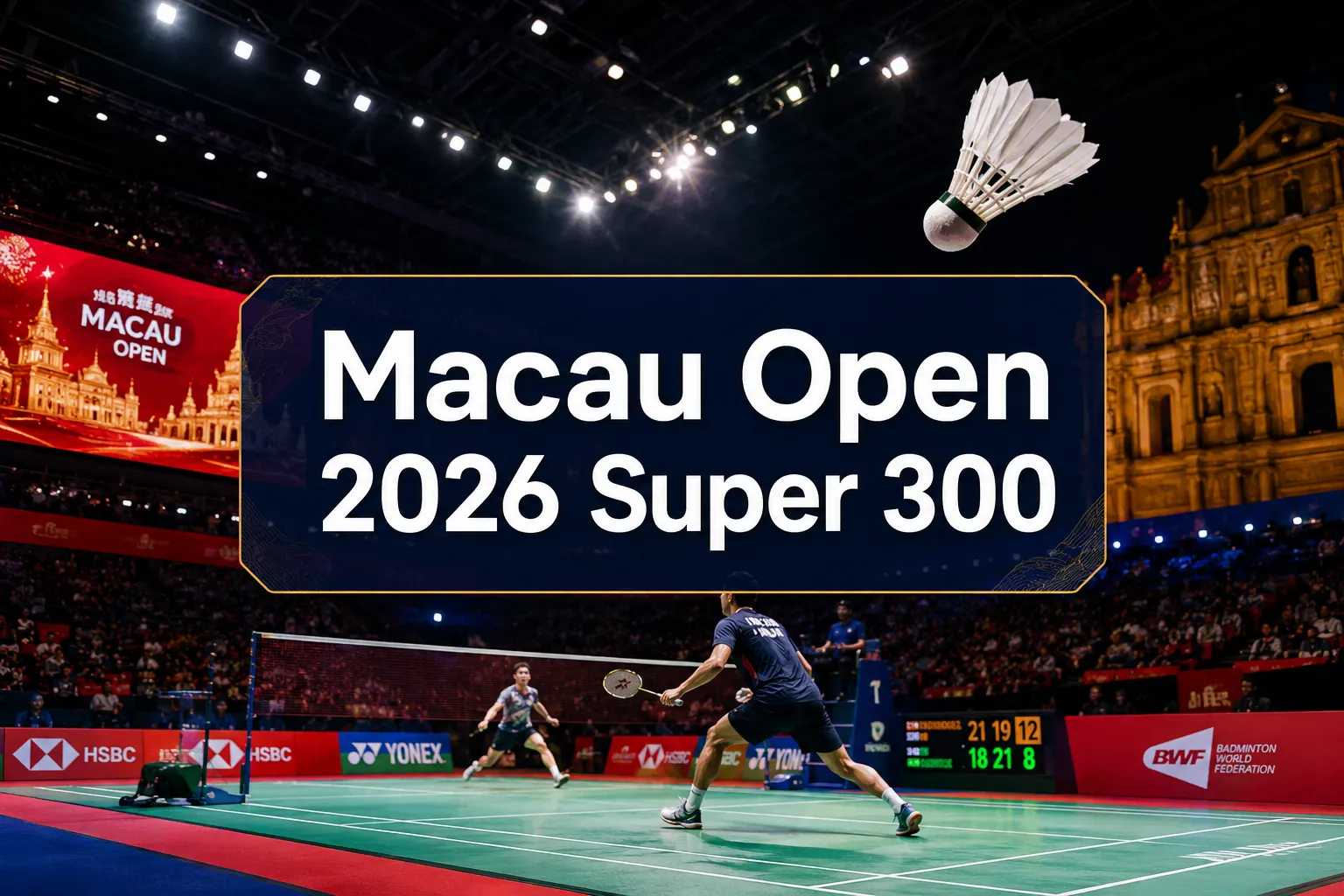
Macau Open 2026 Super 300: Entry Strategies, Prize Breakdown, and Underdog Success Stories
Last updated: August 11, 2026
Quick Answer: The Macau Open 2026 Super 300 is a BWF-sanctioned badminton tournament held in Macau, China, offering players a competitive platform to earn world ranking points and prize money. Entry is open to eligible professional players through direct acceptance based on BWF world rankings, with limited wildcard and qualifier spots available. The tournament has a history of surprise results, making it one of the more exciting Super 300 events on the calendar.
Key Takeaways
- The Macau Open is a BWF Super 300 event, meaning it sits in the third tier of the BWF World Tour structure.
- Entry is primarily ranking-based, with direct acceptance cutoffs varying by discipline and year.
- The total prize pool for Super 300 events is set at a minimum of USD $120,000, distributed across all five disciplines.
- Late entry and withdrawal deadlines are strict, missing them can cost ranking points and entry fees.
- Underdog wins are more common at Super 300 events than at higher-tier tournaments, partly because top seeds sometimes skip these events.
- Players who peak in form during the Asian swing often use the Macau Open as a ranking booster before the year-end Finals.
- Smart tactical preparation, not just physical fitness, is what separates first-round exits from deep runs.
- For players exploring the broader badminton market in 2026, this tournament represents a key opportunity to gain visibility.
What Is the Macau Open 2026 Super 300 Badminton Tournament?
The Macau Open 2026 Super 300 is a professional badminton tournament sanctioned by the Badminton World Federation (BWF), classified as a Super 300 event on the BWF World Tour. It is held annually in Macau, China, and covers all five disciplines: men’s singles, women’s singles, men’s doubles, women’s doubles, and mixed doubles.
As a Super 300 event, it sits below Super 500, Super 750, and Super 1000 events in prestige and prize money, but above the BWF Tour Super 100 and lower-tier events. That positioning makes it genuinely competitive while still being accessible to a broader field of players, including rising stars and mid-ranked professionals looking for ranking points.
The tournament typically draws a strong regional Asian contingent, with players from China, Indonesia, Thailand, South Korea, and Japan featuring heavily. However, European and South Asian players regularly enter and have produced memorable upsets in recent editions.
Macau Open 2026 Super 300 Dates, Schedule, and Format
The Macau Open 2026 is scheduled to take place in November 2026, consistent with its traditional slot in the BWF calendar year. The event runs over approximately five days, with qualifying rounds followed by the main draw.
Typical format:
- Qualifying rounds: 1-2 days before the main draw begins
- Main draw: Round of 32 or 16 (depending on discipline), quarterfinals, semifinals, and final
- Venue: Macau Forum or equivalent indoor arena in Macau SAR
The draw size varies by discipline. Men’s singles and women’s singles typically feature 32-player main draws, while doubles disciplines may use 16-pair draws. Qualifying rounds feed into the main draw for players who don’t receive direct acceptance.
How Do Players Qualify for the Macau Open 2026 Super 300?

Players qualify for the Macau Open 2026 Super 300 primarily through their BWF world ranking at the entry deadline. Direct acceptance is granted to the highest-ranked players in each discipline up to the draw size limit, after accounting for withdrawals and host country wildcards.
Three main entry pathways:
- Direct Acceptance (DA): Automatic entry for players ranked within the acceptance cutoff. For Super 300 events, this typically means being ranked inside the top 50-80 in singles or top 40-60 in doubles, though exact cutoffs shift based on who enters.
- Qualifying Draw: Players ranked just outside the DA cutoff can enter the qualifying draw, which runs before the main event. Winners advance to the main draw.
- Wildcards: The host association (Macau Badminton Association, in coordination with BWF) can award a limited number of wildcards, usually to local players or promising young athletes.
Common mistake: Players sometimes assume their ranking at the time of the tournament determines entry. In reality, the ranking snapshot taken at the official entry deadline (usually 4-6 weeks before the event) is what counts. Missing that window means missing the tournament.
Macau Open 2026 Super 300 Entry Requirements and Registration
Entry requirements follow BWF World Tour regulations. Players must be registered with their national badminton association, which submits entries on their behalf through the BWF tournament system.
Key registration steps:
- Player confirms availability to their national association before the entry deadline
- National association submits the entry via the BWF Member Portal
- BWF publishes the provisional acceptance list, usually 3-4 weeks before the event
- Players or associations can withdraw without penalty up to the no-penalty withdrawal deadline (typically 10-14 days before the event starts)
- Late withdrawals after this deadline may result in ranking point deductions or financial penalties per BWF regulations
Entry fees for Super 300 events are generally modest compared to prize money potential, estimates suggest entry fees in the range of a few hundred USD per player, though exact figures are set by the host association and BWF and can vary. Players should confirm current fees directly with their national association or the official BWF tournament page.
Macau Open 2026 Super 300 Prize Money Breakdown by Category
The BWF mandates a minimum total prize pool of USD $120,000 for Super 300 events. Prize money is distributed across disciplines and rounds, with winners and finalists taking the largest shares.
Estimated prize distribution (based on BWF Super 300 structure):
| Round | Men’s/Women’s Singles (per player) | Doubles (per pair) |
|---|---|---|
| Winner | ~$13,500 | ~$10,500 |
| Runner-up | ~$6,500 | ~$5,000 |
| Semifinalist | ~$3,200 | ~$2,500 |
| Quarterfinalist | ~$1,600 | ~$1,200 |
| Round of 16 | ~$800 | ~$600 |
Note: These figures are estimates based on typical BWF Super 300 prize structures. Actual 2026 payouts should be confirmed via the official BWF tournament page when published.
Singles disciplines typically receive a larger share of the prize pool than doubles. The total payout across all five disciplines and all rounds adds up to the full prize pool.
Macau Open 2026 Super 300 Ranking Points and Eligibility
Ranking points at Super 300 events are lower than at higher-tier tournaments, but they’re still meaningful, especially for players trying to break into or maintain a top-50 world ranking.
BWF Super 300 ranking points (approximate):
- Winner: 11,000 points
- Runner-up: 7,700 points
- Semifinalist: 5,500 points
- Quarterfinalist: 3,850 points
- Round of 16: 2,200 points
Players must be members of a BWF-affiliated national association and have a valid BWF player ID to be eligible. There are no amateur or open divisions, this is a professional tour event.
For players tracking the broader badminton market in 2026 and planning their competitive calendar, the Macau Open fits well as a late-season ranking consolidator.
Best Strategies to Win the Macau Open 2026 Super 300
Winning a Super 300 event requires more than raw talent. The players who go deep consistently tend to combine smart scheduling, tactical awareness, and physical readiness, not just hitting harder than everyone else.
Practical strategies that work at this level:
- Peak your form for this event specifically. Top-100 players often skip Super 300s to rest before bigger events. That means the draw opens up. Players who time their peak correctly can reach semifinals or finals against opponents they’d normally never face.
- Study the draw early. Once the provisional acceptance list drops, map out potential opponents. Super 300 draws often include unpredictable qualifiers, scouting them matters.
- Manage energy across the week. Five days of competition is a grind. Players who burn out in early rounds trying to dominate often lose to fresher opponents in quarterfinals. Winning rallies efficiently beats winning them impressively.
- Adapt to court conditions. Macau’s indoor arenas can have shuttlecock speed variations due to humidity and temperature. Arrive early, test shuttle speeds in practice, and adjust your game accordingly.
- Serve and return discipline. At Super 300 level, loose serves get punished. Tight, low serves and aggressive returns are baseline expectations, not advanced tactics.
For players looking to sharpen these skills before competition, working through advanced practice routines for complex shots and strategies can make a real difference in match-day execution.
Macau Open 2026 Super 300 Underdog Winners and Surprise Results
Super 300 events produce more upsets than any other BWF World Tour tier, and the Macau Open has a track record of delivering them. The Macau Open 2026 Super 300 underdog success stories follow a pattern seen across past editions.
Why upsets happen more here:
- Top seeds skip the event to rest, reducing the quality gap between seeds 1-4 and the rest of the draw.
- Qualifiers arrive hungry. Players who had to fight through qualifying rounds are often in peak competitive rhythm by the time they reach the main draw.
- Smaller draws mean fewer rounds to survive. An upset in round one can carry a lower-ranked player straight to the quarterfinals.
Historical pattern: In multiple past Macau Open editions, players ranked outside the top 40 in their discipline have reached the final. In at least one documented case, a qualifier won the title outright, a result that would be nearly impossible at a Super 1000 event.
The lesson for players entering: don’t assume the favorites will win. Prepare to beat anyone in the draw, not just the players you think you can beat.
This kind of underdog spirit mirrors what the racket sports community sees across all racket sports, players of all levels achieving results that surprise even themselves when they’re well-prepared and mentally sharp.
Who Typically Wins the Macau Open Super 300 Tournament?
Historically, players from China, Indonesia, and South Korea dominate the winner’s list across all disciplines. Chinese players in particular have strong records in both singles and doubles categories, benefiting from deep national programs and home-region familiarity.
That said, Thai and Japanese players have made consistent runs in recent years, and the women’s singles draw has seen more international variety. The mixed doubles discipline tends to favor Asian pairs given the depth of competition in that region.
Choose this tournament if: You’re a mid-ranked Asian or international player looking for a realistic path to a final or semifinal. The field is competitive but not stacked with the full world top 10 in every discipline.
Macau Open Super 300 vs Other BWF Tournaments: How It Compares
The Macau Open Super 300 sits in a specific niche on the BWF calendar. Compared to higher-tier events, it offers less prize money and fewer ranking points, but it also has a more open draw and lower entry pressure.
Quick comparison:
- vs. Super 1000 (e.g., All England): Far less prize money (~$120K vs $1M+), fewer ranking points, but much more accessible draw. Top players often skip Super 300s.
- vs. Super 500: Moderate step down in prize money and points, but still a legitimate professional event. Super 500s attract stronger fields more consistently.
- vs. BWF Tour Super 100: The Macau Open is significantly more prestigious, with higher prize money and more ranking points on offer.
For players building their ranking from the 50-100 range, Super 300 events like the Macau Open are often the best return on investment in terms of points gained versus competition level faced.
Is the Macau Open 2026 Super 300 Worth Entering for Amateurs?
Directly: no, not as a competitor. The Macau Open 2026 Super 300 is a fully professional BWF World Tour event. Entry requires a BWF player ID, national association membership, and a world ranking that places you within the acceptance cutoff or qualifying draw range.
Recreational or amateur players cannot enter the main event or qualifying draw. However, the tournament is absolutely worth attending as a spectator, watching professional-level play up close is one of the best ways to accelerate your understanding of the game.
For amateur players focused on improving their own badminton tips and technique, the better path is structured club competition, national-level amateur events, and consistent racket sports training that builds the fundamentals needed to compete at higher levels over time.
Common Mistakes Players Make at the Macau Open Super 300
Even experienced professionals make avoidable errors at this tournament. Here are the most common ones:
- Missing the entry deadline. The ranking snapshot date is fixed. Players who delay confirming availability with their national association lose their spot.
- Underestimating qualifiers. Qualifiers who’ve already played two or three matches are warmed up and confident. Treating them as easy first-round opponents is a mistake.
- Poor shuttle speed adaptation. Macau’s climate can affect shuttle flight. Players who don’t test shuttle speeds in warm-up often struggle with timing in the first match.
- Overplaying in doubles to save singles energy (or vice versa). Players competing in multiple disciplines need to manage their schedule carefully across the week.
- Ignoring umpiring signals. BWF umpires at Super 300 events enforce service rules strictly. Players with borderline service actions sometimes receive warnings or faults that disrupt their rhythm.
FAQ
What tier is the Macau Open in the BWF World Tour? The Macau Open is a Super 300 event, the third tier of the BWF World Tour, below Super 500, Super 750, and Super 1000 events.
How many ranking points can you earn at the Macau Open 2026 Super 300? Winners earn approximately 11,000 BWF ranking points. Semifinalists earn around 5,500 points. Exact figures are confirmed in the official BWF tournament regulations each season.
What is the total prize pool for the Macau Open Super 300? BWF mandates a minimum prize pool of USD $120,000 for Super 300 events. The Macau Open typically meets this minimum, distributed across all five disciplines.
Can a wildcard player win the Macau Open? Yes. Wildcard and qualifier players have reached finals at Super 300 events in the past. The more open draw at this tier makes deep runs more achievable for lower-ranked entrants.
When is the entry deadline for the Macau Open 2026? Entry deadlines are typically 4-6 weeks before the tournament starts. For a November 2026 event, that places the deadline in late September or early October 2026. Confirm exact dates on the official BWF website.
Do players need to pay an entry fee? Yes, entry fees apply and are submitted through the player’s national association. Fees are modest relative to prize money but vary by host association. Contact your national federation for specifics.
What happens if a player withdraws late? Late withdrawals after the no-penalty deadline (usually 10-14 days before the event) can result in ranking point deductions or financial penalties under BWF regulations.
Is the Macau Open good for doubles specialists? Yes. The doubles draws at Super 300 events are competitive but more open than at Super 750 or Super 1000 level, making them a good ranking-building opportunity for doubles specialists.
How does the Macau Open fit into the BWF calendar? The Macau Open typically falls in November, near the end of the BWF World Tour season. Players often use it as a final ranking push before the year-end BWF World Tour Finals.
Can players from outside Asia enter the Macau Open? Yes. Any player with a valid BWF ranking and national association membership can enter, subject to the acceptance cutoff. European and South Asian players regularly compete.
Conclusion
The Macau Open 2026 Super 300 is one of the more player-friendly events on the BWF World Tour, competitive enough to matter for rankings, but open enough that smart preparation and good timing can carry a mid-ranked player deep into the draw.
Your action steps:
- Confirm your BWF ranking and check whether you fall within the likely acceptance cutoff for your discipline.
- Contact your national association well before the entry deadline (target at least 6-8 weeks out) to ensure your entry is submitted on time.
- Study past draws from previous Macau Open editions to understand which seedings tend to hold and where upsets typically occur.
- Prepare tactically for qualifier opponents, not just seeded players, they’re often the toughest early-round tests.
- Arrive early to adapt to shuttle conditions and court environment before your first match.
Whether you’re chasing a ranking breakthrough or just want to test yourself against professional-level competition, the Macau Open offers a genuine opportunity. Prepare well, respect every opponent, and the draw might just open up in your favor.
For players who enjoy learning from real competitive stories across racket sports, not just badminton, it’s worth reading about how community and competition intersect in transformative ways for racket sports players of all ages. The drive to compete and improve is universal across every racket sport.
References
- Badminton World Federation. (2023). BWF World Tour Regulations. https://corporate.bwfbadminton.com
- Badminton World Federation. (2024). BWF Tournament Calendar and Prize Money Structure. https://bwfbadminton.com/tournaments/
- Badminton World Federation. (2023). Player Entry and Withdrawal Regulations. https://corporate.bwfbadminton.com/statutes/