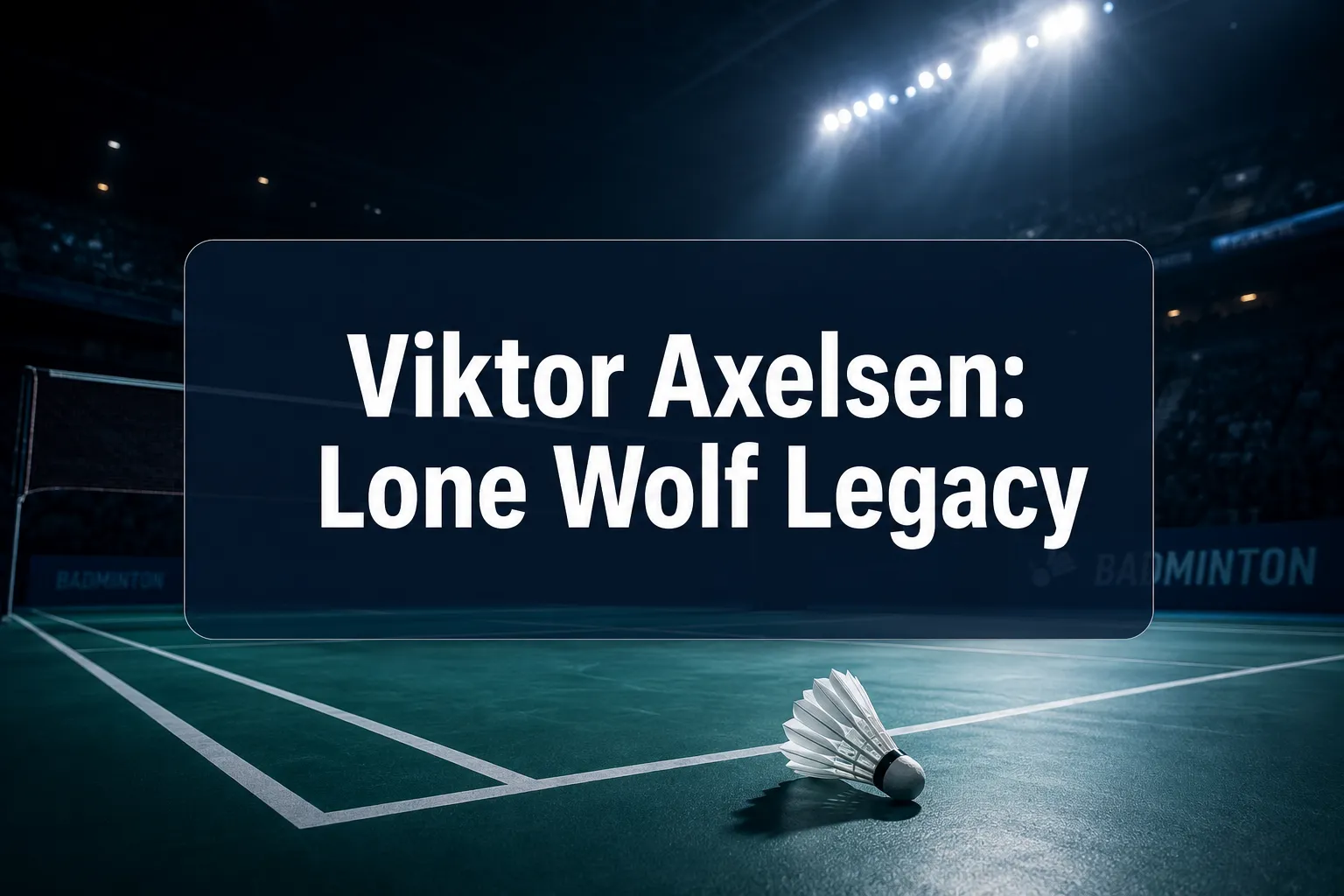
Viktor Axelsen’s retirement and what his ‘lone wolf’ career can teach modern players
Last updated: September 1, 2026
Quick Answer: Viktor Axelsen, the Danish two-time Olympic badminton champion, announced his retirement from professional badminton in April 2026 at age 32, citing chronic back injuries that made it impossible to compete at the highest level. His career is a masterclass in self-directed development: he relocated to Dubai, largely self-coached, and built a dominant global career on his own terms. Viktor Axelsen’s retirement and what his ‘lone wolf’ career can teach modern players is one of the most discussed topics in racket sports right now, and for good reason.
Key Takeaways
- Axelsen retired in April 2026 after persistent back problems ended his bid to reach the LA 2028 Olympics [1][2]
- He won two Olympic gold medals (Tokyo 2020, Paris 2024) and multiple World Championships [8]
- His “lone wolf” approach meant relocating to Dubai and operating largely outside Denmark’s national training system [10]
- He self-coached for significant stretches of his career, hiring specialist support on his own terms
- Mental toughness and accepting physical limits were central to how he ended his career
- His post-retirement path includes writing, media, and mentoring, he built a brand beyond the sport
- The lone wolf model works best for elite, self-aware players, it is not a blueprint every beginner should copy
- Young players can take specific lessons: environment design, ownership of training, and long-term body management
- Axelsen retired at 32, slightly earlier than some peers, but on his own terms rather than through forced exit
- His career challenges the idea that national academy systems are the only path to the top
Why Did Viktor Axelsen Retire From Badminton?
Viktor Axelsen retired from professional badminton in April 2026 because of long-term, unresolvable back injuries that prevented him from training and competing at the level he demanded of himself [1][2]. He had spent months attempting a comeback, using a protected ranking to preserve his competitive status while undergoing rehabilitation [3].
The decision was not sudden. Axelsen had withdrawn from multiple tournaments in the lead-up to his retirement announcement, and the goal of competing at the LA 2028 Olympics, which he had publicly targeted, became medically unrealistic [7]. Rather than continue in a diminished capacity, he chose to retire while still holding the status of reigning Olympic champion [2].
“He ends his career as one of the greatest badminton players in history, stepping away on his own terms rather than being forced out by age alone.”, Olympics.com [7]
His back problems had been a recurring issue for several years, and the cumulative toll of elite-level training finally outweighed the body’s ability to recover [3][4].
Viktor Axelsen’s Career Achievements and Records
Axelsen’s professional career spanned roughly 15 years at the elite level, from his early teens to his retirement at 32 [8]. His record stands among the best in men’s singles badminton history.
Key career highlights:
- 🏅 Olympic gold medals: Tokyo 2020 and Paris 2024
- 🏆 BWF World Championships winner (multiple titles)
- 🌍 Multiple All England Open titles
- 📈 Spent extended periods ranked World No. 1 by the Badminton World Federation
- 📖 Published a book and built a media presence beyond competitive sport
He turned professional in the early 2010s representing Denmark, and his dominance over the latter half of his career, particularly from 2021 onward, made him the benchmark for men’s singles globally [8][10]. His retirement at 32 came while he was still the defending Olympic champion, which is an extraordinarily rare way to leave a sport.
What Does “Lone Wolf” Mean in Badminton?

In badminton, “lone wolf” describes a player who operates independently of a national training center or federation system, making their own decisions about coaching, training partners, travel, and environment [10]. For most elite players, the standard path runs through national academies, think China, Indonesia, or Denmark’s national setup, where coaches, physios, and training groups are provided centrally.
Axelsen broke from that model. He relocated to Dubai, built his own training environment, and took direct ownership of his development rather than fitting into a system designed for a group [10]. This is unusual at the very top of any racket sport, and it drew both admiration and skepticism during his playing days.
What the lone wolf model involves in practice:
- Choosing your own training base and environment
- Hiring specialist coaches and physios independently
- Controlling your own competition schedule
- Taking full personal accountability for results
For players across the racket sports community, whether you’re working on positioning and movement on court or building a structured training routine, Axelsen’s model raises a useful question: how much ownership do you take over your own development?
How Did Viktor Axelsen Train Differently Than Other Players?
Axelsen’s training differed from most elite players in three concrete ways: location, structure, and accountability. By basing himself in Dubai rather than Denmark, he designed his training environment around his specific needs, climate, facilities, and access to high-quality sparring partners from across Asia and Europe [10].
He worked with coaches and support staff he selected himself, rather than those assigned by a national federation. This gave him the flexibility to adjust his training load around his back condition, something that would have been harder inside a rigid national program.
Three practical differences in his approach:
- Environment by design, Dubai offered year-round training conditions and proximity to Asian tournament circuits
- Specialist-led recovery, managing a chronic back injury required custom physio and load management, not a one-size-fits-all program
- Selective competition, he chose tournaments strategically rather than following a mandated federation calendar
This level of self-direction requires both the financial means and the self-awareness to know what you need. It is not a model most junior players can or should replicate immediately, but the underlying principle of taking ownership of your development applies at every level.
Viktor Axelsen’s Mental Toughness Strategies
Mental toughness was a defining feature of Axelsen’s career, and it showed most clearly in how he handled adversity, injuries, pressure as world No. 1, and ultimately the decision to retire [5][7]. He consistently demonstrated the ability to perform under pressure while managing a body that was working against him in his later years.
Mental strategies visible in his career:
- Accepting limitations honestly, rather than forcing a comeback that could have ended badly, he acknowledged when the body could no longer meet the mind’s standards [2]
- Long-term goal orientation, targeting LA 2028 showed he was thinking in multi-year cycles, not just the next tournament
- Controlling what he could control, the move to Dubai was partly about removing external noise and focusing purely on performance
- Ending on his own terms, retiring as defending Olympic champion rather than grinding through a decline phase
For any player in the racket sports community, this is the most transferable lesson: the ability to assess your situation honestly and make decisions based on long-term wellbeing rather than short-term ego.
Viktor Axelsen’s Sponsorships and Financial Independence
Axelsen’s financial independence was a direct enabler of his lone wolf model. Self-funding a training base in Dubai, hiring your own coaching staff, and managing your own competition schedule requires significant resources that most players simply do not have [10].
He built strong sponsorship relationships, most notably with Yonex, one of the leading names in racket sports equipment, and his global profile as a two-time Olympic champion made him commercially attractive well beyond Denmark’s domestic market.
Why this matters for the lone wolf discussion:
- Financial independence gave him the freedom to leave the national system without losing training quality
- His brand extended beyond badminton into books, media, and mentoring, creating income streams outside prize money
- This multi-role approach to a sports career is increasingly relevant for modern athletes across all racket sports
The lesson here is not “get rich first.” It is that building a personal brand and diversifying your value as an athlete creates options, and options create freedom.
Is Lone Wolf Training Better Than Team Training in Badminton?
The lone wolf model is not universally better than team-based training, it depends entirely on the player’s experience level, self-awareness, and resources. For Axelsen, it worked because he was already an elite player with years of high-level coaching behind him when he made the shift [10].
Choose lone wolf training if:You are an advanced player, financially independent, highly self-aware, and have an established technical foundation.
Stick with team/academy training if:
You are developing fundamentals, benefit from peer competition, or need structured accountability.
For most recreational and intermediate players, the kind who make up the core of the racket sports community, a team or club environment provides irreplaceable benefits: coaching feedback, training partners, and the social motivation that keeps people playing. The community-building aspect of racket sports is genuinely valuable and should not be dismissed.
The takeaway is not to go it alone. It is to take more personal ownership within whatever structure you have access to.
What Can Young Badminton Players Learn From Axelsen?
Viktor Axelsen’s retirement and what his ‘lone wolf’ career can teach modern players comes down to five practical lessons that apply regardless of your level or sport.
Five lessons from Axelsen’s career:
- Design your environment intentionally, where you train, who you train with, and how you recover all matter. Don’t just accept the default.
- Own your development, even within a club or academy, take responsibility for your own progress rather than waiting to be coached.
- Manage your body for the long term, Axelsen’s back problems were partly a product of elite-level load. At any level, recovery and injury prevention deserve as much attention as skill work.
- Build a career, not just a ranking, his post-playing identity as an author, media figure, and mentor shows the value of thinking beyond the next match.
- Know when to stop, ending a career while still at the top requires more courage than grinding on past your best. Honest self-assessment is a skill.
These lessons translate directly to players across all racket sports, from badminton tips to tennis training guides to anyone working on their game in pickleball or padel. If you’re just starting out, resources like what to expect in your first pickleball clinic show how structured learning environments can accelerate development in the early stages.
Common Mistakes Young Players Make That Axelsen Avoided
Several patterns derail promising players that Axelsen consistently sidestepped throughout his career [10][5].
Mistakes Axelsen avoided:
- Outsourcing all decision-making to coaches, he stayed actively involved in shaping his own training rather than being a passive recipient
- Ignoring the body’s signals, while his back ultimately ended his career, he managed it carefully for years rather than training through pain until catastrophic breakdown
- Staying in a system that no longer served him, when the national setup wasn’t the right fit, he moved rather than stayed out of loyalty or inertia
- Defining himself only by results, building a broader identity meant retirement was a transition, not an identity crisis
Viktor Axelsen’s Retirement Age Compared to Other Pros
Axelsen retired at 32, which is slightly younger than some badminton legends but not unusually early for a player who had competed at the highest level for over a decade [8][2]. For context, Lin Dan of China competed into his mid-30s, and Lee Chong Wei of Malaysia retired at 36 due to cancer. Kento Momota, a contemporary rival, has also faced significant health challenges affecting his career arc.
The difference with Axelsen is the circumstances: he retired as the reigning Olympic champion, not after a visible decline in results. That is exceptionally rare in any sport. His back injury accelerated the timeline, but his decision to leave while still at the top reflects the same self-directed mindset that defined his whole career [1][7].
Viktor Axelsen vs Other Top Players: Coaching Approach
Most of Axelsen’s elite contemporaries, players like Momota, Shi Yuqi, or Kunlavut Vitidsarn, operate within national federation systems that provide centralized coaching, training partners, and support infrastructure. Axelsen’s approach was deliberately different [10].
Comparison of coaching models:
| Approach | Axelsen (Lone Wolf) | National Academy Model |
|---|---|---|
| Coach selection | Self-selected specialists | Federation-assigned |
| Training base | Dubai (self-chosen) | National center |
| Schedule control | Personal | Federation-guided |
| Financial model | Sponsorship-funded | Federation-supported |
| Best suited for | Elite, self-aware players | Developing players |
Neither model is objectively superior. The national system produces the majority of world-class players. Axelsen’s model produced two Olympic gold medals and a multi-year world No. 1 ranking, but it required a very specific combination of talent, resources, and self-knowledge to work.
Can All Badminton Players Succeed With the Lone Wolf Approach?
No, and Axelsen himself would likely be the first to say so. The lone wolf model requires a technical foundation, financial independence, and a level of self-awareness that takes years to develop [10]. Attempting it too early in a career, before the fundamentals are solid, is one of the most common mistakes ambitious players make across all racket sports.
For players at the beginner to intermediate level, the priority should be finding good coaching, quality training partners, and a supportive community. The kind of environment you find in a well-run club or through structured programs, like those covered in resources on how classes can transform your game, is exactly what builds the foundation that a lone wolf approach later depends on.
The lesson from Axelsen is not to skip that foundation. It is to eventually take ownership of it.
Global Tributes and Axelsen’s Legacy in Racket Sports
When Axelsen announced his retirement, tributes came from across the badminton world and beyond [9]. Fellow players, federations, and sports organizations recognized not just his results but the manner in which he competed and the model he represented.
His legacy in racket sports is threefold:
- On-court excellence, two Olympic golds and a sustained period of world No. 1 dominance
- Career model, proof that self-directed development can reach the absolute peak of a sport
- Post-career platform, a template for how modern athletes can build lasting careers beyond their playing days
For the broader racket sports community, players working on badminton tips, tennis training guides, padel strategies, and more, Axelsen’s story is a reminder that how you build a career matters as much as the results you produce.
Conclusion: What Viktor Axelsen’s Retirement Really Teaches Us
Viktor Axelsen’s retirement and what his ‘lone wolf’ career can teach modern players is ultimately a story about ownership. He owned his training environment, his coaching decisions, his competitive schedule, and finally, his exit. That consistency of self-direction, from a young player in Denmark to a two-time Olympic champion retiring on his own terms in 2026, is the through-line of his entire career [1][7][10].
Actionable next steps for players at every level:
- Audit your training environment, is it actually designed around your needs, or are you just going along with the default?
- Take one area of ownership, pick one aspect of your game (recovery, footwork, mental prep) and own it completely rather than waiting to be told what to do
- Think long-term about your body, racket sports equipment reviews and gear upgrades matter, but injury prevention is the most important gear decision you’ll ever make
- Build beyond the scoreboard, develop skills, relationships, and knowledge that outlast your competitive peak
Whether you’re new to the racket sports community or a seasoned competitor, Axelsen’s career offers a clear signal: the players who last, and who leave the sport with something to show beyond a ranking, are the ones who take genuine ownership of their journey.
FAQ
How old was Viktor Axelsen when he retired? Viktor Axelsen was 32 years old when he announced his retirement from professional badminton in April 2026. [2]
What injury caused Viktor Axelsen to retire? Chronic back problems that resisted rehabilitation and made it impossible to train and compete at elite level were the primary cause of his retirement. [1][3]
Did Viktor Axelsen win the Paris 2024 Olympics? Yes. Axelsen won the men’s singles gold medal at the Paris 2024 Olympics, making him a two-time Olympic champion. [8]
What does “lone wolf” mean in Viktor Axelsen’s career? It refers to his decision to relocate to Dubai and operate largely outside Denmark’s national training system, self-selecting his coaches, training partners, and competition schedule. [10]
Was Viktor Axelsen the world No. 1 when he retired? He had spent extended periods as BWF World No. 1 and retired as the reigning Olympic champion, though his ranking had been affected by injury-related withdrawals in his final months. [7][8]
Why did Axelsen move to Dubai? He moved to Dubai to build a custom training environment that suited his specific needs, giving him access to high-quality facilities and proximity to Asian tournament circuits while operating independently. [10]
Can recreational players use the lone wolf training model? Not directly, the model requires an advanced technical foundation and financial independence. Recreational players benefit more from structured coaching and community-based training environments.
What did Viktor Axelsen do after retiring? His post-retirement plans include writing, media creation, and mentoring, roles he had already begun building during his playing career. [7]
How long did Viktor Axelsen play professional badminton? He competed professionally for approximately 15 years, turning elite-level from his early to mid-teens through to his retirement at 32. [8]
What is Viktor Axelsen’s biggest career achievement? Winning back-to-back Olympic gold medals at Tokyo 2020 and Paris 2024 is widely considered the peak of his career. [2][7]
Did other players react to Axelsen’s retirement? Yes, tributes came from across the global badminton community, with players, federations, and sports organizations acknowledging his impact on the sport. [9]
Is the lone wolf approach better for mental toughness? It can develop stronger self-reliance, but it also removes the support structures that help many athletes manage pressure. Mental toughness develops through challenge, not isolation, the model matters less than the mindset.
References
[1] Danish Olympic Champion Axelsen Calls Time Career 2026 04 15 – https://www.reuters.com/sports/danish-olympic-champion-axelsen-calls-time-career-2026-04-15/
[2] Reigning Olympic Champ Viktor Axelsen Ends Badminton Career – https://www.espn.com/olympics/story/_/id/48513903/reigning-olympic-champ-viktor-axelsen-ends-badminton-career
[3] Viktor Axelsen Retired Badminton – https://www.nbcsports.com/olympics/news/viktor-axelsen-retired-badminton
[4] english.news.cn – https://english.news.cn/20260415/e414f88b00b24114babf969bc09cd470/c.html
[5] taipeitimes – https://www.taipeitimes.com/News/sport/archives/2026/04/16/2003855691
[6] english.news.cn – https://english.news.cn/europe/20260415/d5408b23a13041d39ef90663a92f7b1d/c.html
[7] Viktor Axelsen Retires Professional Badminton – https://www.olympics.com/en/news/viktor-axelsen-retires-professional-badminton
[8] Viktor Axelsen – https://en.wikipedia.org/wiki/Viktor_Axelsen
[9] Sport Tributes Viktor Axelsen Retirement Badminton – https://www.olympics.com/en/news/sport-tributes-viktor-axelsen-retirement-badminton
[10] Axelsen A Lone Wolf Who Bet On Himself To Beat The World – https://www.hindustantimes.com/sports/badminton/axelsen-a-lone-wolf-who-bet-on-himself-to-beat-the-world-101776273245830.html

![The Underrated Skill Transforming Pickleball in 2026: Mastering [Key Skill from Video] for Tournament Wins](https://rallyracket.com/wp-content/uploads/2026/06/The-Underrated-Skill-Transforming-Pickleball-in-2026-Mastering-Key-Skill-from-Video-for-Tournament-Wins-768x504.png "The Underrated Skill Transforming Pickleball in 2026: Mastering [Key Skill from Video] for Tournament Wins")