Badminton’s Net Play Revolution: How Synthetic Shuttles Are Changing Delicate Shots
Last updated: July 28, 2026
Quick Answer: In April 2026, the Badminton World Federation (BWF) approved synthetic feather shuttlecocks from Victor and Yonex for use at Grade 3 and Junior International tournaments, a formal step in Badminton’s Net Play Revolution: How Synthetic Shuttles Are Changing Delicate Shots at every level. These shuttles use carbon-graphite or nylon stems with engineered synthetic skirts to mimic feather flight, but they behave differently enough at the net that players need to adjust their timing, touch, and spin technique to keep their soft shots sharp.
Key Takeaways
- The BWF approved Victor’s NCS MAX 12 and Yonex’s Crosswind 70 for Grade 3 and Junior International tournaments in April 2026 [2][4]
- Synthetic shuttles are not yet permitted at the Olympics, World Championships, or BWF World Tour events [1][4]
- Synthetic skirts use nylon nano-sheets with chevron holes engineered to reproduce the drag and deceleration of feather shuttles [1]
- Net drops, tumbles, and spinning tape shots feel slightly different with synthetics, players report needing finer touch adjustments
- Synthetics last significantly longer than feather shuttles and are more consistent across humidity changes
- Beginners benefit from synthetics’ durability and consistency; advanced players need time to recalibrate delicate net play
- The BWF’s push is driven by sustainability concerns and feather supply shortages [3][7]
- Synthetic shuttles cost less per tube but the gap is narrowing as quality improves [5]
What Are Synthetic Badminton Shuttles Made Of?
Synthetic badminton shuttles combine a natural cork base with a man-made skirt and stem. The cork base is kept because it delivers the best feel on racket contact, that part hasn’t changed. What’s different is everything above it.
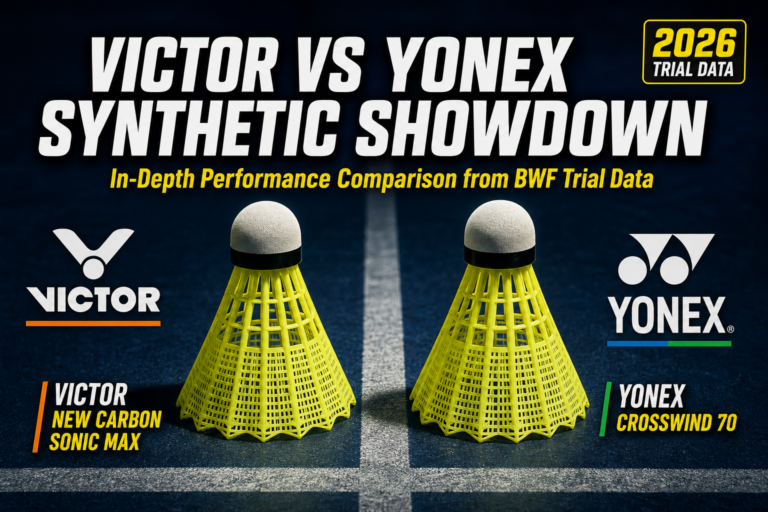
The newest approved models, including Victor’s NCS MAX 12 and Yonex’s Crosswind 70, use carbon-graphite or nylon stems attached to a nylon nano-sheet skirt. That skirt features engineered “chevron holes”, small cutouts designed to replicate the aerodynamic drag and deceleration profile of real goose or duck feathers [1]. The goal is to make the shuttle slow down and arc the same way a feather shuttle does, especially on high clears and net drops.
Key materials at a glance:
- Base: Natural cork (same as feather shuttles)
- Stem: Carbon-graphite or rigid nylon
- Skirt: Nylon nano-sheet with chevron-pattern perforations
- Skirt shape: Engineered to match the cone angle of a 16-feather natural shuttle

How Do Synthetic Shuttles Differ from Feather Shuttles?
The core difference is in how the skirt deforms on impact and how the shuttle decelerates through the air. Feather shuttles flex and spread slightly on contact, giving players that classic “soft” feel on net kills and drop shots. Synthetic skirts are stiffer and more uniform, which changes the feedback you get through the racket.
Flight differences players notice most:
- Initial speed: Synthetics tend to leave the racket slightly faster on hard smashes
- Deceleration: Modern synthetics are much closer to feather shuttles than older nylon models, but the arc on net drops can still feel marginally flatter
- Spin and tumble: Feather shuttles spin and tumble more naturally at the net tape; synthetics require slightly more deliberate racket angle to achieve the same effect
- Wind sensitivity: Feather shuttles are more affected by air movement; synthetics are more stable in variable conditions
For recreational players, the difference is subtle. For advanced players working on net play, it’s noticeable enough to require practice adjustment.
Why Are Synthetic Shuttles Changing Badminton in 2026?
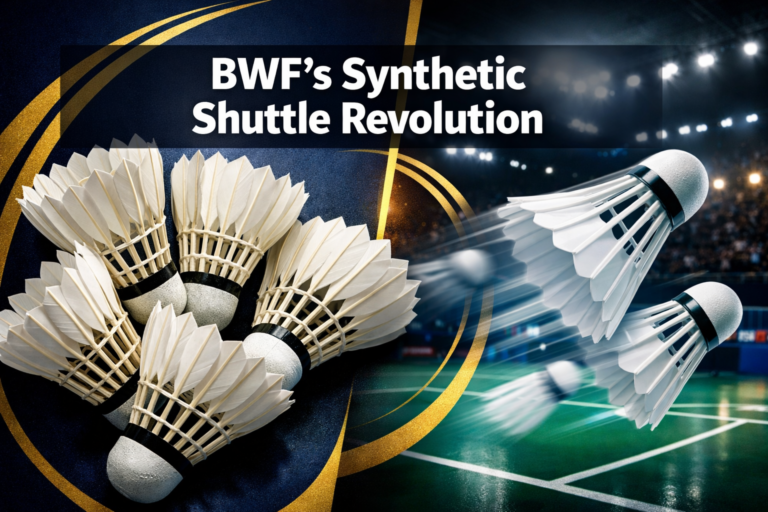
Badminton’s Net Play Revolution: How Synthetic Shuttles Are Changing Delicate Shots is happening for two big reasons: sustainability and supply security [3][7].
Feather shuttles rely on goose and duck feathers, a supply chain that’s vulnerable to seasonal shortages, animal welfare regulations, and rising costs. The BWF has been working toward synthetic alternatives since at least 2020 [3], and the April 2026 approval for Grade 3 and Junior International events marks the first formal competitive rollout [2][4].
Beyond supply issues, synthetics can cut shuttlecock consumption by an estimated 25% because they last longer under match conditions [1]. For clubs running weekly sessions, that’s a meaningful cost saving over a full season.
“The BWF’s synthetic shuttle initiative is squarely about long-term sustainability and making the sport more accessible globally.”, BWF corporate communications [3]
The trial at lower-tier tournaments is deliberate: the BWF is collecting player feedback and performance data before deciding whether to expand approval to World Tour events [4][7].
Do Synthetic Shuttles Affect Drop Shots and Net Kills?
Yes, and this is where Badminton’s Net Play Revolution: How Synthetic Shuttles Are Changing Delicate Shots gets most interesting for players who rely on touch at the net.
Drop shots: The stiffer synthetic skirt means the shuttle doesn’t “give” as much on a soft drop. Players used to feather shuttles often find their drops travel slightly further than intended when they first switch. The fix is to reduce racket head speed a fraction earlier in the swing.
Net kills: Synthetics respond well to flat, punchy net kills. The firmer skirt actually helps here, the shuttle comes off the strings cleanly and travels fast. Less adjustment needed for aggressive net play.
Spinning tape shots: This is the trickiest area. Feather shuttles tumble and spin unpredictably when they clip the tape, which is part of what makes them so hard to return. Synthetic shuttles spin less erratically, so tape shots are slightly more predictable for both the hitter and the receiver.
Practical tips for adjusting net play:
- Start with slower net drills, focus on feel before adding speed
- Reduce your grip pressure slightly on drop shots
- Practice spinning net shots deliberately at a steeper angle to compensate for reduced natural tumble
- Give yourself at least 2-3 sessions before judging the shuttle’s behavior
Best Synthetic Shuttles for Net Play
For players specifically focused on net play and soft shot quality, the two BWF-approved synthetic models are the current benchmark [4][5].
| Shuttle | Best For | Key Feature |
|---|---|---|
| Yonex Crosswind 70 | Intermediate to advanced | Nylon nano-sheet skirt, close feather-flight feel |
| Victor NCS MAX 12 | Club and tournament play | Carbon-graphite stem, consistent deceleration |
| RSL Tourney | Budget recreational | Durable nylon, good for beginners |
| Yonex Mavis 350 | Outdoor/casual play | Robust nylon, less suited for delicate net play |
For net play specifically, the Crosswind 70 and NCS MAX 12 are the top choices because their chevron-hole skirt design most closely replicates the drag profile players expect on drops and tumbles [1][4].
Are Synthetic Shuttles Better for Beginners or Advanced Players?
Both groups benefit, but for different reasons, and the trade-offs are worth knowing before you switch.
For beginners: Synthetics are a great starting point. They’re more durable, hold their shape longer, and don’t require the careful temperature-conditioning that feather shuttles need. They’re also more forgiving when mishit, which means more consistent practice rallies. If you’re just building your net game, synthetics let you focus on technique without worrying about shuttle wear.
For advanced players: The adjustment period is real. Players with refined touch at the net, especially those who rely on spinning drops and tape shots, will notice the difference in skirt flex and tumble behavior. That said, the newer BWF-approved models are significantly closer to feather performance than older nylon shuttles. Most advanced players adapt within a few focused practice sessions.
Choose synthetics if:
- You play recreationally or at club level
- You train outdoors or in variable humidity
- Budget and shuttle longevity matter to your club
- You’re a junior player building fundamentals
Stick with feathers if:
- You compete at BWF World Tour level (required by current rules) [4]
- Your net game depends on highly specific tumble and spin behavior
- You’re preparing specifically for feather-shuttle tournaments
Synthetic vs Feather Shuttles: Cost and Durability
Synthetic shuttles cost less per tube and last longer, that combination makes them attractive for clubs and recreational players.
A tube of quality feather shuttles (12 shuttles) typically runs $25,$45 USD depending on brand and grade, and a single shuttle may last only one to three games at competitive pace. Synthetic shuttles in the same tube format generally cost $10,$20 USD and can last three to five times longer under similar conditions [5][6].
The BWF’s own research suggested newer synthetic designs could reduce overall shuttle consumption by around 25% compared to feather shuttles [1], which compounds the cost savings over a full season.
Durability factors:
- Synthetic skirts don’t break or bend like feather vanes
- Cork bases wear at a similar rate to feather shuttles
- Synthetics hold shape better in humid or outdoor conditions
- Feather shuttles require humidity-controlled storage; synthetics don’t
Can You Use Synthetic Shuttles in Tournament Play?
It depends on the tournament level. As of April 2026, synthetic shuttles are approved for BWF Grade 3 and Junior International tournaments only [2][4]. They are not permitted at the Olympics, World Championships, or BWF World Tour events [1][4].
For club tournaments, national associations, and recreational leagues, the rules vary by organizer. Many club-level competitions already allow or even prefer synthetics for cost reasons.
Before your next tournament:
- Check your national badminton federation’s current approved shuttle list
- Confirm with the tournament organizer which shuttle will be used in match play
- Practice with that specific shuttle type in the weeks before the event
Do Synthetic Shuttles Fly Differently in Humidity?
Yes, and this is one area where synthetics have a clear advantage. Feather shuttles absorb moisture from the air, which changes their weight and flight arc. In humid conditions, feather shuttles fly slower and shorter; in dry conditions, they fly faster. Players often need to switch between shuttle speeds mid-match to compensate.
Synthetic shuttles are far less affected by humidity. The nylon skirt doesn’t absorb moisture the way feather vanes do, so the flight behavior stays consistent across different environments [5]. This makes synthetics particularly useful for:
- Outdoor play in variable weather
- Coastal or tropical climates with high humidity
- Indoor halls without climate control
- Junior players who shouldn’t have to think about shuttle speed adjustment
Common Mistakes Players Make Switching to Synthetic Shuttles
Most adjustment problems come from players applying feather-shuttle habits directly to synthetics without any recalibration.
Mistake 1: Using the same touch on drop shots Synthetics don’t decelerate quite as sharply on soft shots. Players often overshoot the net on drops at first. Fix: practice slow-feed net drops before full rallies.
Mistake 2: Expecting the same tape-shot tumble Feather shuttles tumble erratically off the tape. Synthetics spin more predictably. Don’t rely on the shuttle “doing the work”, add deliberate wrist rotation.
Mistake 3: Dismissing synthetics after one session The adjustment takes time. Give it at least three practice sessions with focused net drills before forming an opinion.
Mistake 4: Using outdoor nylon shuttles as a proxy Older nylon shuttles (like the Yonex Mavis 350) fly very differently from the newer BWF-approved synthetic feather models. Don’t judge the new generation by the old standard.
If you’re looking to sharpen your overall racket sports skills, our racket sports gear reviews section covers equipment comparisons across multiple sports to help you make smarter gear decisions.
Are Synthetic Shuttles Good for Indoor and Outdoor Play?
Synthetic shuttles work well in both settings, but they shine outdoors. Feather shuttles are essentially unusable in wind, even a light breeze sends them off course. Synthetic shuttles, with their stiffer, more uniform skirt, handle light wind much better [5][6].
For indoor play, both types work. The choice comes down to budget, tournament requirements, and personal preference. At club level, synthetics are increasingly the default for indoor training sessions because of their durability and consistency.
Quick guide:
- 🏸 Indoor competitive: Feather (if tournament rules require) or BWF-approved synthetic
- 🏸 Indoor recreational/training: Synthetic, saves money, lasts longer
- 🏸 Outdoor casual: Synthetic, much better wind resistance
- 🏸 Outdoor competitive: Synthetic, feathers are impractical
Just as equipment evolution has shaped other racket sports, see how pickleball equipment has evolved from wooden paddles to modern gear, synthetic shuttles represent a similar shift in badminton.
What’s the Difference Between Nylon and Synthetic Badminton Shuttles?
“Nylon” and “synthetic” are often used interchangeably, but in 2026 they refer to different generations of product.
Traditional nylon shuttles (like the Yonex Mavis series) use a single-piece molded plastic skirt. They’re cheap, durable, and good for beginners, but they fly noticeably differently from feather shuttles, especially on drops and clears.
Modern synthetic feather shuttles (like the Yonex Crosswind 70 and Victor NCS MAX 12) use individual nylon nano-sheet “feathers” attached to a stem, mimicking the structure of a real feather shuttle. The chevron-hole design in the skirt replicates aerodynamic drag much more accurately [1][4].
The gap between nylon and feather flight has narrowed dramatically with the new generation. For net play specifically, modern synthetic feather shuttles are far closer to the real thing than any previous nylon design.
Which Professional Players Use Synthetic Shuttles?
As of 2026, no professional players are required to use synthetic shuttles in top-tier competition. The BWF’s approval currently covers only Grade 3 and Junior International events [2][4], so World Tour professionals still compete exclusively with feather shuttles.
However, several national federations and junior programs have introduced synthetic shuttles into training environments. Junior players competing in BWF-sanctioned junior events are now among the first competitive players to gain match experience with the new approved models [10].
The BWF’s trial is explicitly designed to gather feedback from players and coaches at these levels before any decision about expanding synthetic shuttle use to elite competition [4][7]. That feedback loop, from junior and Grade 3 players, will shape whether synthetics eventually reach the sport’s biggest stages.
For players interested in how strategy adapts alongside equipment changes, the principles in our guide on singles vs. doubles play strategies apply regardless of shuttle type and are worth revisiting as you adjust your game.
Conclusion: Adapting Your Net Game for the Synthetic Era
Badminton’s Net Play Revolution: How Synthetic Shuttles Are Changing Delicate Shots is not a distant future event, it’s happening now, in junior halls and Grade 3 tournaments around the world. The physics are real: synthetic skirts behave differently on drops, tumbles, and tape shots, and players who understand those differences will adapt faster than those who don’t.
Your next steps:
- Try a tube of BWF-approved synthetics (Yonex Crosswind 70 or Victor NCS MAX 12) in your next training session
- Run slow net drills first, focus on drop shot distance before adding speed
- Practice deliberate spin on net shots rather than relying on natural tumble
- Track your adjustment over three sessions before drawing conclusions
- Check your tournament rules, know which shuttle is approved at your level
The racket sports community is in the middle of a genuine equipment shift. Getting comfortable with synthetics now, while they’re still in the trial phase, puts you ahead of the curve when they become the standard at more competition levels.
Want to keep improving across all your racket sports? Explore more racket sports gear reviews and training guides at Rally Racket, built for players who want to play smarter, not just harder.
FAQ
Q: Are synthetic shuttles approved for the Olympics? No. As of 2026, synthetic shuttles are only approved for BWF Grade 3 and Junior International tournaments. The Olympics, World Championships, and BWF World Tour still require feather shuttles [1][4].
Q: How long do synthetic shuttles last compared to feather shuttles? Synthetic shuttles typically last three to five times longer than feather shuttles under similar playing conditions. The nylon skirt doesn’t break or bend the way feather vanes do [5].
Q: Do synthetic shuttles feel the same as feather shuttles on net drops? Not exactly. Synthetic skirts are stiffer, so drops can travel slightly further than expected. Most players adjust within a few focused practice sessions by reducing racket head speed slightly.
Q: Can I use synthetic shuttles outdoors? Yes, synthetics are actually better suited for outdoor play than feather shuttles. Their nylon skirt is far less affected by wind and humidity [5][6].
Q: What is the Yonex Crosswind 70? The Yonex Crosswind 70 is one of the two BWF-approved synthetic feather shuttlecocks (alongside Victor’s NCS MAX 12). It uses a nylon nano-sheet skirt with chevron holes designed to replicate feather flight, particularly on drops and clears [1][4].
Q: Are synthetic shuttles cheaper than feather shuttles? Yes. A tube of quality feather shuttles typically costs $25,$45 USD, while comparable synthetic tubes run $10,$20 USD. Combined with longer durability, synthetics offer significant cost savings for clubs [5][6].
Q: Why is the BWF introducing synthetic shuttles? The BWF’s primary drivers are sustainability and supply security. Feather shuttles depend on goose and duck feathers, which face supply chain pressures. Synthetics also reduce overall shuttle consumption [3][7].
Q: Do synthetic shuttles spin differently at the net? Yes. Feather shuttles tumble more erratically off the tape. Synthetic shuttles spin more predictably, which means tape shots are slightly easier to read for both players. Advanced players should add deliberate wrist rotation to compensate.
Q: What’s the difference between old nylon shuttles and new synthetic feather shuttles? Old nylon shuttles (like the Yonex Mavis) use a single molded plastic skirt and fly noticeably differently from feather shuttles. New synthetic feather shuttles use individual nylon nano-sheet “feathers” with aerodynamic perforations that closely replicate real feather flight [1].
Q: Should beginners use synthetic or feather shuttles? Beginners should start with synthetic shuttles. They’re more durable, consistent, and don’t require humidity conditioning. Beginners can focus on technique without worrying about shuttle wear or storage.
References
[1] BWF Synthetic Badminton Shuttles April 2026 – https://www.peakmocks.com/current-affairs/bwf-synthetic-badminton-shuttles-april-2026
[2] BWF Test Out Synthetic Feather Shuttlecocks 2026-04-08 – https://www.reuters.com/sports/bwf-test-out-synthetic-feather-shuttlecocks-2026-04-08/
[3] BWF Begins Adoption of Synthetic Feather Shuttlecock for Long-Term Sustainability – https://corporate.bwfbadminton.com/news-single/2020/01/20/bwf-begins-adoption-of-synthetic-feather-shuttlecock-for-long-term-sustainability
[4] BWF Approves Synthetic Shuttlecocks Victor Yonex Tournaments – https://indianexpress.com/article/sports/badminton/bwf-approves-synthetic-shuttlecocks-victor-yonex-tournaments-10625439/
[5] BWF Approved Synthetic Shuttlecocks – https://www.aeroplanebadminton.com/bwf-approved-synthetic-shuttlecocks/
[6] BWF Approved Synthetic Shuttles (Reddit) – https://www.reddit.com/r/badminton/comments/kszga3/bwf_approved_synthetic_shuttles/
[7] BBC Sport – Badminton Synthetic Shuttlecocks – https://www.bbc.com/sport/badminton/articles/czre12zel8vo
[10] Badminton Synthetic Shuttlecock Junior Tournament Trial Sustainability – https://www.firstpost.com/sports/badminton-news/badminton-synthetic-shuttlecock-junior-tournament-trial-sustainability-13998295.html