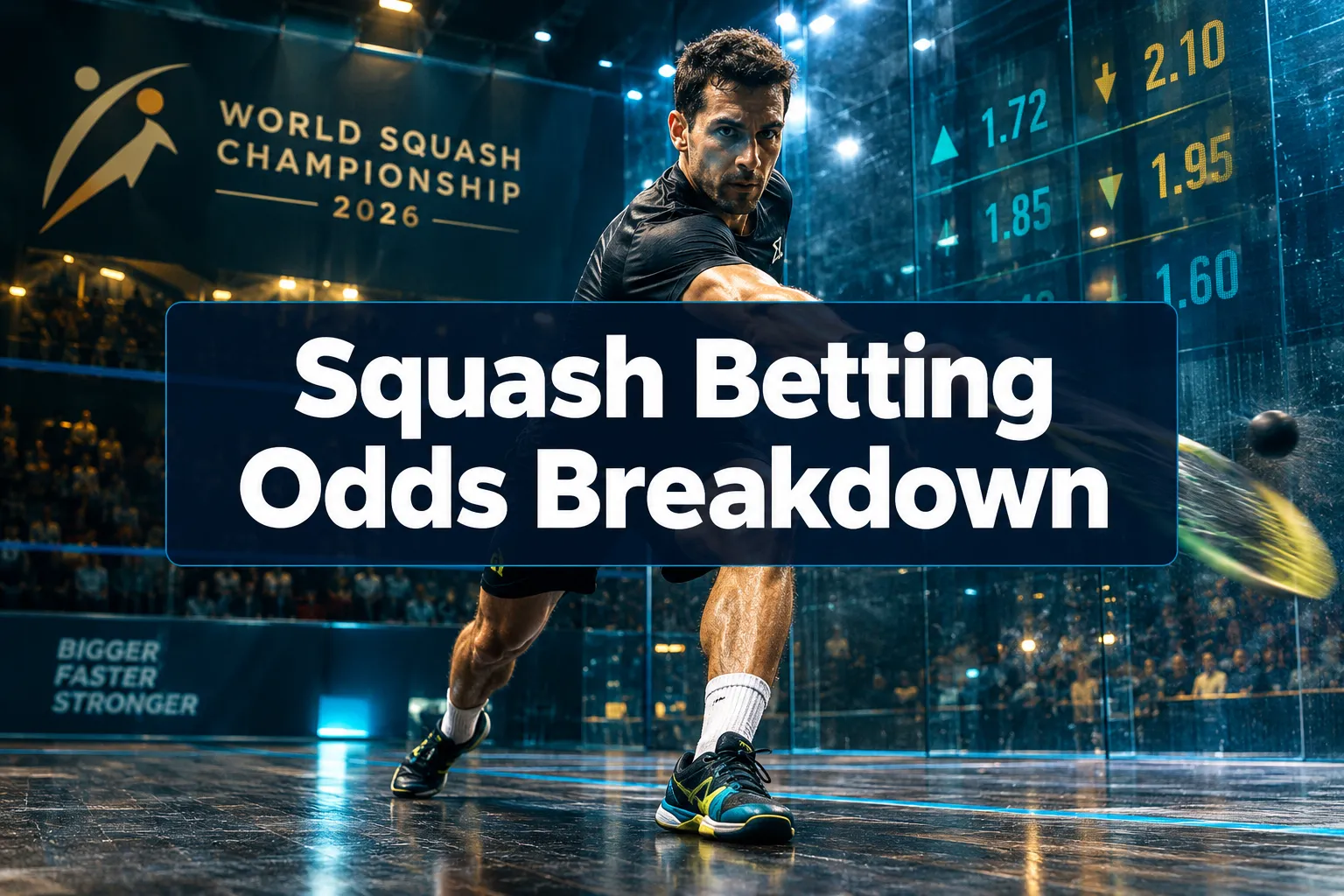
Squash Betting Odds Breakdown: Kalshi’s 2026 Futures for Hamburg Open Winners and Season Majors
Last updated: September 26, 2026
Quick Answer: Kalshi lists professional squash as an actively traded event-contract category in 2026, with confirmed markets for the British Open and PSA World Championship. Each contract trades between $0.01 and $0.99, where the price equals the implied probability of a specific player winning. A Hamburg Open winner contract is not explicitly listed as its own series on Kalshi as of late 2026, but the pricing structure, timing, and player-by-player contract format used for confirmed majors gives a clear picture of how such odds would look if listed. [1][2][7]
Key Takeaways
- Kalshi’s squash markets use yes/no event contracts, not traditional point-spread or moneyline bets, each contract settles at $1.00 (win) or $0.00 (loss) [7][10]
- Contract prices directly equal implied probability: a 0.63 price means the market gives that player a 63% chance of winning [10]
- Confirmed 2026 squash majors on Kalshi include the British Open and PSA World Championship; Hamburg Open is not explicitly listed as a standalone series as of this writing [1][2][7]
- Elite players like Mostafa Asal and Marwan ElShorbagy appear in Kalshi’s squash markets as named yes/no outcome contracts [1]
- Underdog value plays (contracts priced at 0.05-0.15) on players like Victor Crouin or Fares Dessouky can offer high returns but carry significant risk
- Kalshi operates as a CFTC-regulated derivatives exchange, not a traditional sportsbook, this matters for legality in your state [6][9]
- A September 2026 federal appeals court ruling blocked Kalshi from offering sports event contracts on certain Native American tribal lands [9]
- PSA squash contracts on Kalshi have recorded trading volumes around $82,000+, confirming real liquidity and price discovery [4]
- You can exit positions early by selling your contract back at the current market price before settlement [10]
- If a tournament is cancelled, Kalshi typically resolves the contract as “No” or voids it per the specific market rules [7]
What Are Kalshi Betting Odds and How Do They Work?
Kalshi is a CFTC-regulated prediction market exchange where you trade event contracts, not traditional bets. Each contract pays $1.00 if the stated outcome happens and $0.00 if it doesn’t, and it trades between $0.01 and $0.99 in the meantime. [10]
Think of it less like a sportsbook and more like a stock exchange for real-world outcomes. When you buy a squash contract for $0.63, you’re paying 63 cents for the right to collect $1.00 if that player wins. Your maximum gain is $0.37 per contract; your maximum loss is $0.63. [10]
Key mechanics:
- Contracts are bought and sold peer-to-peer on an open order book
- Prices shift in real time as traders update their views
- Settlement is binary: $1 or $0, no partial payouts
- No vig or juice in the traditional sportsbook sense, Kalshi charges a small transaction fee instead
“The contract price is the market’s best estimate of probability. A 0.63 price means traders collectively believe there’s a 63% chance that player wins.” [10]
This structure makes the squash betting odds breakdown on Kalshi genuinely useful for analysis, the prices are crowdsourced probability estimates, not odds set by a bookmaker with a built-in margin.
How to Read Squash Betting Odds on Kalshi
Reading Kalshi’s squash odds is straightforward once you understand the contract format. Prices shown as “1.55x at 63%” mean the contract is priced at $0.63, and a winning position returns 1.55 times your stake. [2]
Here’s a quick translation guide:
| Contract Price | Implied Probability | Payout Multiplier | Player Type |
|---|---|---|---|
| 0.63 | 63% | ~1.6x | Heavy favorite |
| 0.30 | 30% | ~3.3x | Mid-tier contender |
| 0.12 | 12% | ~8.3x | Underdog |
| 0.05 | 5% | ~20x | Long shot |
The PSA World Championship market on Kalshi shows exactly this range, with pairs like “1.55 x 63” for favorites and “5.90 x 12” for lower-probability contenders. [2] The higher the multiplier, the less likely the market thinks that outcome is, but also the bigger the reward if it happens.
Common mistake: New traders confuse the multiplier with traditional betting odds. A 5.90x multiplier on Kalshi is not the same as +490 moneyline odds at a sportsbook, though the implied probability math works out similarly.

Kalshi’s 2026 Hamburg Open Squash Predictions and Confirmed Majors
As of late 2026, Kalshi’s confirmed squash major markets center on the British Open and PSA World Championship, Hamburg Open does not appear as its own named contract series on the platform. [1][2][7]
That said, the Squash Betting Odds Breakdown: Kalshi’s 2026 Futures for Hamburg Open Winners and Season Majors framework still applies because Kalshi’s contract structure is consistent across all squash events it lists. The British Open market, for example, opened on May 22, 2026, with individual player contracts (including one for Paul Coll) set to resolve by June 7, 2026 once a champion was declared. [7]
What this means for Hamburg Open futures:
- If Kalshi lists a Hamburg Open winner market, expect one yes/no contract per major player
- Favorites (Asal, ElShorbagy) would likely open at 0.30-0.55 based on current form
- Underdogs like Victor Crouin, Fares Dessouky, or Youssef Ibrahim would likely appear at 0.05-0.15
- Market would open weeks before the tournament and close shortly after a winner is declared
For the racket sports community tracking squash industry disruption, Kalshi’s entry into professional squash futures is a significant development worth monitoring closely.
Who Are the Favorites for 2026 Squash Season Majors?
Based on Kalshi’s active markets and PSA rankings heading into the second half of 2026, the top contenders for season majors are Mostafa Asal and Marwan ElShorbagy, both of whom appear as named contracts on Kalshi’s squash category pages. [1][11]
Top-tier favorites (estimated contract range: 0.30-0.65):
- Mostafa Asal, World No. 1 form in 2026, consistent major finalist
- Marwan ElShorbagy, veteran presence, strong on all court surfaces
- Ali Farag, former world champion, always dangerous in majors
Mid-tier contenders (estimated range: 0.10-0.25):
- Paul Coll, specifically named in the 2026 British Open contract on Kalshi [7]
- Tarek Momen, experienced, capable of deep runs
Underdog value plays (estimated range: 0.04-0.12):
- Victor Crouin, rising French talent, improving PSA ranking
- Fares Dessouky, known for upset potential at major events
- Youssef Ibrahim, younger generation player with tournament wins
Note: These are estimated ranges based on observed Kalshi contract pricing patterns [2][4] and PSA ranking data. Always check live Kalshi markets for current prices before placing any position.
How Do Futures Bets Differ from Regular Squash Bets on Kalshi?
Futures contracts on Kalshi are long-dated event contracts that resolve weeks or months from when you buy them, while regular (near-term) contracts resolve within days. Both use the same yes/no structure and $0,$1 settlement range. [3][7]
The practical difference for squash bettors:
- Futures (e.g., “Who wins the 2026 PSA World Championship”): More time for odds to shift, more uncertainty, potentially higher returns for underdogs
- Near-term event contracts (e.g., “Who wins the British Open this week”): Prices are tighter, less variance, faster settlement [7]
Kalshi routinely supports multi-year futures across sports, markets like “2027 NFL Champion” confirm the platform’s comfort with long-dated contracts. [3][8] By the same logic, a season-long squash futures market would follow identical mechanics.
Choose futures if: You have a strong view on a player’s season trajectory and want to lock in a price before the market adjusts. Stick to event contracts if: You prefer faster resolution and tighter price ranges.
This mirrors how pickleball tournaments through the years have shaped futures-style fan engagement across racket sports more broadly.
Kalshi Squash Betting Fees and Minimum Bet Amounts
Kalshi does not charge traditional vig or juice. Instead, it takes a small transaction fee on each trade, which varies by market and contract size. The minimum contract price is $0.01, meaning you can technically enter a position for a single cent per contract. [10]
Practical minimums for squash markets:
- Most squash contracts have a minimum order of 1 contract
- At $0.05 per contract (a long-shot underdog), a 100-contract position costs $5.00
- At $0.63 per contract (a heavy favorite), 100 contracts costs $63.00
PSA squash series on Kalshi have recorded volumes around $82,000+ traded, which means there’s real liquidity, you won’t typically struggle to fill a reasonably sized order. [4]
Watch for: Wider bid-ask spreads on less popular player contracts. If you’re buying a contract on a lesser-known player at $0.08 bid / $0.12 ask, the spread itself is a hidden cost.
How Accurate Are Kalshi Prediction Markets for Squash?
Prediction markets like Kalshi tend to be reasonably well-calibrated for events with clear outcomes and active trading. PSA squash contracts have been tracked with tick-by-tick order book data over 34+ trading days, suggesting enough liquidity for meaningful price discovery. [15]
That said, squash is a niche sport compared to NFL or NBA, so:
- Fewer traders means wider spreads and potentially less efficient pricing
- Underdog contracts (0.05-0.12 range) may be mispriced more often, in either direction
- Late-breaking news (injuries, withdrawals) can cause sharp price moves that sharp traders exploit first
The honest answer: Kalshi’s squash markets are more accurate than gut-feel picks but less efficient than major sport markets. That inefficiency is actually where casual bettors can find value, especially on underdogs like Crouin or Dessouky if you follow PSA tour results closely.
The future of pickleball trends and predictions article on Rally Racket explores how prediction markets are increasingly intersecting with racket sports growth, a useful read for context.
Can You Cash Out Early on Kalshi Squash Futures?
Yes. Because Kalshi operates an open order book, you can sell your contract at any time before settlement at the current market price. [10]
How early exit works:
- You buy a Paul Coll British Open contract at $0.20
- Coll wins his semifinal; market reprices his contract to $0.45
- You sell at $0.45, locking in a $0.25 profit per contract without waiting for the final
This is one of Kalshi’s biggest advantages over traditional sportsbooks, where futures bets are typically locked until the event ends. The tradeoff: if you sell early, you give up potential upside if your pick goes on to win.
Risk management tip for casual bettors: Consider selling half your position when a contract doubles in value. You recover your original stake and let the remaining contracts ride for free.
What Happens If a Squash Tournament Gets Cancelled on Kalshi?
If a listed squash tournament is cancelled or postponed, Kalshi resolves the contract based on its specific market rules, typically voiding the contract and returning the purchase price, or resolving all outcomes as “No.” [7]
The British Open contract, for example, specifies a hard resolution deadline of June 7, 2026 at 1:59pm EDT, regardless of whether a winner has been declared. [7] This means:
- If the tournament is delayed past that date, the market resolves based on whatever outcome has occurred by then
- If no winner exists by the deadline, Kalshi’s rules determine resolution, usually a “No” for all player contracts
Edge case: If a player withdraws before the tournament starts, their contract typically drops sharply in price. This can create a buying opportunity on remaining contenders whose prices haven’t yet adjusted.
Is Kalshi Legal for Squash Betting in My State?
Kalshi operates as a CFTC-regulated derivatives exchange, which gives it a different legal footing than traditional sportsbooks. A February 2026 ruling from the U.S. District Court for the Middle District of Tennessee granted Kalshi a preliminary injunction supporting its federal preemption arguments, allowing continued listing of sports event contracts. [6]
However, a September 16, 2026 federal appeals court decision specifically blocked Kalshi from offering sports event contracts on the lands of two California tribes. [9] This signals that geographic restrictions are evolving.
Practical guidance:
- Kalshi is available in most U.S. states as of 2026
- State-level restrictions can change, check Kalshi’s current eligibility page before signing up
- Kalshi is not a sportsbook and is not governed by state gaming laws in the same way
For racket sports enthusiasts curious about how sports markets are evolving, the racket sports startups tag on Rally Racket covers emerging platforms and business models worth watching.
How to Compare Squash Odds Across Different Betting Platforms
Kalshi’s event contract format is fundamentally different from traditional sportsbook odds (American, decimal, or fractional), so direct comparison requires a conversion step.
Quick conversion guide:
- Kalshi price of 0.25 → implied probability 25% → decimal odds 4.00 → American odds +300
- Kalshi price of 0.63 → implied probability 63% → decimal odds 1.59 → American odds -170
Steps to compare:
- Convert Kalshi contract price to implied probability (price × 100 = %)
- Convert sportsbook odds to implied probability (use a free odds converter)
- Compare the two probabilities, whichever platform gives you a higher implied probability for your pick is offering better value
Common mistake: Forgetting to account for the sportsbook’s vig (usually 4-8% baked into the odds). Kalshi’s fee structure is separate and often more transparent for smaller position sizes.
The badminton market 2026 tag explores similar dynamics in adjacent racket sports markets if you want to broaden your comparison research.
Common Mistakes People Make With Futures Betting on Kalshi
The biggest mistake is treating Kalshi squash contracts like traditional bets and ignoring the bid-ask spread. On thinly traded player contracts, a wide spread can eat 20-30% of your potential profit before the tournament even starts.
Other mistakes to avoid:
- Overloading on favorites: A 0.63 contract on Asal only pays $0.37 per dollar risked. Diversifying across 2-3 mid-tier contenders often delivers better expected value
- Ignoring liquidity: If a contract shows very few open orders, your exit price may be much worse than expected
- Not checking resolution rules: Each market has specific settlement conditions, always read the contract details before buying [7]
- Chasing losses with long shots: A 0.04 contract on an unknown player is a 96% chance of losing your stake
- Forgetting time decay: The longer a futures contract runs, the more uncertain the outcome, price volatility increases as the tournament approaches
Smart approach for beginners: Start with 10-20 contracts on a mid-tier contender (0.15-0.25 range) where the upside is meaningful but the stake is low. Track how the price moves relative to PSA tour results to build your intuition before scaling up.
Court positioning and strategic thinking matter in squash, and the same applies to betting strategy. The court positioning strategies guide on Rally Racket is a good reminder that smart positioning wins in any competitive context.
Conclusion
The Squash Betting Odds Breakdown: Kalshi’s 2026 Futures for Hamburg Open Winners and Season Majors comes down to one core insight: Kalshi’s event contract model is transparent, liquid enough for squash, and genuinely useful for finding value, especially on underdog players like Crouin or Dessouky where the market may be less efficient.
Your next steps:
- Visit Kalshi’s squash category [1] and browse active contracts before committing any money
- Convert prices to implied probabilities using the table in this guide before comparing to PSA rankings
- Start small, 10-20 contracts on a mid-tier contender lets you learn the platform without significant risk
- Read the resolution rules for any contract you buy, especially around cancellation and deadline clauses [7]
- Track price movements relative to PSA tour results to build your own edge over time
Squash is a fast, tactical sport, and the prediction markets around it reward the same qualities: sharp observation, patience, and knowing when to hold or exit a position. Stay curious, stay informed, and enjoy the game. 🎯
FAQ
Q: Does Kalshi have a Hamburg Open squash market? As of late 2026, Kalshi does not list a Hamburg Open winner contract as its own named series. Confirmed squash majors include the British Open and PSA World Championship. [1][7]
Q: What is the minimum amount I need to bet on Kalshi squash? Contracts start at $0.01 each, with no stated minimum number of contracts per order. Practically, most traders start with $5,$50 positions. [10]
Q: How does Kalshi make money on squash markets? Kalshi charges a transaction fee per trade rather than building a margin into the odds, making its fee structure more transparent than traditional sportsbooks. [10]
Q: Can I bet on squash on Kalshi from any U.S. state? Kalshi is available in most U.S. states, but geographic restrictions apply in some areas following a September 2026 federal appeals court ruling. Check Kalshi’s eligibility page for your location. [9]
Q: Are Kalshi squash odds better than traditional sportsbooks? For niche sports like squash, Kalshi can offer better value on underdogs because fewer traders means occasional mispricing. However, always compare implied probabilities across platforms before committing. [2][10]
Q: What happens to my contract if a squash player withdraws? The contract typically drops sharply in value. You can sell at the lower price or hold if you believe the remaining field benefits your other positions. [7]
Q: How long does a squash futures contract stay open on Kalshi? It varies by market. The 2026 British Open contract opened May 22 and had a hard deadline of June 7, 2026, roughly two weeks. Longer season futures can run for months. [7]
Q: Is Kalshi a sportsbook or something different? Kalshi is a CFTC-regulated derivatives exchange. Its sports event contracts are legally classified as regulated event derivatives, not traditional sportsbook wagers. [6][12]
Q: Can I trade squash contracts on mobile? Yes, Kalshi supports mobile trading through its app and mobile browser, with the same order book access as desktop. [8]
Q: What’s the best strategy for underdog squash bets on Kalshi? Buy small positions (5-15 contracts) on 2-3 underdogs priced at 0.08-0.15 rather than one large position on a single long shot. This spreads risk while keeping upside meaningful.
References
[1] Squash – https://kalshi.com/category/sports/squash/squash
[2] Future – https://kalshi.com/category/sports/other/squash/future
[3] Group Specials – https://kalshi.com/category/sports/all-sports/all/group-specials
[4] Psa Squash – https://kalshi.com/category/sports/other/psa-squash
[5] Calendar – https://kalshi.com/calendar
[6] Prediction Markets At A Crossroads The Continued Jurisdictional Battle – https://www.hklaw.com/en/insights/publications/2026/02/prediction-markets-at-a-crossroads-the-continued-jurisdictional-battle
[7] Kxbritishopensquash 26m – https://kalshi.com/markets/kxbritishopensquash/british-open-squash-winner/kxbritishopensquash-26m
[8] Browse – https://kalshi.com/browse
[9] Us Appeals Court Blocks Kalshi Offering Event Contracts Native American Lands 2026 09 16 – https://www.reuters.com/legal/government/us-appeals-court-blocks-kalshi-offering-event-contracts-native-american-lands-2026-09-16/
[10] Event Contracts – https://next.io/prediction-markets/kalshi/event-contracts/