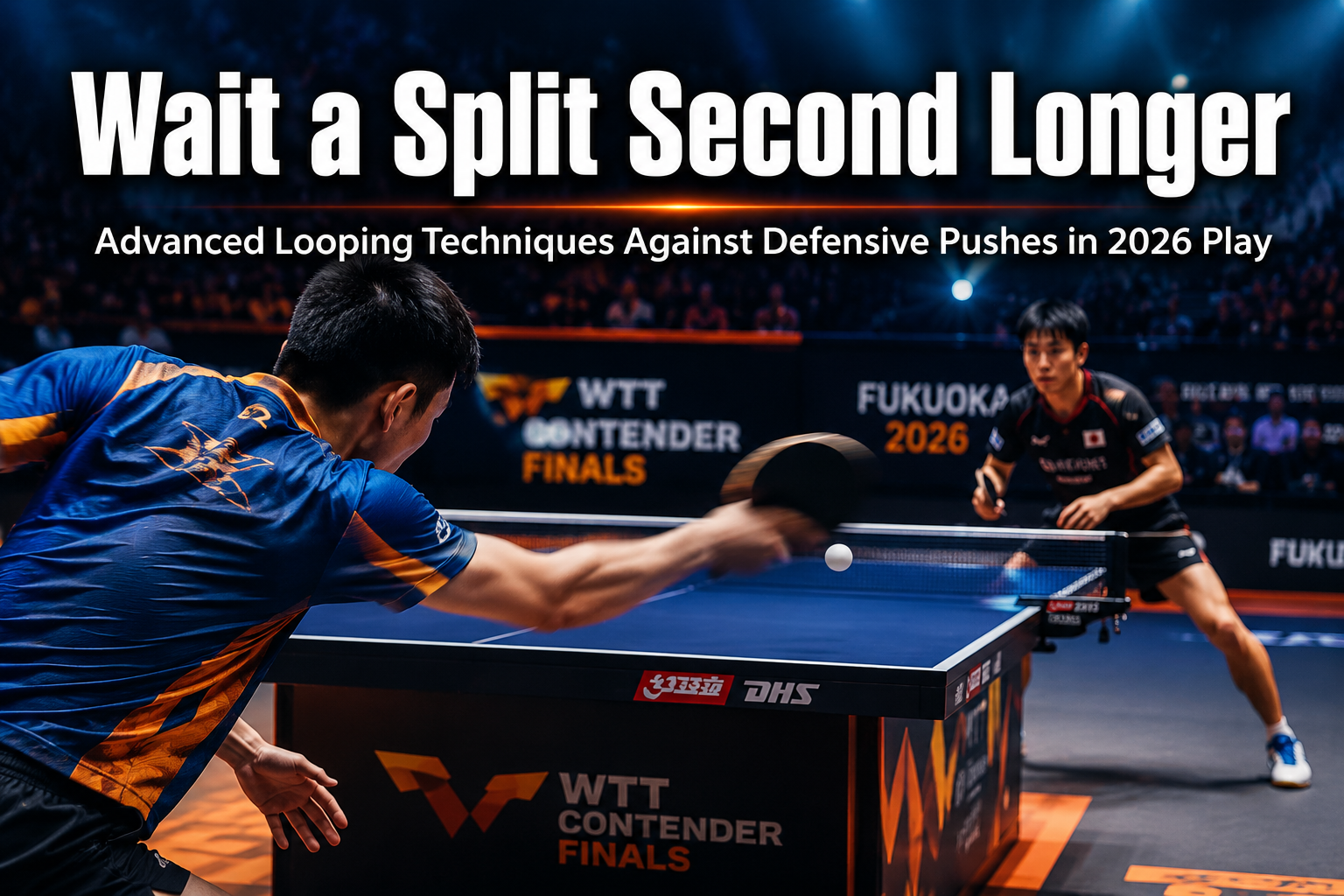
Wait a Split Second Longer: Advanced Looping Techniques Against Defensive Pushes in 2026 Play
Last updated: May 28, 2026
Quick Answer
Waiting a split second longer before executing a loop against a defensive push gives you more time to read ball spin, drop height, and placement — all of which directly affect your contact angle and power transfer. The core coaching principle, well-documented at TableTennisCoaching.com, is simple: let the ball drop slightly past its peak before accelerating your stroke [4]. This small timing adjustment separates intermediate players from advanced ones in 2026 competitive play.
Key Takeaways
- Timing, not power, is the biggest factor when looping against a defensive push
- Letting the ball drop below table height before contact gives you more spin and control
- A defensive push produces heavy backspin — your loop must brush upward at a steep angle to overcome it
- The “wait a split second longer” principle applies across table tennis, pickleball, and padel defensive exchanges
- Pro players like Eli Ho (TigerWing style) use grip and rubber innovations to expand the hitting window [2]
- Common beginner mistake: rushing the stroke and hitting flat into the net
- Dedicated drilling — as little as 20–30 minutes per session — builds the muscle memory needed for consistent timing
- These techniques are fully legal in all major competitive formats, including ITTF-sanctioned events
- Equipment choice (rubber type, paddle weight) meaningfully affects how much time you have to react
- Physical training — especially reaction drills and hip rotation work — accelerates skill development
What Exactly Is a Defensive Push in Competitive Play?
A defensive push is a controlled, low-trajectory return shot that uses backspin to make attacking difficult. The player brushes under the ball with a short or long stroke, sending it back low over the net with heavy backspin and minimal pace [6].
In competitive play, a well-placed push does two things: it forces the opponent to generate their own power from scratch, and it punishes any mistimed loop with a net error. Pushes can be short (landing near the net) or long (deep toward the baseline), and the spin level varies based on how sharply the player angles their paddle at contact [6].
Why pushes are so effective defensively:
- They reset rally pace and force the attacker to re-read spin
- A heavy backspin push can cause a flat or rushed loop to dive straight into the net
- Short pushes limit the attacker’s swing space and angle options
Understanding the push is the first step toward looping it well. Check out our guide on footwork fundamentals for advanced play — because your feet need to be set before your timing can work.
How Do Advanced Looping Techniques Differ from Basic Techniques?
Basic looping focuses on making contact and getting the ball over the net. Advanced looping — especially in the context of Wait a Split Second Longer: Advanced Looping Techniques Against Defensive Pushes in 2026 Play — is about controlling when and where contact happens to maximize spin reversal and placement.
Here’s the key difference in a table:
| Factor | Basic Loop | Advanced Loop |
|---|---|---|
| Timing | At or near ball peak | Slightly after peak (drop phase) |
| Contact point | Middle of ball | Upper-back of ball |
| Swing path | Forward-dominant | Upward-forward brush |
| Wrist use | Minimal | Active snap at contact |
| Placement intent | Just over net | Targeted to opponent’s weak side |
| Spin reversal | Partial | Full — heavy topspin from backspin |
The advanced version also incorporates forearm acceleration and a wrist adjustment at the moment of contact, which generates the spin needed to overcome heavy backspin [3]. TableTennisCoaching.com emphasizes making forehand and backhand looping central to your game — not just an occasional weapon [1].

Which Pro Players Are Known for Split-Second Timing Tricks?
Several elite players have built their game around precise loop timing against defensive play, but the TigerWing style — developed by coach John Ho and mastered by Eli Ho — stands out as the most technically documented example in 2026 [2].
What makes Eli Ho’s timing distinctive:
- Uses a hybrid shakehand-penhold grip that shifts the hitting zone by approximately 3 cm on backhand loops [2]
- Employs long pimples on the backhand to absorb and redirect spin, then switches to inverted rubber for aggressive topspin when the moment is right
- Forehand loops combine forearm acceleration with wrist snap — generating high-spin drives that punish defensive pushes [2]
The TigerWing approach is a strong example of how equipment and grip innovation can extend the timing window, giving players more room for that split-second delay [2].
At ITTF Worlds 2026, the most consistent loop-killers against defensive players were those who stayed patient in the rally, read the spin depth, and committed to steep upward brush angles rather than flat drives.
Which Defensive Strategies Are Most Vulnerable to Looping?
Not all defensive pushes are equally hard to loop. Short, low-spin pushes near the net are the most attackable — they give you a clear angle and less spin to overcome. Long pushes with heavy backspin to the backhand corner are harder but still very loopable with the right technique [4].
Most vulnerable defensive situations:
- A push that lands mid-table or deeper (you have room to swing)
- A push with moderate backspin (easier to brush through)
- A push directed to your forehand (your strongest loop side for most players)
- A push that sits up slightly above net height
Harder to loop:
- Very short pushes that land close to the net (limited swing arc)
- Ultra-heavy backspin pushes to the wide backhand
- Pushes combined with a sudden change in pace
The principle of waiting a split second longer is most valuable against heavy backspin pushes. The extra time lets the ball drop into a position where your upward swing path naturally overcomes the spin [4].
What Are Common Mistakes Beginners Make with Looping Against Defense?
The most common mistake is rushing — making contact too early, at the ball’s peak or even on the rise. This leads to a flat stroke that the backspin pulls straight into the net [5].
Top 5 beginner mistakes:
- Hitting flat — not brushing upward enough to reverse the backspin
- Rushing the swing — not waiting for the ball to drop to a comfortable contact height
- Incorrect paddle angle — too closed (face-down) against heavy backspin
- No wrist involvement — relying only on arm swing, which reduces spin generation [3]
- Poor footwork — being too far from the ball or off-balance before the swing
💡 “The loop against a push is not a power shot — it’s a spin shot. Brush first, drive second.”
For drills that build consistency against these exact mistakes, our intermediate drills to elevate your game page is a great next step.
How Much Practice Time Do You Need to Master These Techniques?
Most intermediate players can develop reliable loop timing against defensive pushes within 4–8 weeks of focused practice — assuming 3–4 sessions per week with deliberate drill work. That’s a realistic estimate, not a guarantee, since individual starting points vary.
Suggested practice breakdown per session (30 minutes):
- 10 min — Multiball or robot drill: loop against backspin feeds, focusing on timing delay
- 10 min — Partner drill: push-loop exchange, alternating sides
- 10 min — Match play: use the loop intentionally in points, track net errors
The key is deliberate repetition, not just volume. Each rep should have a specific focus — contact point, brush angle, or placement. Our advanced practice routines guide covers how to structure these sessions effectively.
Are These Techniques Legal in All Competitive Tournaments?
Yes. Every technique covered here — timing delays, wrist snap at contact, grip variations, and rubber selection — is fully legal under ITTF rules and sanctioned in all major competitive formats as of 2026.
The TigerWing hybrid grip (shakehand-penhold) is legal [2]. Long pimple rubber on the backhand is legal, provided it meets ITTF thickness and approved rubber list requirements. There are no timing rules that restrict when in the ball’s arc you make contact.
The only equipment-related restriction to be aware of: rubber must be ITTF-approved, and racket coverings must meet color contrast requirements (one red, one black side). Check current ITTF equipment regulations before tournament play to confirm your specific rubber is on the approved list.
What Equipment Helps Improve Split-Second Reaction Timing?
The right equipment doesn’t replace skill, but it does give you more margin for error. For looping against defensive pushes, two equipment factors matter most: rubber type and paddle weight.
Equipment considerations:
- High-tension inverted rubber on the forehand gives more spin potential from a brushing stroke, which is forgiving when timing is slightly off [1]
- Medium-weight paddle (around 165–185g total) allows faster swing acceleration without fatigue
- Ball machines / multiball feeders are the single best training tool for building timing repetition — they deliver consistent backspin feeds so you can isolate the timing variable
- Slow-motion video (most smartphones shoot at 240fps) lets you review contact point and brush angle in real time
For racket sports gear reviews and equipment guidance across multiple sports, explore our racket sports gear reviews tag for up-to-date recommendations.
What Physical Training Helps Improve Split-Second Decision Making?
Reaction time and explosive hip rotation are the two physical qualities that most directly support advanced loop timing. Both are trainable.
Effective physical drills:
- Reaction ball drills — bounce an irregular ball off a wall and respond; builds unpredictable reaction speed
- Hip rotation exercises — cable rotations and medicine ball throws develop the rotational power that drives loop acceleration
- Lateral shuffle and split-step practice — gets you into position faster so your timing isn’t rushed by poor footwork
- Vision training — tracking a moving target (ball on a string, for example) sharpens the ability to read ball trajectory early
Our agility training guide for racket sports players covers several of these drills in detail, and they transfer well across racket sports — from table tennis to pickleball and padel.
How Do Different Game Styles Impact Looping Effectiveness?
Wait a Split Second Longer: Advanced Looping Techniques Against Defensive Pushes in 2026 Play works differently depending on your overall game style. Aggressive attackers benefit most from this timing adjustment because they’re already committed to looping as a primary weapon [1]. Defensive or all-round players may use the delayed loop more selectively.
- Aggressive attacker style: Use the timing delay on every push — it’s your bread-and-butter transition shot
- All-round style: Combine the delayed loop with placement variation; don’t always loop to the same spot
- Defensive style: Use the loop as a surprise weapon after a series of pushes to break rhythm
The TigerWing double-winged approach shows how a hybrid style can use both forehand and backhand loops against pushes — giving opponents no safe side to push to [2]. This is increasingly common at the 2026 competitive level and worth studying for any player who wants to improve racket sports skills.
Understanding singles vs. doubles play strategies also matters here — the timing and placement of your loop changes depending on whether you have a partner covering half the table.
What Are the Risks of Mistiming an Advanced Loop Technique?
Mistiming a loop against a defensive push is one of the most common rally-ending errors at intermediate level. The two main failure modes are net errors (too flat, too early) and long errors (too much upward angle, too late).
Risk breakdown:
| Mistiming Type | What Happens | Why It Occurs |
|---|---|---|
| Too early (on the rise) | Ball goes into the net | Flat contact, backspin wins |
| Too late (ball very low) | Weak, floaty return | No leverage, poor contact |
| Wrong brush angle | Sidespin error, wide miss | Wrist not aligned at contact |
| Rushed footwork | Off-balance, inconsistent | Not set before the swing |
The good news: mistiming is correctable with video feedback and deliberate drilling. Most players fix the “too early” error fastest — it just requires patience and the conscious decision to wait. For injury prevention during high-volume drilling, our common injuries and how to avoid them guide has practical advice that applies across racket sports.
Can These Techniques Work for Amateur Players, or Just Pros?
These techniques absolutely work for amateur and recreational players — in fact, the “wait a split second longer” adjustment is one of the most accessible advanced tips because it requires no special athleticism, just awareness and patience.
The TigerWing grip and rubber innovations are more advanced and suit players who are already comfortable with standard technique [2]. But the core timing principle — letting the ball drop before contact, brushing upward with wrist snap — is something any intermediate player can start practicing this week.
Choose this approach if:
- You already loop occasionally but keep netting pushes
- You play against defensive players regularly and lose points on push exchanges
- You want a repeatable, high-percentage loop rather than a power gamble
Not the right focus if:
- You’re still learning basic forehand topspin mechanics
- Your footwork isn’t stable enough to set up consistently before the swing
FAQ
Q: What does “wait a split second longer” actually mean in practice? A: It means letting the ball drop slightly past its highest point — into the downward phase of its arc — before making contact. This gives you a better angle to brush upward and overcome backspin. [4]
Q: Does this technique work in pickleball and padel too? A: Yes. The principle of reading spin and timing your loop or topspin drive after the ball drops applies in pickleball and padel defensive exchanges, though the mechanics differ slightly due to ball and paddle differences.
Q: How open should my paddle face be when looping against a heavy push? A: Slightly open (tilted back 10–20 degrees) at the start of the swing, closing through contact as you brush upward. The heavier the backspin, the more open your starting angle should be. [5]
Q: Can I use a backhand loop against a push, or is forehand only? A: Both work. The backhand loop against a push is slightly harder to generate spin with for most players, but the TigerWing RSB technique shows it’s very effective with the right grip and rubber combination. [2]
Q: What’s the single fastest fix for looping into the net? A: Focus on brushing the upper-back of the ball rather than hitting through it. If you’re netting pushes consistently, your contact is too flat — add more upward brush angle. [3]
Q: How do I know if a push has heavy or light backspin? A: Watch the opponent’s paddle angle and swing speed at contact. A steep downward angle with a fast swing = heavy backspin. A flatter, slower push = lighter spin. The ball’s flight path (very low, hugging the table) also signals heavy spin.
Q: Is it worth investing in a ball machine for this kind of drilling? A: Yes, if you’re serious about improving. Ball machines deliver consistent backspin feeds that let you isolate timing without relying on a partner to push perfectly every time.
Q: Do these techniques apply in doubles play? A: Yes, though court positioning changes your available swing arc. In doubles, you’ll often have less time and space, so the split-second delay needs to be even more precise. See our doubles play tactics guide for positioning tips.
Q: How long until I see improvement in match play? A: Most players notice fewer net errors within 2–3 weeks of focused drilling. Consistent, confident looping against pushes typically takes 6–8 weeks of regular practice.
Q: Are there any rule restrictions on how I grip my paddle? A: No. Grip style (shakehand, penhold, hybrid) is unrestricted in ITTF and most national federation rules. Rubber specifications are regulated, but grip is a personal choice.
Conclusion
The gap between a loop that nets and a loop that wins a point often comes down to less than half a second. Wait a Split Second Longer: Advanced Looping Techniques Against Defensive Pushes in 2026 Play is really about building one habit: patience before power.
Your action plan:
- This week — Film your loops against pushes in slow motion. Check whether you’re contacting at the peak or on the drop.
- Next session — Run 10 minutes of deliberate backspin-feed loops, focusing only on timing. No power, just brush.
- This month — Add partner push-loop exchange drills 3x per week. Track your net error rate.
- Ongoing — Study the TigerWing style for backhand loop ideas, and keep refining your footwork so your timing is never rushed.
The racket sports community at Rally Racket is here to help you build these skills step by step — whether you’re a table tennis player, a pickleball enthusiast, or someone who loves competing across multiple racket sports. Keep drilling, stay patient at the table, and trust the timing.
References
[1] tabletenniscoaching – https://www.tabletenniscoaching.com/node/3741
[2] Tigerwing Style Excels In Double Winged Looping – https://iftt04.com/2026/04/30/tigerwing-style-excels-in-double-winged-looping/
[3] Table Tennis Forehand Loop Technique – https://sportsreflector.com/blog/table-tennis-forehand-loop-technique
[4] tabletenniscoaching – https://www.tabletenniscoaching.com/node/35
[5] Forehand Topspin Table Tennis Guide From Basics To Advanced – https://playingtabletennis.com/forehand-topspin-table-tennis-guide-from-basics-to-advanced/
[6] Push With Purpose And Placement – https://butterflyonline.com/push-with-purpose-and-placement/
[7] tabletenniscoaching – https://www.tabletenniscoaching.com/node/36