Launching Sustainable Local Racquetball Leagues in 2026
Last updated: October 9, 2026
Quick Answer: Launching sustainable local racquetball leagues in 2026 means combining smart financial planning, eco-conscious operations, and consistent player recruitment into a structure that keeps running year after year. Start with at least 8-12 committed players, secure affordable court time, register your events through USA Racquetball and R2Sports [2], and build in green practices from day one. Leagues that align their calendars with national events and use digital management tools tend to grow fastest.
Key Takeaways
- 8-12 players is a workable minimum to launch a singles or doubles ladder; 20+ gives you real division depth
- Registering with USA Racquetball and R2Sports [2] gives your league legitimacy, ranking points, and national visibility
- Startup costs typically run $500,$2,000 for a small community league (court deposits, software, basic gear)
- Eco-friendly practices, recycled balls, refillable water stations, local sponsors, lower costs and attract sustainability-minded members
- Align your league calendar with USA Racquetball’s 2026 National Championship schedule [4] to avoid date conflicts and create feeder pathways
- Age-inclusive divisions (juniors through seniors/masters) dramatically improve long-term membership retention
- Streaming matches and using league management software cuts administrative overhead and expands reach
- Co-programming with pickleball, tennis, or padel clubs lets you share facilities and reduce per-sport resource use
Is Racquetball Growing in Popularity in 2026?
Racquetball is experiencing a quiet but real resurgence in 2026, driven by youth programs, collegiate competition, and cross-sport enthusiasm. USA Racquetball’s 2026 National Championship calendar [4] includes dedicated High School Nationals (Feb 25, Mar 1, Vetta Racquet Sports, Concord, St. Louis), Junior Nationals (Des Moines, June 24-28), and Intercollegiate Championships (University of Minnesota, March 26-28), signaling that youth and campus pathways are a strategic priority for the sport’s governing body.
The American Racket Sports Association also noted a “historic convergence” of major racket sports in July 2026, with padel, tennis, and racquetball all gaining media attention simultaneously. That rising tide lifts all boats, and it’s a good moment for community organizers to step in.
Takeaway for organizers: National momentum is real. A well-run local league launched now can ride that wave rather than fight for attention.
What Makes a Racquetball League Sustainable?
A sustainable racquetball league survives beyond its first season because it balances three things: financial self-sufficiency, consistent player engagement, and environmental responsibility. Leagues that depend on a single sponsor or one enthusiastic organizer tend to collapse when that support disappears.
The pillars of sustainability include:
- Recurring revenue from membership fees, not just one-time entry fees
- Volunteer infrastructure so no single person carries all the administrative load
- Eco-friendly operations, recycled or refurbished balls, LED court lighting, waste-sorting stations, modeled on what major sports like MLS have done with their “Greener Goals” zero-waste initiatives [6]
- Institutional registration through USA Racquetball [1] and R2Sports [2] so the league gains ranking points and national visibility
- Calendar coordination with regional and national events [4] to avoid burnout and unnecessary travel
Sustainability is also social. Leagues that include juniors, adults, and masters divisions keep members across life stages, which smooths out the inevitable churn of any single age group.
How to Start a Racquetball League in Your City
Starting a racquetball league in your city requires five core steps: assess available courts, build a founding player group, set up a legal and financial structure, register with national bodies, and launch a pilot season.

Here’s a practical sequence:
- Scout courts. Contact YMCAs, university recreation centers, athletic clubs, and city parks departments. Many have underused racquetball courts willing to offer block booking discounts.
- Recruit a founding group. Aim for 12-20 players before your first meeting. Use Facebook Groups, Nextdoor, local gym bulletin boards, and platforms like Meetup.
- Choose a legal structure. A simple nonprofit or LLC protects organizers from liability. Many small leagues operate as informal clubs under a parent organization (a YMCA or recreation department).
- Register with USA Racquetball. Affiliation [1] gives access to sanctioned tournament infrastructure, insurance options, and the R2Sports event platform [2].
- Run a pilot season. Six to eight weeks, one match night per week, with a short end-of-season social event. Gather feedback before committing to a full annual calendar.
For ideas on how other racquet sports communities have built local networks from scratch, the guide on participating in local pickleball events offers transferable lessons on recruitment and event structure.
How Many Players Do You Need to Start a Racquetball League?
The practical minimum is 8 players for a round-robin singles ladder, but 16-24 players gives you enough depth for meaningful divisions and backup when people cancel. Below 8, a single dropout can derail a whole match night.
For doubles leagues, 8 teams (16 players) is a comfortable starting point. If you want separate skill divisions (beginner, intermediate, advanced), plan for at least 6 players per division.
Choose your format based on player count:
| Player Count | Best Format |
|---|---|
| 8-12 | Single round-robin ladder |
| 13-24 | Two skill divisions, ladder or bracket |
| 25-40 | Full divisional league with playoffs |
| 40+ | Age and skill subdivisions, festival-style finals |
Racquetball League Startup Costs and Budget
A lean community league can launch for $500,$2,000, depending on court rental rates and whether you need to purchase equipment. This is an estimate based on typical community recreation pricing, actual costs vary by region and facility.
Key cost categories:
- Court rental: $15,$40/hour per court is a common range for club or YMCA facilities; block-booking discounts can cut this significantly
- League management software: Many platforms offer free tiers for small leagues (see the software section below)
- Basic equipment: Balls, eye guards for loaner use, a whiteboard or bracket display, budget $100,$300
- Insurance: USA Racquetball affiliation [1] can include event liability coverage; check current membership tiers
- Marketing: Flyers, a free social media page, and a Google Form for sign-ups cost nothing
Common mistake: Underestimating court deposit requirements. Some facilities require a multi-month deposit for block bookings. Negotiate a month-to-month trial for your first season.
Racquetball Court Rental Options for Leagues
Most local leagues rent courts from YMCAs, university recreation centers, private athletic clubs, or city-owned recreation facilities. Each option has trade-offs.
- YMCAs and community centers: Lowest cost, often willing to partner with leagues for mutual promotion, but hours may be limited to off-peak slots
- Private athletic clubs: Better court quality and more flexible hours, but higher per-hour rates; some offer revenue-sharing arrangements for leagues that bring in new members
- University rec centers: Excellent for collegiate or young-adult leagues; the 2026 Intercollegiate Championships at the University of Minnesota [4] show that campus facilities are already central to the sport’s infrastructure
- City parks departments: Often the most affordable, especially for nonprofit leagues; may require a formal permit application
Edge case: If no dedicated racquetball courts exist in your city, squash courts can be adapted for racquetball with minor rule adjustments. It’s not ideal, but it’s a workable bridge while advocating for dedicated space.
How to Find Racquetball Players in Your Area
The fastest way to find players is to combine digital outreach with in-person presence at existing facilities. Post on local Facebook Groups, Reddit city subreddits, and Nextdoor. Add your league to the USA Racquetball club directory [1] and list open events on R2Sports [2] so players searching nationally can find you.
Additional tactics that work:
- Post flyers at gyms, university rec centers, and sporting goods stores
- Host a free intro clinic, one Saturday morning session converts curious newcomers into committed members faster than any flyer
- Tap cross-sport communities. Players from tennis, squash, and pickleball often pick up racquetball quickly. The guide on finding your local pickleball community shows how those networks are built and offers a model worth borrowing
Racquetball League Membership Fees and Pricing
Most small community leagues charge $30,$80 per season for membership, plus any per-match court fee split among players. This is a general community recreation estimate; pricing should reflect your actual court costs and local market.
A common structure:
- Season membership fee: Covers admin costs, software, and basic equipment
- Per-night court fee split: Players pay their share of court rental each match night (often $5,$10/person)
- Tournament entry fee: Separate charge for end-of-season playoffs or sanctioned events
Offering a junior/student discount (typically 30-50% off adult rates) is one of the highest-return investments a new league can make for long-term growth.
Racquetball League Software and Management Tools
R2Sports [10] is the most widely used platform for racquetball event management in the U.S., and it integrates directly with USA Racquetball’s official results and rankings system [2][5]. For small leagues, free or low-cost options include:
- R2Sports: Bracket management, registration, results posting, used for official USA Racquetball events [2]
- LeagueApps or TeamSnap: Good for season scheduling, communication, and payment collection
- Google Sheets + Google Forms: Zero cost, sufficient for a league under 30 players
- Discord or GroupMe: Low-friction communication for match scheduling and last-minute changes
The 2026-27 IRT pro season is also centralizing livestreams on a subscription platform [8], which signals a broader shift toward digital content. Local leagues can stream finals matches on YouTube or Facebook Live at no cost, it builds community and attracts new players.
Eco-Friendly Racquetball Equipment and Supplies
Eco-friendly racquetball operations focus on three areas: equipment longevity, facility energy use, and waste reduction. None of these require large budgets.
- Recycled or refurbished balls: Some suppliers offer reconditioned balls at lower cost; bulk purchasing also reduces packaging waste
- Durable eye guards: Buy quality protective eyewear once rather than cheap disposables
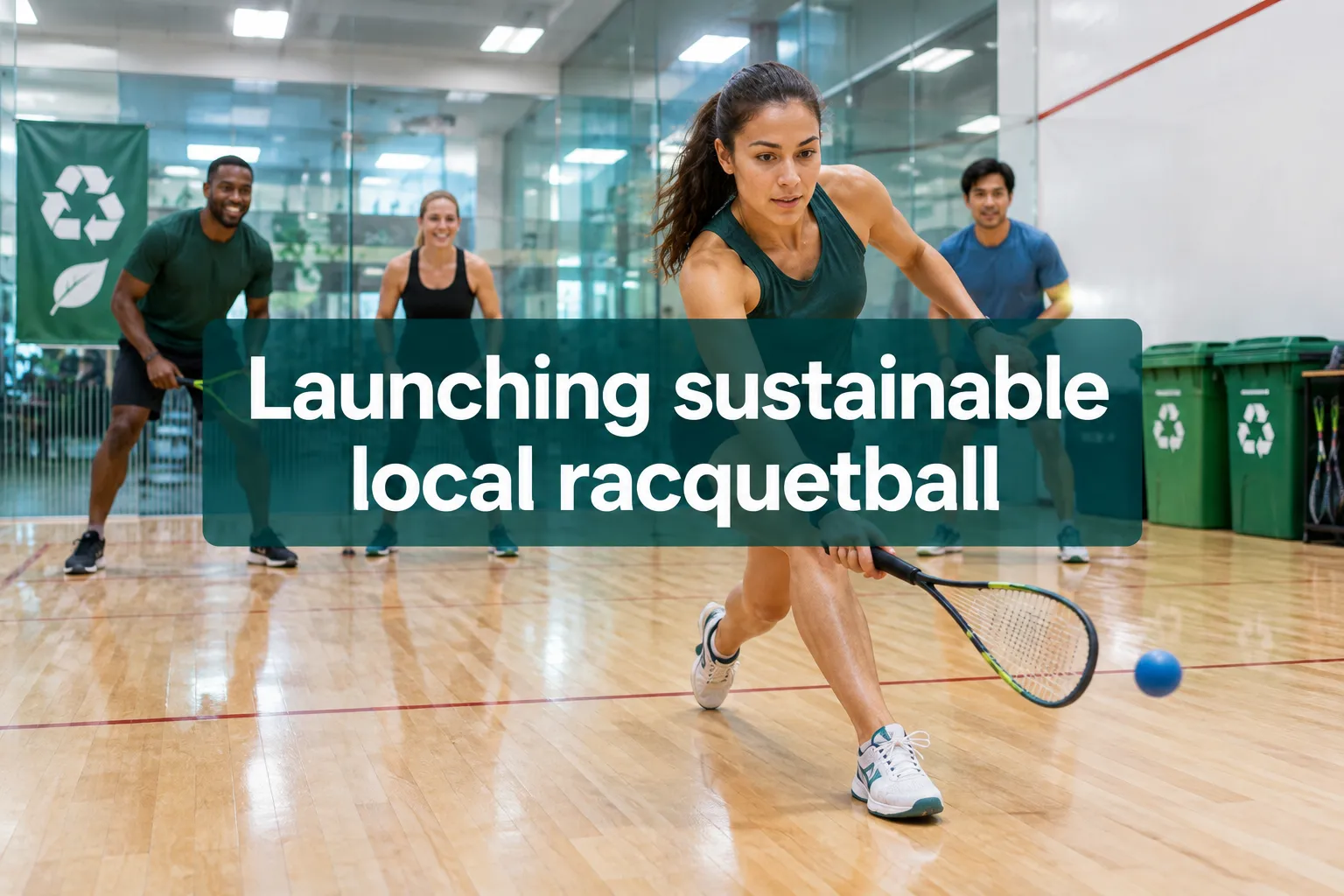
- Refillable water stations: Eliminate single-use plastic bottles at match nights
- Waste sorting: Simple labeled bins (recycling, compost, landfill) at court entrances, modeled on MLS’s zero-waste stadium initiatives [6], signal commitment and are easy to implement
- LED court lighting: If your facility hasn’t upgraded, advocate for it; LED courts use significantly less energy than older fluorescent systems
- Local sponsors: Partnering with local businesses instead of national chains reduces supply-chain emissions and keeps money in the community
Best Practices for Organizing Local Sports Leagues, and Common Mistakes
The best-run local leagues share a few habits: they communicate consistently, they plan their calendars 3-6 months ahead, and they make it easy for new players to join mid-season.
Best practices:
- Publish the full season schedule before it starts, players plan their lives around it
- Designate a backup coordinator so the league doesn’t collapse if the main organizer is unavailable
- Align your schedule with the USA Racquetball 2026 National Championship calendar [4] to avoid date conflicts and create natural feeder pathways to national events
- Celebrate milestones: first-season finals, 100th match played, first junior champion
Common mistakes when launching a sports league:
- Starting too big. A 40-player launch with four divisions sounds exciting but is logistically brutal for a first-time organizer. Start with one division and expand.
- Ignoring calendar congestion. Scheduling league nights that conflict with regional tournaments [5] splits your player pool and causes resentment.
- No written policies. Default win rules, forfeit procedures, and code of conduct should be written down before the first match, not after the first dispute.
- Skipping registration. Leagues that don’t register with USA Racquetball [1] miss out on ranking points, insurance options, and the visibility that comes from appearing in official results [5].
For a parallel look at how local clubs in other racquet sports handle tournament hosting and community building, the role of local clubs in hosting tournaments is worth reading.
How to Keep a Sports League Running Year-Round
Year-round leagues survive by varying their format across seasons and scheduling around natural calendar breaks. A four-season model works well for most climates:
- Winter: Indoor singles ladder (January, March), aligned with the USA Racquetball Indoor Nationals window [4]
- Spring: Doubles round-robin, ending before summer travel season
- Summer: Casual open-play nights or outdoor racquetball if courts are available; the 2026 Outdoor Nationals at Marina Park, Huntington Beach (July 10-12) [4] is a natural anchor event
- Fall: Competitive season with a formal playoff bracket
Key retention tactic: Host one social event per season, a cookout, a watch party for a streamed pro match, or a skills clinic. The social glue is often what keeps casual players from drifting away between competitive seasons.
State and regional events listed in USA Racquetball results [5][7] show that masters and senior participation remains strong year-round. Scheduling some daytime slots specifically for older players improves retention across age groups.
What Age Groups Should a Local Racquetball League Target?
A sustainable local league should target all age groups from the start, with juniors (under 18), adults (18-49), and masters/seniors (50+) as distinct divisions. Each group has different scheduling needs and motivations.
- Juniors: After-school and weekend slots; tie into High School Nationals pathways [3] for motivated young players
- College-age adults: Evening slots; competitive formats with ranking implications
- Working adults: Weeknight evenings, 6-9 PM; value convenience and consistent scheduling
- Masters/seniors: Daytime or early-evening slots; value social connection alongside competition
The 2026 High School Nationals spotlight [3] and strong masters participation in state championships [5] both confirm that multi-generational programming is where the sport’s growth is happening. Leagues that serve only one age group are leaving membership, and long-term sustainability, on the table.
For more on how community engagement works across racquet sports age groups, community engagement in pickleball offers a useful parallel framework.
Launching Sustainable Local Racquetball Leagues in 2026: Registration and Visibility
Registering your league and events with USA Racquetball [1] and listing them on R2Sports [2][10] is the single highest-leverage action a new organizer can take for visibility. Official registration means your players earn national ranking points, your events appear in search results for racquetball players moving to your city, and your league gains access to USA Racquetball’s insurance and governance resources.
The 2026 event calendar [4][5] shows dozens of sanctioned events across the U.S., from the SoCal Open in Fullerton to the W. Ray Williams Fall Open in Virginia to the OctoberFest Open in Texas. Local leagues that feed into this ecosystem gain credibility that standalone leagues simply can’t match.
Registration is free to start. There’s no reason to delay it until your league is “big enough.” Register early, even with a small founding group.
Conclusion: Your Next Steps for Launching Sustainable Local Racquetball Leagues in 2026
The opportunity to build a thriving, enduring racquetball community in your city is genuinely strong right now. National momentum, a structured championship calendar [4], and growing cross-sport interest all work in your favor.
Actionable next steps:
- This week: Contact two or three local facilities (YMCA, university rec center, athletic club) about court availability and block-booking rates
- Within 30 days: Recruit your founding group of 12-20 players using social media, gym flyers, and a free intro clinic
- Before your first season: Register with USA Racquetball [1] and create your league on R2Sports [2]; set your season calendar around the 2026 national event schedule [4]
- From day one: Implement basic eco-friendly practices, refillable water stations, recycling bins, local sponsors, so sustainability is baked in, not bolted on later
- After your pilot season: Gather player feedback, add an age division you didn’t have before, and stream your finals match on YouTube
For additional inspiration on building racquet sports communities from the ground up, the guides on finding local pickleball courts and clubs and the importance of joining local sports groups translate well to the racquetball context.
The leagues that will still be running in 2030 are the ones being built thoughtfully right now. Start small, register officially, go green from the start, and let the sport do the rest.
FAQ
How long does it take to launch a racquetball league from scratch? Most organizers can go from idea to first match night in 6-10 weeks if courts are available and a founding player group is in place. Registration with USA Racquetball [1] typically takes a few days.
Do I need a nonprofit status to run a local racquetball league? No. Many small leagues operate informally under a parent organization like a YMCA, or as a simple LLC. Nonprofit status becomes useful if you want to apply for grants or accept tax-deductible donations.
Can a racquetball league share courts with other sports? Yes, and it’s encouraged. Co-locating with pickleball, squash, or tennis clubs reduces per-sport facility costs and opens cross-promotion opportunities. Some racquetball courts can be adapted for squash or padel with minor modifications.
What is R2Sports and why does it matter for local leagues? R2Sports [10] is the primary tournament and league management platform used by USA Racquetball. Listing your events there gives your league national visibility, integrates with official rankings, and makes registration easy for traveling players.
How do I handle players who skip matches without notice? Write a forfeit policy before your first season starts. A common approach: one unexcused absence results in a forfeit loss; two results in removal from the current season’s standings. Clear policies prevent most disputes.
What eco-friendly changes make the biggest difference for a small league? Eliminating single-use plastic bottles (via refillable water stations) and setting up basic waste-sorting bins are the two highest-visibility, lowest-cost changes. Both signal commitment to sustainability without requiring significant investment.
Should a new league charge membership fees or just per-match fees? A combination works best. A modest seasonal membership fee covers fixed costs (software, equipment, admin), while a small per-match court fee split keeps variable costs fair. Relying only on per-match fees makes budgeting unpredictable.
How do I get junior players involved in a new league? Partner with local middle and high schools, offer a student discount, and schedule junior-friendly weekend morning slots. Tying junior participation to pathways toward USA Racquetball High School Nationals [3] gives motivated young players a clear competitive goal.
Is it worth streaming league matches online? Yes, even for small leagues. A free YouTube or Facebook Live stream of your finals match builds community, attracts new players, and demonstrates activity to potential sponsors. The pro circuit’s move toward subscription streaming [8] shows this is the direction the sport is heading.
What’s the biggest mistake new league organizers make? Trying to do everything alone. Designate roles, a scheduling coordinator, a communications lead, a court liaison, before your first season. Shared ownership is what keeps leagues running when life gets busy.
References
[1] USA Racquetball – https://www.usaracquetball.com/ [2] USA Racquetball Events – https://www.usaracquetballevents.com/ [3] Spotlight: 2026 USA Racquetball High School National Championships – https://www.usaracquetball.com/news/2026/january/18/spotlight-2026-usa-racquetball-high-school-national-championships [4] USA Racquetball’s 2026 National Championship Calendar – https://www.usaracquetball.com/news/2025/september/21/usa-racquetball-s-2026-national-championship-calendar [5] USA Racquetball Events Results – https://www.usaracquetballevents.com/results.asp [6] MLS Celebrates Earth Day: Greener Goals Week of Service 2026 – https://www.mlssoccer.com/news/mls-celebrates-earth-day-greener-goals-week-of-service-2026 [7] USA Racquetball Events Michigan Results – https://www.usaracquetballevents.com/michigan/results.asp?otherStatesOnly=YES [8] Pro Racquetball Stats Blog – https://blog.proracquetballstats.com/index.php/category/usa/ [9] USA Racquetball Events California Results – https://www.usaracquetballevents.com/California/results.asp?otherStatesOnly=YES [10] R2 Sports Current Events – https://www.r2sports.com/r2-sports-current-events.asp?sportID=1