
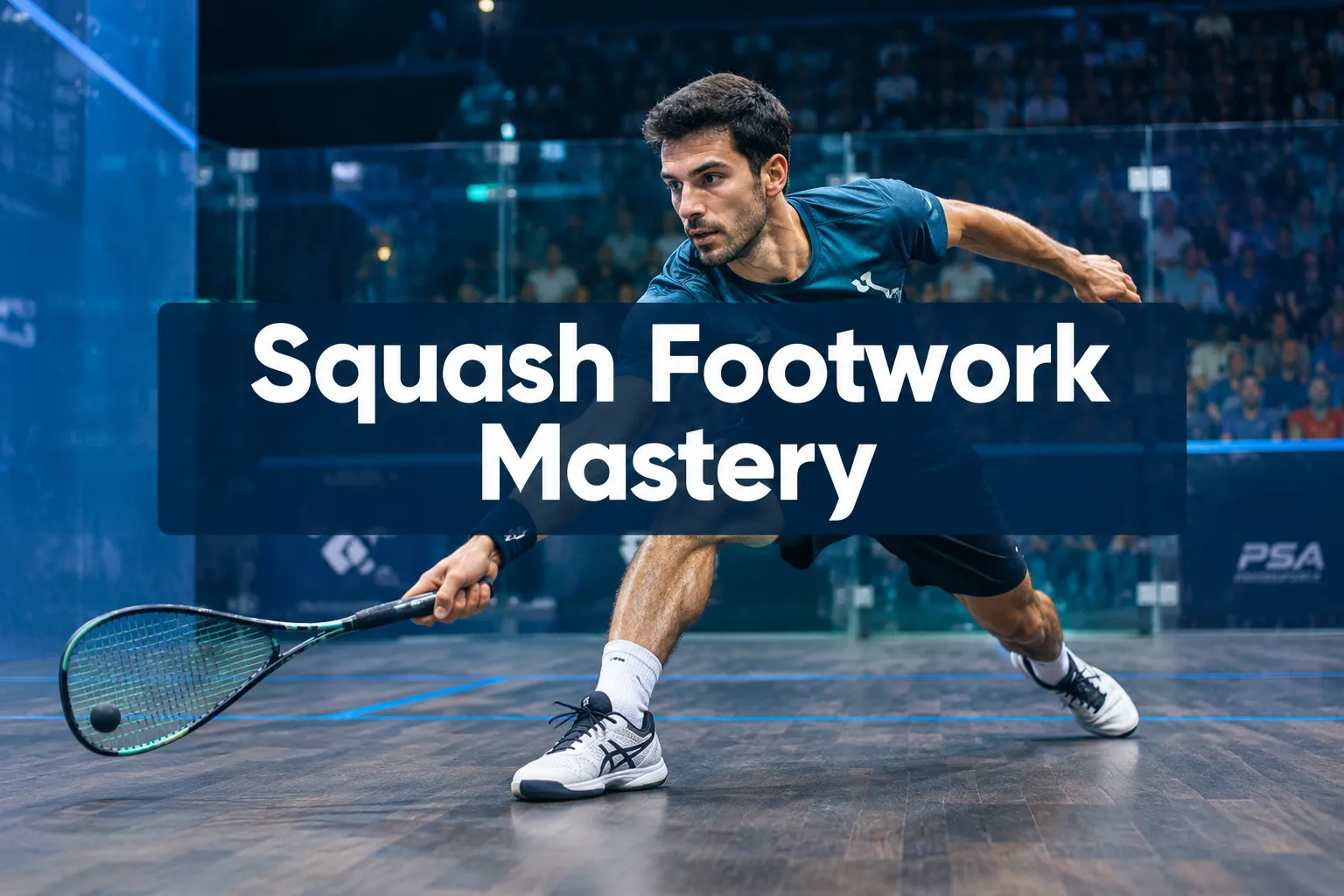
Squash Footwork Mastery: Modern Movement Patterns, Off-the-Tee Recovery, and Injury-Resilient Training
Last updated: October 17, 2026
Quick Answer: Squash footwork mastery combines T-centric movement, precise split-step timing, and controlled lunging to reach every corner efficiently and recover safely. Modern players move differently than older generations, they prioritize deceleration and court geometry over raw speed. With the right drills, strength work, and footwear, most competitive amateurs can build noticeably better movement within 6-12 weeks.
Key Takeaways
- The T-position is your home base, every movement pattern starts and ends there
- Modern squash footwork emphasizes controlled deceleration, not just acceleration
- Off-the-T recovery is a trainable skill, not just an athletic gift
- Poor footwork is one of the leading contributors to squash-related knee, ankle, and calf injuries [1]
- Ghosting drills (solo movement patterns without a ball) are the most efficient way to build court movement
- Lateral speed improves fastest when combined with lunge strength and hip mobility work
- Players over 40 can absolutely improve footwork, the approach just shifts toward load management and mobility
- Squash footwork differs significantly from tennis footwork in stance width and recovery angle
- Proper squash shoes (not tennis or running shoes) are non-negotiable for safe movement [3]
- Most beginners can reach functional footwork competence in 8-12 weeks of focused practice
What Is Proper Squash Footwork Technique?
Good squash footwork is built on three core principles: starting from the T, moving efficiently to the ball, and recovering back before your opponent hits. The foundation is a low, balanced athletic stance with weight on the balls of the feet and knees slightly bent.

Here’s what proper technique looks like in practice:
- Split step: A small, two-footed hop timed to your opponent’s swing. This loads your legs and lets you push off in any direction instantly.
- Pivot and drive: From the T, pivot on the foot closest to your target corner and drive with the opposite leg.
- Lunge to the ball: The hitting lunge should land with your knee directly over (not past) your ankle to protect the joint. [8]
- Recovery step: After hitting, push back off the lunge foot and return to the T using crossover steps, not shuffle steps.
Common mistake: Many beginners skip the split step entirely and just react when they see the ball move. Without that loading moment, your first step is always late.
How Do Modern Squash Players Move Differently Than Traditional Players?
Modern pro squash movement is more geometry-driven and less sprint-dependent than the style common 20 years ago. Today’s top players use shorter, more controlled steps near the ball rather than long, lunging strides from a distance.
Key differences in the modern approach:
| Traditional Style | Modern Style |
|---|---|
| Long strides to the ball | Short, precise steps near contact point |
| Emphasis on raw speed | Emphasis on deceleration control |
| Wide, static stance at T | Dynamic, ready-position stance |
| Recovery after every shot | Anticipatory recovery mid-rally |
| Linear movement paths | Curved, arc-based movement paths |
The biggest shift is the focus on deceleration. Getting to the ball fast matters less if you arrive off-balance. Modern movement coaching teaches players to slow down into the shot, not crash into it. This also dramatically reduces injury risk, especially to the knees and ankles. [1]
Best Footwork Drills for Squash Beginners
For beginners, the single most effective drill is ghosting, moving through the four corners of the court without a ball, focusing entirely on footwork pattern and T-recovery. Start slow, build accuracy, then add speed.
Starter drill sequence (15-20 minutes, 3x per week):
- Two-corner ghost: Move front-forehand to front-backhand and back to T, 10 reps each side
- Four-corner ghost: Hit all four corners in sequence (front-forehand → rear-backhand → front-backhand → rear-forehand), recover to T each time
- Random ghost: Have a partner call out corners while you move, this trains reaction, not just pattern memory [6]
- Lunge holds: Lunge to each corner and hold for 2 seconds before recovering, reinforcing knee-over-ankle alignment
For more movement drills that apply across racket sports, check out this guide on improving footwork drills to enhance your movement on the court.
Choose this approach if: You’re in your first 6 months of squash and your shots are decent but you’re always late to the ball.
How to Recover Faster After Hitting the Ball in Squash
Fast off-the-T recovery comes from two things: pushing hard off the lunge foot immediately after contact, and already knowing where you’re going before you finish the shot. Most slow recoveries happen because players watch the ball instead of moving.
Recovery mechanics, step by step:
- Hit the ball and immediately load your lunge foot
- Push back with that foot, don’t wait to watch the shot
- Use crossover steps (not shuffles) for the first 2-3 strides back to T
- Arrive at the T in a ready position before your opponent makes contact
Drill for faster recovery: After each ghosting rep, add a verbal cue (“T!”) to trigger your push-back. Over time, the recovery becomes automatic. [6]
“The fastest players in squash aren’t the ones who sprint to the ball, they’re the ones who are already moving back before the ball leaves the wall.”
Why Is Court Positioning Important in Squash?
Court positioning determines how much court you have to cover and how much pressure you put on your opponent. A player who controls the T forces their opponent into longer, harder retrieval runs.
Good positioning means:
- Returning to within one step of the T after every shot
- Adjusting your T position slightly based on where your opponent is (not always dead center)
- Never camping in the back corners, that’s where rallies are lost
For players who want to understand how positioning principles transfer across racket sports, this article on positioning and movement for new players is a solid read.
Squash Footwork Exercises to Prevent Injuries
Bad footwork causes a large share of squash injuries, particularly to the knees, ankles, calves, and Achilles tendon [1] [2]. The good news is that most of these injuries are preventable with the right off-court work.
Injury-resilient training priorities:
- Calf raises (single-leg): Builds Achilles tendon resilience, which is one of the most commonly injured structures in squash [3]
- Lateral band walks: Strengthens hip abductors, which stabilize the knee during lunges
- Ankle circles and toe mobility: Foot and toe mobility is a foundation for safe, fluid movement [10]
- Eccentric lunge training: Lowering slowly into a lunge builds deceleration strength, not just power
- Hip flexor stretching: Tight hip flexors restrict stride length and increase lower back strain
Before every session: A 5-10 minute dynamic warm-up (leg swings, high knees, lateral shuffles) is non-negotiable. Static stretching before play actually reduces power output, save it for after. For a practical warm-up framework that applies to racket sports broadly, see this guide on essential warm-up routines for preventing injuries.
Can Bad Footwork Cause Squash Injuries?
Yes, poor footwork mechanics are directly linked to the most common squash injuries. When players lunge with the knee caving inward, land flat-footed, or skip the split step, they place excessive stress on joints that aren’t designed for those loads. [1] [2]
The most common movement-related injuries in squash include:
- Knee ligament strains from deep lunges without proper alignment
- Ankle sprains from planting on uneven or unexpected foot angles
- Calf and Achilles strains from explosive push-offs without adequate warm-up [3]
- Lower back pain from poor hip mobility and overextended lunges
The fix isn’t to lunge less, it’s to lunge better. Keeping the knee stacked over the ankle, landing on a slightly bent knee, and building progressive lunge strength off-court are the key corrections. [8]
What Shoes Are Best for Squash Footwork?
Squash-specific shoes are the right choice, not tennis shoes, not running shoes, and definitely not cross-trainers. Squash shoes are built with a low profile, non-marking gum sole, and lateral support designed for the court’s quick direction changes. [3]
What to look for in squash shoes:
- Gum rubber sole for grip on hardwood or glass-backed courts
- Low heel-to-toe drop for better court feel and ankle stability
- Reinforced lateral sidewall to handle frequent side-to-side cuts
- Snug midfoot fit to prevent the foot from sliding inside the shoe during lunges
For a broader look at how footwear affects performance across racket sports, this article on how the right shoes can improve your game covers the key considerations well.
Edge case: If you play on a glass-backed court (common in club and tournament settings), check that your shoes are approved for that surface, some gum soles leave marks.
How Do Pro Squash Players Practice Their Movement?
Professional squash players dedicate significant solo practice time to movement, often more time than to shot-making. Ghosting sessions, court sprints, and structured footwork circuits are standard parts of their weekly training. [6]
A typical pro movement session might include:
- 20-30 minutes of structured ghosting (timed sets with rest intervals)
- Specific corner focus based on weaknesses identified from match video
- Resistance band movement work to build lateral power
- Cool-down mobility work targeting hips, ankles, and calves
The key insight for competitive amateurs: you don’t need to train like a pro, but borrowing the structure helps. Even 2-3 dedicated footwork sessions per week (15-20 minutes each) will produce visible improvement within a month.
How to Improve Lateral Movement Speed in Squash
Lateral speed in squash improves most when you train the specific movement patterns used on court, not just general fitness. Running more won’t make you faster sideways, lateral-specific drills and hip strength will.
Effective lateral speed builders:
- Side-to-side cone drills (2-3 meters apart, 10 reps, 3 sets)
- Lateral band walks with a resistance band above the knees
- Crossover step drills focusing on hip rotation, not just leg speed
- Court sprint intervals, full-width court sprints with 30-second rest
For players who want to see how lateral movement training principles apply across racket sports, the guide on footwork in pickleball drills to enhance agility and positioning offers useful crossover drills.
Squash Footwork Training for Players Over 40
Players over 40 can absolutely improve their squash footwork, the approach just needs to be smarter, not harder. The main adjustments are longer recovery between sessions, more emphasis on mobility, and progressive load management for the joints.
Practical adjustments for 40+ players:
- Replace high-rep ghosting sets with shorter, higher-quality reps (quality over volume)
- Add 10 minutes of hip and ankle mobility work before every session
- Build lunge strength gradually, start with bodyweight, add load only when form is solid
- Rest 48 hours between intense footwork sessions to allow tendon recovery
- Prioritize Achilles and calf health, these structures take longer to adapt in older athletes [3]
The goal isn’t to move like a 22-year-old. It’s to move efficiently, stay injury-free, and keep improving. Many 40+ club players have dramatically better footwork than younger beginners simply because they’ve learned to move smart.
What’s the Difference Between Squash and Tennis Footwork?
Squash and tennis footwork share the split step but diverge significantly after that. The court size, ball speed, and wall geometry create completely different movement demands.
| Feature | Squash Footwork | Tennis Footwork |
|---|---|---|
| Court size | Much smaller, tighter steps | Larger, longer strides |
| Recovery target | T-position (center) | Baseline or net position |
| Lunge depth | Deeper, more frequent | Less frequent, more varied |
| Lateral vs. linear | Heavily lateral | Mix of lateral and linear |
| Wall interaction | Must anticipate ball off walls | No wall factor |
| Stance at contact | Often open or semi-open | Often closed or semi-open |
For crossover players: If you’re coming from tennis, your biggest adjustment will be shortening your strides and learning to recover to a fixed point (the T) rather than tracking the ball. Your split step timing will transfer well, the recovery habits won’t.
How Long Does It Take to Master Squash Footwork?
Functional footwork competence, meaning you can reach most balls and recover to the T consistently, is achievable in 6-12 weeks for most beginners who practice deliberately. Full movement mastery, where footwork becomes automatic under match pressure, typically takes 1-2 years of consistent play and focused drills.
Realistic timeline:
- Weeks 1-4: Learn the T-position, split step, and basic corner patterns through ghosting
- Weeks 5-12: Build consistency, add speed, and start integrating footwork into live play
- Months 4-12: Refine under pressure, address specific weaknesses, add strength work
- Year 2+: Footwork becomes automatic; focus shifts to anticipation and positioning
The biggest accelerator is deliberate practice, not just playing more games, but setting aside specific time for movement drills separate from match play. [6]
Common Footwork Mistakes in Squash
Most footwork errors fall into a small number of patterns. Recognizing yours is the first step to fixing it.
The most common mistakes:
- Skipping the split step: Leads to late, reactive movement instead of proactive positioning
- Watching the ball instead of moving: Delays recovery by 0.5-1 second, huge at club level
- Lunging with the knee past the toes: Increases knee strain significantly [1] [8]
- Shuffling back to the T: Slower than crossover steps and leaves you flat-footed
- Standing too upright: A higher center of gravity slows your first step
- Not bending the knees on landing: Flat-footed landings spike joint impact forces [2]
Quick fix drill: Film yourself from the side during a ghosting session. Most players are shocked at how upright they stand and how late their split step fires.
Conclusion
Squash footwork mastery isn’t about being the fastest person on the court, it’s about being in the right place, at the right time, without breaking down physically. The modern approach to movement patterns, off-the-T recovery, and injury-resilient training gives every player a clear path to improvement, regardless of age or current level.
Your next steps:
- Add two 15-minute ghosting sessions to your weekly routine this week
- Check your lunge mechanics, knee over ankle, not past the toes
- Invest in proper squash shoes if you haven’t already
- Start single-leg calf raises off-court to build Achilles resilience
- Film one session to spot your biggest footwork habit to fix
Whether you’re new to squash or a seasoned club player looking to sharpen your movement, the racket sports community here at Rally Racket has your back. Small, consistent changes to your footwork will pay off in every rally, and keep you playing injury-free for years to come.
FAQ
What is the T-position in squash? The T-position is the center of the court where the service box lines form a T-shape. It’s the ideal recovery position because it gives you equal access to all four corners of the court.
How often should I practice squash footwork drills? Two to three dedicated footwork sessions per week (15-20 minutes each) is enough to see clear improvement within 4-6 weeks. More is not always better, recovery matters too.
Is ghosting effective for improving squash movement? Yes. Ghosting, moving through court corners without a ball, is the most efficient way to build movement patterns because it removes the distraction of shot-making and lets you focus entirely on footwork.
Can I use tennis shoes for squash? No. Tennis shoes have a different sole pattern and lateral support profile. Squash shoes are specifically designed for the quick direction changes and court surface of squash. Using the wrong shoes increases injury risk. [3]
Why do my knees hurt after squash? Knee pain after squash is often linked to deep lunges with poor alignment, specifically the knee caving inward or extending past the toes. Strengthening hip abductors and practicing controlled lunge mechanics can help. See a physiotherapist if pain persists. [1]
What’s the best way to improve squash footwork at home? Solo ghosting in a clear space (you don’t need a court), lateral band walks, single-leg calf raises, and hip mobility exercises are all effective off-court footwork builders.
How does squash footwork differ from badminton footwork? Badminton uses more explosive jumping and a wider base for overhead shots. Squash footwork is more lateral and lunge-based, with a tighter recovery to a fixed T-position. The split step is common to both.
Is squash footwork harder to learn than tennis footwork? Most crossover players find squash footwork harder initially because the court is smaller, the ball is faster off the walls, and the recovery point (the T) is fixed. Tennis allows more varied positioning. With focused practice, the adjustment typically takes 4-8 weeks.
What muscles does squash footwork train? Squash footwork primarily works the quads, glutes, calves, hip abductors, and core. The Achilles tendon and ankle stabilizers also take significant load. [2]
How do I stop being late to the ball in squash? The most common cause of late arrival is skipping the split step. Timing your split step to fire as your opponent’s racket makes contact will immediately improve your first-step reaction.
References
[1] Common Squash Injuries – https://share.upmc.com/2024/04/common-squash-injuries/ [2] Common Squash Injuries – https://sportsfoundation.org/common-squash-injuries/ [3] Squash – https://physioworks.com.au/sports/racquet/squash/ [6] Court Movement Drills – https://campsquash.com/2025/03/24/court-movement-drills/ [8] The Biomechanics Of The Squash Swing Forehand And Backhand – https://squashchamps.com/article/the-biomechanics-of-the-squash-swing-forehand-and-backhand [10] Injury Prevention Mobility Prerequisites For Playing Squash – https://squashmagazine.com/2016/08/injury-prevention-mobility-prerequisites-for-playing-squash/