South American Games 2026: Argentina’s XIII South American Games and Racquetball’s Growing Latin American Presence
Last updated: November 6, 2026
Quick Answer: The XIII South American Games, branded “Santa Fe 2026”, ran from September 12 to 26, 2026, across Rosario, Santa Fe, and Rafaela, Argentina. More than 4,000 athletes from 15 nations competed across 43 sports, with racquetball featured as a core event at Parque de la Independencia in Rosario. The Games confirmed Latin America’s status as the heartland of competitive racquetball.
Key Takeaways
- 🇦🇷 Santa Fe 2026 hosted 4,000+ athletes from 15 South American countries in 43 sports and roughly 60 disciplines [1][2]
- 📅 Competition ran September 12-26, 2026; the opening ceremony was held at the National Flag Monument in Rosario [3]
- 💰 Argentina invested over US$90 million in Games infrastructure, including ~US$75 million from CAF development financing [from source material]
- 🏸 Racquetball competition ran September 21-26 at ISEF No. 11, Parque de la Independencia, Rosario [4]
- 🌎 Five nations competed in racquetball: Argentina, Bolivia, Chile, Ecuador, and one additional South American country, across seven medal events [5]
- 🥇 Argentina topped the racquetball medal standings, capitalizing on home-court advantage [4]
- 📺 Every event streamed live and free on the Panam Sports Channel [1]
- 🎮 Esports were included for the first time, signaling a push to attract younger audiences [6]
- 🏅 Argentina finished second overall in the medal table with 293 total medals (81 gold, 87 silver, 125 bronze) [7]
When and Where Did the South American Games 2026 Take Place?
The XIII South American Games ran from September 12 to 26, 2026, spread across three Argentine cities: Rosario, Santa Fe, and Rafaela. Some sports also took place in Paraná, Mar del Plata, and Buenos Aires.
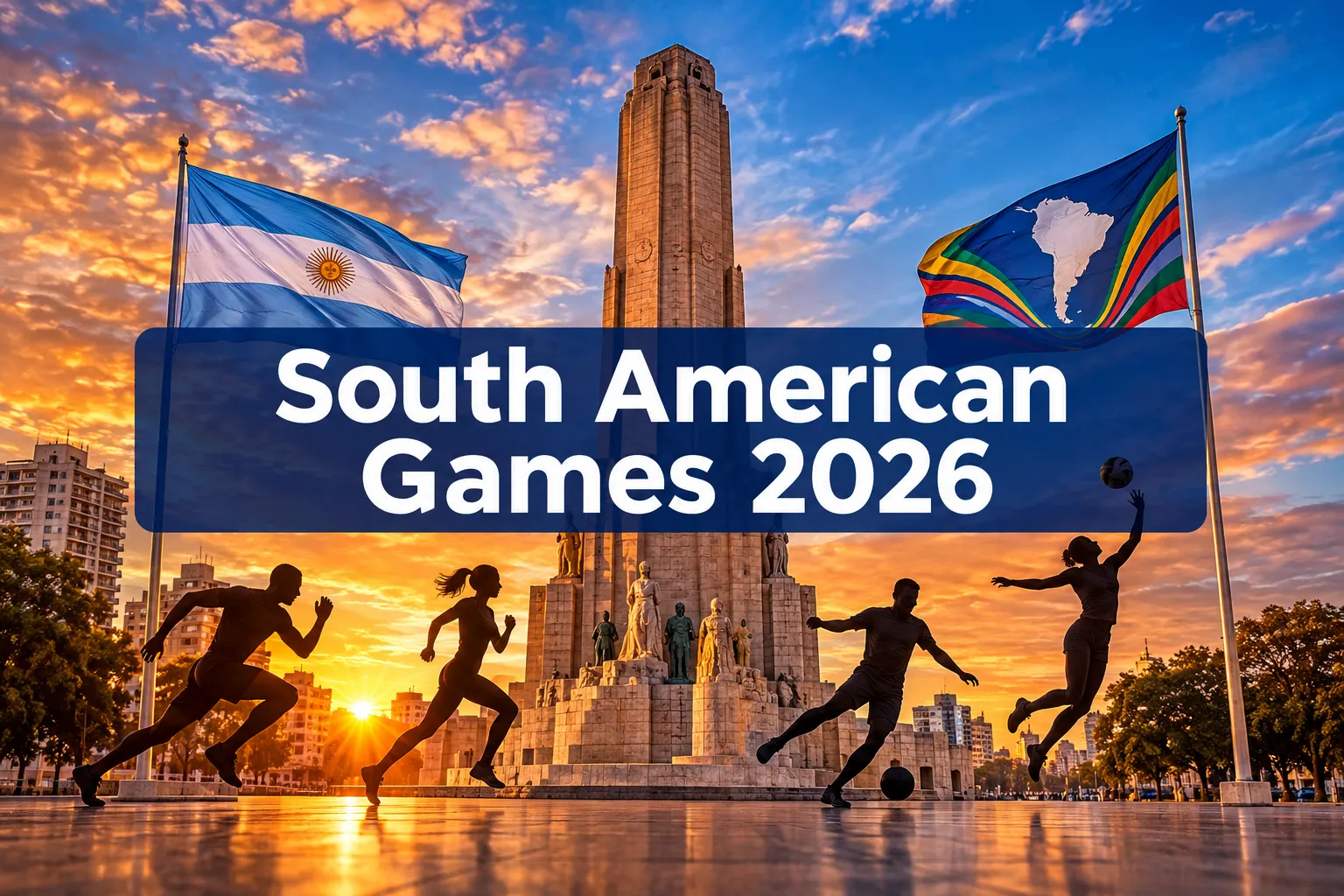
The opening ceremony was held at the Monumento Nacional a la Bandera (National Flag Monument) in Rosario on September 12, a free public event that provincial authorities called one of the most significant sporting occasions in Santa Fe’s history [3]. The two-week program brought together more than 4,000 athletes competing for medals in 43 sports and around 60 disciplines [1][2].
Santa Fe province had previously hosted other ODESUR (South American Sports Organization) events, which made it a logical choice as a consolidated regional hub [8].
What Is the Difference Between the South American Games and the Pan American Games?
The South American Games are a regional multi-sport event exclusively for the 15 nations of South America, organized by ODESUR. The Pan American Games, organized by Panam Sports, include all 41 National Olympic Committees across North, Central, and South America, a much larger field.
| Feature | South American Games | Pan American Games |
|---|---|---|
| Governing body | ODESUR | Panam Sports |
| Participating nations | ~15 (South America only) | ~41 (all Americas) |
| Frequency | Every 4 years | Every 4 years |
| Scale (Santa Fe 2026) | 4,000+ athletes, 43 sports | 6,000+ athletes, 60+ sports |
| Broadcast (2026) | Panam Sports Channel (free) | Varies by edition |
Panam Sports characterized Santa Fe 2026 as South America’s largest multi-sport event of the year [1]. Think of the South American Games as the continent’s own proving ground, where emerging sports like racquetball often get more visibility than they would in a bigger, crowded Pan American program.

How Is Argentina Preparing, and Performing, as Host?
Argentina committed over US$90 million to Games-related infrastructure, with approximately US$75 million financed by CAF, Banco de Desarrollo de América Latina y el Caribe, plus contributions from the provincial treasury [from source material]. An ODESUR inspection commission reviewed ongoing venue works as recently as July 2026, treating the Games as a long-term catalyst for sports facility upgrades across all three host cities [from source material].
On the field, Argentina delivered: the host nation finished second in the overall medal table with 81 gold, 87 silver, and 125 bronze medals, 293 total. By September 23, Argentina had already surpassed 200 medals, showing consistent depth across sports [7]. Panam Sports named Argentina its “NOC of the Month” in October 2026, citing both hosting success and athletic performance.
Common mistake to avoid: Assuming the host nation always wins the overall table. At Santa Fe 2026, Brazil finished first, with Argentina shining brightly in second [7].
What Sports Are Included in the South American Games 2026?
Santa Fe 2026 featured 43 sports and approximately 60 disciplines, ranging from traditional Olympic events like athletics, swimming, and gymnastics to regional favorites and emerging sports [1][2].
Notably, esports were included in the official program for the first time, running September 12-16 in coordination with ODESUR, the provincial government, and the Argentine Olympic Committee [6]. This signals a broader strategy to modernize the event and appeal to younger audiences, a rising tide that also lifts visibility for niche sports like racquetball.
Racquetball was a core part of the official schedule, not a demonstration sport, reinforcing its status in the South American sports ecosystem [4][9].
How Does Racquetball Fit Into the South American Games 2026?
Racquetball at Santa Fe 2026 ran from September 21 to 26 at Instituto Superior de Educación Física (ISEF) No. 11, inside Parque de la Independencia in Rosario [4][5][9]. The International Racquetball Federation (IRF) described the event as bringing “many of the world’s top athletes” to a dedicated venue integrated into a major multi-sport Games setting [9].
Seven medal events were contested:
- Men’s open singles
- Women’s open singles
- Men’s open doubles
- Women’s open doubles
- Mixed open doubles
- Men’s team
- Women’s/combined team [5]
A total of 26 racquetball athletes competed across these events, representing five nations: Argentina, Bolivia, Chile, Ecuador, and one additional South American country [5]. Each country could enter two players in singles and one team per doubles/mixed event, a format designed to keep the field high-quality within a busy multi-sport schedule.
Argentina topped the racquetball medal standings on home soil, with athletes such as Natalia Méndez and Diego García standing out in doubles competition [4].
Why Is Racquetball So Popular in Latin America?
Racquetball took root in Latin America during the 1980s and 1990s, partly because the sport requires relatively modest infrastructure, a standard enclosed court, compared to field sports. Countries like Bolivia, Mexico, and Argentina built strong club cultures early, and those foundations compound over decades.
Bolivia and Argentina have historically been among the most competitive racquetball nations in the Americas. The South American Games provide a continental platform that sustains that culture by giving athletes a clear competitive goal every four years.
The IRF consistently frames the South American Games as a strategic growth platform for the sport, not just a competition, but a way to cement racquetball’s case for inclusion in future large multi-sport events [9]. If you’re curious how racquet sports in general build grassroots communities, the dynamics are similar to what club leaders describe when growing the pickleball community.
How Is Racquetball Different from Squash?
Racquetball and squash are both played in enclosed courts, but they’re distinct sports. The clearest differences:
- Ball: Racquetball uses a larger, bouncier hollow rubber ball; squash uses a smaller, lower-bounce ball that must warm up during play.
- Racquet: Racquetball racquets are shorter and stiffer; squash racquets are longer with a smaller head.
- Court: A racquetball court is slightly wider and uses all four walls plus the ceiling. Squash has a “tin” (a metal strip at the bottom of the front wall) that marks a fault zone.
- Scoring: Racquetball is played to 15 points (rally scoring); squash typically uses point-a-rally scoring to 11.
- Pace: Racquetball rallies tend to be faster because of the bouncier ball and ceiling play.
Understanding these differences matters for fans attending the Games, racquetball’s faster pace and ceiling shots make it visually exciting for casual spectators.
For those interested in how other fast-paced racquet sports develop strategy, beginner racquet sport strategies follow some of the same court-positioning principles.
How Many Countries Compete in the South American Games, and Which Are Best at Racquetball?
The South American Games typically include 14 to 15 nations, all members of ODESUR. Santa Fe 2026 had 15 participating countries [1][2].
For racquetball specifically, five nations competed at Santa Fe 2026 [5]. The sport’s footprint in the region is solid but still expanding, not every South American country fields a competitive racquetball program yet.
Historically dominant racquetball nations in South America:
- Bolivia, long one of the top racquetball countries in the hemisphere
- Argentina, particularly strong on home soil and in doubles events
- Chile and Ecuador, consistent competitors with growing programs [4]
Bolivia and Mexico (at the Pan American level) have traditionally set the benchmark. The South American Games allow Bolivia and Argentina to showcase depth that often gets overlooked in global coverage.
How Do Athletes Qualify for Racquetball at the South American Games?
Qualification is managed through ODESUR’s national federation allocation process. Each National Olympic Committee nominates athletes through their national racquetball federation, and ODESUR sets entry limits per country per event.
At Santa Fe 2026, the entry format allowed two players per country in singles and one team per doubles/mixed event. This keeps the field manageable within a multi-sport schedule while ensuring genuine international competition. Athletes typically qualify through national championships and regional rankings compiled by their federation in the months leading up to the Games.
Where Can Fans Watch the South American Games 2026?
Every event at Santa Fe 2026 streamed live and free on the Panam Sports Channel [1]. This comprehensive broadcast approach extended reach for lower-profile sports like racquetball to audiences across the Americas and globally.
For racquetball specifically, the IRF promoted the Games through its own news and event channels, directing fans to official streams [9][10]. If you missed the live coverage, Panam Sports typically archives event footage on its platform after the competition concludes.
How Do I Get Tickets to South American Games 2026 in Argentina?
Ticket sales for Santa Fe 2026 were handled through the official Games organizing committee, with information distributed via the Santa Fe provincial government’s communications channels [3][8]. The opening ceremony at the National Flag Monument was a free public event [3], meaning anyone in Rosario could attend at no cost.
For individual sport venues, ticket availability varied by event. Racquetball, as a niche sport within the Games, typically offered free or low-cost access to encourage attendance. Official information was available through santafe.gov.ar and the Panam Sports website.
Is Racquetball Growing Faster Than Other Sports in Latin America?
The honest answer: racquetball is growing steadily, but it isn’t the fastest-growing racquet sport in absolute numbers. Pickleball, for example, has seen explosive growth globally. However, racquetball’s growth in Latin America is structurally different, it’s consolidating an already strong base rather than starting from zero.
The IRF’s positioning of Santa Fe 2026 as a growth platform [9] reflects a deliberate strategy: use high-visibility multi-sport events to recruit new athletes, secure broadcast exposure, and build the case for broader inclusion (such as future Pan American Games editions). The integration of esports at Santa Fe 2026 also creates shared digital infrastructure and younger audiences that racquetball can tap into [6].
For context on how other racquet sports leverage grassroots momentum, it’s worth reading about the origins and growth of pickleball, the dynamics of community-driven sport growth apply across racquet disciplines. The right footwear and equipment also plays a role in making any court sport accessible to beginners.
FAQ
Q: What is the official name of the 2026 South American Games? The XIII South American Games, officially branded “Santa Fe 2026,” hosted across Rosario, Santa Fe, and Rafaela, Argentina [2].
Q: How many athletes competed at Santa Fe 2026? More than 4,000 athletes from 15 South American nations [1].
Q: Was racquetball an official sport at Santa Fe 2026? Yes, racquetball was a core official sport, not a demonstration event, with seven medal categories [4][5].
Q: Who organized the South American Games? ODESUR (Organización Deportiva Suramericana) governs the Games. Panam Sports provided broadcast and promotional support [1][2].
Q: How did Argentina perform overall at Santa Fe 2026? Argentina finished second in the medal table with 81 gold, 87 silver, and 125 bronze medals, totaling 293 medals [7].
Q: Which country won the most medals at Santa Fe 2026? Brazil finished first in the overall standings [7].
Q: How many racquetball events were held at Santa Fe 2026? Seven events: men’s singles, women’s singles, men’s doubles, women’s doubles, mixed doubles, men’s team, and women’s/combined team [5].
Q: Where exactly was racquetball played at the Games? At ISEF No. 11, located within Parque de la Independencia in Rosario [4][9].
Q: Was the South American Games broadcast free to watch? Yes, all events streamed live and free on the Panam Sports Channel [1].
Q: Did any new sports debut at Santa Fe 2026? Esports made their official debut in the Games program, running September 12-16 [6].
Conclusion
The South American Games 2026: Argentina’s XIII South American Games and Racquetball’s Growing Latin American Presence delivered on every front, a well-funded host, a packed multi-sport program, and a racquetball competition that brought five nations and 26 elite athletes to Rosario’s courts. Argentina’s US$90 million infrastructure investment and second-place medal haul signal that the country is cementing itself as a serious force in South American sport, on and off the court.
For racquetball specifically, Santa Fe 2026 wasn’t just a competition, it was a strategic statement. The IRF’s framing of the Games as a growth platform, combined with free global streaming and integration into a modern multi-sport event that now includes esports, gives the sport real tools to expand its Latin American footprint.
What to do next:
- Follow the IRF at internationalracquetball.com for qualification updates and upcoming continental events
- Watch archived footage on the Panam Sports Channel to study elite South American play
- Check your national federation’s calendar, the South American Games racquetball circuit feeds directly into Pan American-level competition
- Share this article with coaches and players who want context on where Latin American racquetball stands heading into the next Olympic cycle
References
- Just 10 Days to Go Santa Fe 2026 South American Games Set to Kick Off with Every Moment Live and Free on the Panam Sports Channel. panamsports.org.
- 2026 South American Games. wikipedia.org.
- Noticia. santafe.gov.ar.
- Racquetball at the 2026 South American Games. wikipedia.org.
- internationalracquetball.com.
- Noticia. santafe.gov.ar.
- Santa Fe 2026 Brazil Rules Argentina Shines at Home and Chile Edges Venezuela in a Thriller for Fourth. panamsports.org.
- Noticia. santafe.gov.ar.
- Feed. internationalracquetball.com.
- News. internationalracquetball.com.