Building a Home Squash57 Court: Budget Setup, Safety Tips, and 2026 Gear Essentials
Last updated: November 14, 2026
Quick Answer: Building a home Squash57 court means following standard World Squash Federation singles court dimensions (9,750 mm × 6,400 mm), since Squash57 is fully “plug-and-play” on any regular squash court. [1][2] A garage or basement conversion is the most realistic DIY option for most homes, with per-player gear costs in 2026 running roughly $120,$200 USD for a solid starter kit. Safety gear, especially certified eye protection, is non-negotiable.
Key Takeaways
- Squash57 uses a standard squash court, no special walls or dimensions are needed beyond WSF singles specs [2][3]
- Minimum interior space: 9,750 mm long × 6,400 mm wide, with generous ceiling height (aim for at least 5.5 m / 18 ft) [2]
- A garage or basement conversion is the most budget-friendly path; portable wall panels are a viable alternative for backyards
- Certified protective eyewear (ASTM F3164 or F803) is mandatory for all players, not optional [4]
- 2026 gear essentials per player: racket ($30,$120), balls ($8,$15 for a 3-pack), shoes ($40,$100), eye protection ($15,$40) [5]
- Hardwood or sport-vinyl flooring is best; avoid concrete without a proper sport surface on top
- Squash57’s larger, bouncier ball makes it more beginner-friendly than traditional squash [6][7]
- Blue-dot balls suit recreational play; black-dot balls are for competition; red-dot is best for cold courts [5][7]
- Regular floor cleaning and a strict non-marking shoe rule are the two most important maintenance habits [4]
- Always cross-check WSF specifications online before purchasing bulk equipment or marking court lines [3]
What’s the Difference Between Squash57 and Regular Squash?
Squash57 (formerly called racketball in the UK) is played on the same court as standard squash, but uses a larger 57 mm ball and a shorter, racquetball-style racket. [1][7] The bigger ball bounces more, rallies last longer, and the learning curve is noticeably shallower, which makes it a great entry point for newer players and those returning from injury. [6][7]
Key differences at a glance:
| Feature | Squash57 | Traditional Squash |
|---|---|---|
| Ball diameter | 57 mm (bouncier) | ~40 mm (less bounce) |
| Racket style | Shorter, racquetball-style frame | Longer squash frame |
| Ball warm-up needed | No | Yes |
| Court dimensions | Same WSF singles court | Same WSF singles court |
| Beginner-friendliness | High | Moderate |
Because the courts are identical, a home build aimed at Squash57 supports both sports without any structural changes. [2][7] That’s a big win for multi-sport households.
What’s the Minimum Space You Need for a Squash57 Court?
The WSF specifies a singles squash court interior of 9,750 mm long × 6,400 mm wide, that’s roughly 32 ft × 21 ft in imperial measurements. [2] Ceiling height should be at least 5.5 m (about 18 ft) to allow full lob shots without restriction, though some recreational builds work with slightly lower ceilings.
Beyond the court footprint itself, factor in:
- At least 300-500 mm of run-off space behind the back wall for the door swing and player movement
- Clearance on each side wall for safe play without hitting structure
- A solid, unobstructed floor area, no columns inside the court
Bottom line: The room you’re converting needs to be at least 10.5 m × 7 m (roughly 34 ft × 23 ft) with 5.5 m of clearance overhead to comfortably house a compliant court. [2]
Can You Fit a Squash Court in a Garage or Basement?
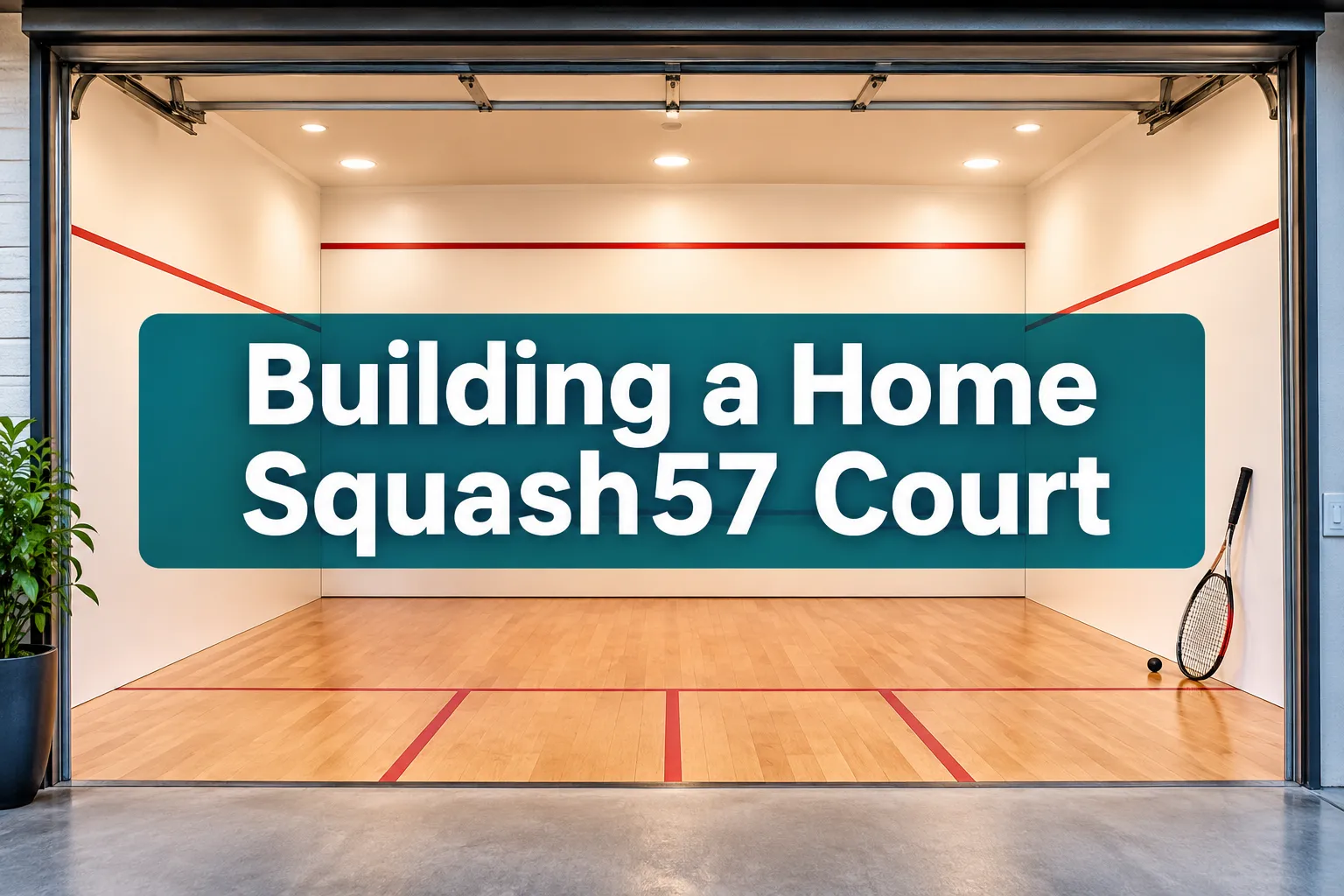
Most standard double-car garages fall short of full WSF dimensions, but many single-story home extensions, barn conversions, or large basements can work. The honest answer: a standard two-car garage (typically around 6 m × 6 m) is too small for a full court. You need a larger space.
What actually works:
- Large detached garages or workshops (10 m+ in length), the most common DIY success story
- Basement conversions, feasible if the ceiling clears 5.5 m, which is rare but not impossible in older large homes
- Garden room or outbuilding builds, purpose-built structures are increasingly popular and can be sized correctly from the start
- Portable wall panels, for backyards, freestanding wall systems allow hitting practice without a full enclosed court (better for solo drilling than match play)
If a full court isn’t feasible, a single front-wall setup in a garage gives you a solid hitting wall for drills and fitness training, which covers a lot of what makes squash great. This kind of community-first, low-barrier approach to racket sports is something the racket sports community strongly encourages, getting on court in any form beats waiting for perfection.

How Much Does It Cost to Build a Home Squash Court From Scratch?
Building a full home squash court is a significant investment. Realistic cost ranges in 2026 vary widely based on whether you’re doing a full structural build or a conversion.
Rough budget estimates (USD, 2026):
- Basic garage conversion (walls, flooring, lighting, lines): $15,000,$30,000+
- Purpose-built outbuilding with full WSF spec: $40,000,$80,000+
- Portable hitting wall (single-wall DIY setup): $500,$3,000 depending on materials
- Per-player gear starter kit: $120,$200 [5]
The biggest cost drivers are:
- Flooring, proper hardwood or sport surface installation
- Wall construction, smooth, impact-resistant panels (plywood-core with hardboard finish is common)
- Lighting, even, shadow-free overhead lighting is critical for safe play
- Glass back wall, optional but adds to the professional feel and viewing experience
If the full build cost feels steep, check our guide to pickleball court dimensions and layout for comparison, sometimes a multi-sport surface makes better financial sense for recreational households.
Best Flooring Materials for a Home Squash Court
Hardwood is the gold standard for squash courts, and it works equally well for Squash57. Maple hardwood with a sport-grade finish provides the right balance of grip, shock absorption, and ball response. [4]
Flooring options ranked for home use:
- Maple hardwood (sprung sub-floor), best performance, highest cost
- Sport-vinyl over hardwood, slightly cheaper, still WSF-compatible
- High-density rubber sport tiles, budget option, adequate for recreational play
- Bare concrete, not recommended; too hard on joints and alters ball bounce
Whatever surface you choose, enforce a strict non-marking shoe rule from day one. Street shoes and outdoor trainers will scuff and damage any court surface quickly. [4] This single rule protects your investment more than almost anything else.
What Court Walls Should You Know About (And How the Ball Bounces)?
Squash57 is played on the same court as standard squash, so the wall setup is identical: a front wall with a tin at the bottom (the out-of-play zone), service boxes marked on the floor, and an out-of-court line running across the top. [2][3]
Wall construction tips for home builds:
- Front wall: Must be flat, hard, and highly impact-resistant, typically 18-22 mm plywood core with 3-4 mm hardboard facing
- Side walls: Same construction, painted white for visibility
- Back wall: Can be solid (same as side walls) or glass, glass allows spectating and coaching observation
- Paint: Use specialist squash court paint; it’s harder than standard wall paint and reduces scuffing
The Squash57 ball’s larger size and extra bounce mean it hits walls with slightly different angles than a traditional squash ball. Beginners find this more forgiving, the ball comes off walls more predictably and doesn’t die in the corners as quickly. [6][7]
Always verify current WSF line specifications online before painting. The official rules point directly to WSF’s online specs for exact measurements, so check these before marking anything permanently. [3]
What Are the Most Common Mistakes When Building a Squash Court?
The biggest mistakes fall into three categories: underestimating space, skipping safety planning, and cutting corners on materials.
Mistakes to avoid:
- Wrong ceiling height, going below 5.5 m limits full-game play and increases injury risk from lob shots
- Non-compliant wall surfaces, soft drywall or textured finishes affect bounce unpredictably and dent easily
- Poor lighting, shadows near the front wall make judging ball depth dangerous
- No eyewear rule, skipping protective eyewear enforcement is the most serious safety omission [4]
- Skipping the tin, the tin (a metal or hardboard kick strip at the base of the front wall) must be installed at the correct height; it’s not decorative
- Buying bulk balls before checking specs, WSF specifications for Squash57 balls are maintained online and can be updated; always verify before bulk purchasing [3]
Common edge case: Players who’ve built racquetball courts sometimes assume the dimensions match squash. They don’t, racquetball courts are typically 20 ft × 40 ft (approximately 6 m × 12 m), which is narrower and longer than a squash court. Don’t assume compatibility without measuring. [2][4]
Safety Gear and Equipment You Need for Squash57
Certified protective eyewear is the single most important safety item for Squash57. US Squash requires eyewear meeting ASTM F3164 (F803 is also still accepted) at its events, and all players must wear protective eyewear, full stop. [4] This applies at home courts too, especially when playing with less-experienced players who may mishit balls unpredictably.
2026 safety checklist for home Squash57 play:
- ✅ Certified protective eyewear (ASTM F3164 or F803)
- ✅ Non-marking indoor court shoes
- ✅ No food or open drinks on or near the court
- ✅ Adult supervision for younger players
- ✅ Written house rules posted near the court entry
- ✅ No racket throwing or slamming on walls/floors [4]
For anyone new to racket sports safety, the same principles apply across sports, see our guide on common pickleball injuries and how to avoid them for a broader look at injury prevention in enclosed court sports.
Is Squash57 Easier for Beginners and Kids to Learn?
Yes, Squash57 is intentionally designed as a more accessible version of squash. National federations including England Squash and US Squash describe it as lower-impact and more forgiving, particularly for beginners, older players, and those coming back from injury. [6][7]
The larger 57 mm ball doesn’t require warming up (unlike traditional squash balls), bounces more consistently, and stays in play longer. This means beginners spend more time rallying and less time picking up dead balls from corners, which keeps sessions fun and builds confidence faster.
For kids and families, Squash57 is an excellent starting point before transitioning to traditional squash. The same court, the same rules framework, but a more rewarding early experience. [6]
Best Squash57 Rackets and Balls to Buy in 2026
The right gear makes a real difference, especially on a home court. Here’s what to look for in 2026. [5]
Rackets (2026 picks):
- Budget ($30,$50): Entry-level Karakal or Dunlop Squash57 frames, solid for beginners
- Mid-range ($50,$80): Karakal FF 150 or FF 160, popular with players transitioning from squash
- Intermediate ($80,$120): Head Graphene Radical 160 or Tecnifibre frames, composite construction, better feel
All rackets must conform to WSF specifications. [1][3] Standard racquetball rackets are also permitted and widely used. [5]
Balls:
- Blue dot, bouncier, recommended for recreational and beginner play [5][7]
- Black dot, less bounce, used for competition [7]
- Red dot, extra bounce, best suited for cold courts or very cold home spaces [5]
The official Dunlop Squash57 blue-dot ball is the standard for most recreational home court play. A 3-pack runs $8,$15 USD. [5]
For more gear guidance across racket sports, our racket sports gear reviews and training guides cover Squash57 transitions in depth.
How Do You Maintain and Clean a Squash Court?
Maintenance is simpler than most people expect, consistency matters more than effort. [4]
Regular maintenance routine:
- After every session: Sweep or dry-mop the floor to remove dust and rubber residue
- Weekly: Wipe down walls with a damp cloth to remove ball marks and scuffs
- Monthly: Inspect the floor surface for lifting edges or scuff damage; check the tin for dents
- Annually: Consider a professional floor re-coat if the surface shows significant wear
Banning food and open beverages from the court area is one of the most effective maintenance rules, spills on hardwood can warp flooring and create dangerous slip zones. [4]
How Often Do You Need to Resurface a Squash Court?
A well-maintained hardwood squash court floor typically needs resurfacing (sanding and recoating) every 5-10 years, depending on usage volume and how well the non-marking shoe rule is enforced. [4] Heavy daily use from multiple players accelerates wear; a home court used a few times per week can last toward the longer end of that range.
Sport-vinyl surfaces may need replacing sooner (3-7 years) but are cheaper to install initially. Wall paint typically needs touching up every 2-4 years as ball impacts leave scuff marks.
Are There Cheaper Alternatives to Building a Full Court at Home?
Absolutely, and for many players, a partial setup delivers 80% of the benefit at a fraction of the cost.
Budget-friendly alternatives:
- Single hitting wall (concrete or plywood panel, 4 m wide × 5 m tall): $500,$3,000 DIY, great for solo drilling and fitness
- Portable rebound panels designed for racket sports: available from specialty suppliers, easy to set up and store
- Shared court membership at a local club: often the most cost-effective path before committing to a home build
- Multi-sport surface (combining squash lines with pickleball or badminton): maximizes use of available space
If community play matters as much as home training, finding local courts and clubs through racket sports community networks is worth exploring before spending on construction.
Conclusion
Building a home Squash57 court is one of the most rewarding investments a serious racket sports player can make, but it pays to plan carefully. Start by confirming your available space against WSF singles dimensions. [2] If a full court isn’t feasible, a hitting wall or portable setup still delivers genuine training value.
Your next steps:
- Measure your available space against WSF specs (9,750 mm × 6,400 mm interior, 5.5 m ceiling) [2]
- Download the latest WSF court specifications and Squash57 rules before marking or building anything [3]
- Budget realistically, full conversion starts around $15,000,$30,000; gear per player runs $120,$200 [4][5]
- Order certified eyewear before the first session, no exceptions [4]
- Start with blue-dot balls for recreational play; switch to black-dot as skills develop [5][7]
Squash57’s low barrier to entry, forgiving bounce, and fast-paced rallies make it one of the most enjoyable ways to stay active at home. Build it right, play it safe, and you’ll have a court the whole household uses for years.
FAQ
Q: Does a Squash57 court need different dimensions than a regular squash court? No. Squash57 uses identical WSF singles court dimensions: 9,750 mm long × 6,400 mm wide. No structural modifications are needed. [2][7]
Q: What’s the difference between Squash57 and Squash40? Squash57 uses a 57 mm diameter ball (bouncier, no warm-up needed); Squash40 refers to traditional squash played with the standard ~40 mm ball. Same court, different balls and rackets. [1][7]
Q: Can I use a racquetball racket for Squash57? Yes. US Squash confirms that either a dedicated Squash57 racquet or a standard racquetball racquet is permitted, provided it meets WSF specifications. [5]
Q: Is protective eyewear really required for home play? Yes. All players must wear protective eyewear, ASTM F3164 or F803 certified. This applies at home courts, not just organized events. [4]
Q: What’s the cheapest way to get started with Squash57 at home? A single hitting wall plus a racket, balls, eye protection, and court shoes is the most affordable home setup, total under $3,500 DIY including the wall, and around $120,$200 per player for gear. [4][5]
Q: How high does the ceiling need to be? Aim for at least 5.5 m (roughly 18 ft). Lower ceilings limit lob shots and increase the risk of players jumping into structural elements. [2]
Q: What ball should beginners use? Blue-dot Squash57 balls, they’re bouncier and more forgiving for beginners and recreational players. [5][7]
Q: How long does a home squash court floor last before resurfacing? A well-maintained hardwood floor lasts 5-10 years before needing resurfacing, depending on usage and adherence to non-marking shoe rules. [4]
Q: Can kids play Squash57? Yes. Squash57 is specifically noted by England Squash and US Squash as more accessible and lower-impact, making it well-suited for younger players. Adult supervision is recommended at home. [6][7]
Q: Where do I find the official WSF court specs and Squash57 rules? The WSF publishes current court specifications and Squash57 Standard Rules on their website. The 2024 Squash57 Standard Rules V2.5 points directly to these online sources as the authoritative reference. [3]
References
- Squash 57 Rules. worldsquash.org.
- 171128 Court Specifications. worldsquash.org.
- 240101 Squash 57 Standard Rules V2.5. worldsquash.org.
- How To Maintain An HOA Racquetball Or Squash Court. joinourhoa.com.
- Mastering Squash57 Training Drills Gear Recommendations and Transition Tips From Traditional Squash. rallyracket.com.
- Squash 57. ussquash.org.
- Squash57. englandsquash.com.