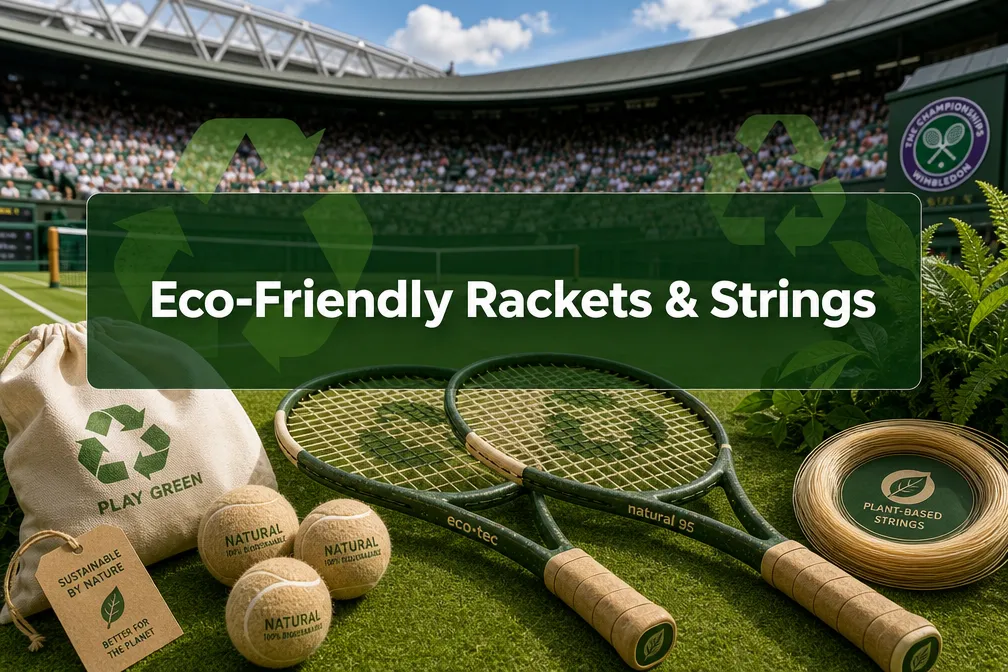
Eco-friendly rackets, balls, and strings in response to sustainability push at major events
Last updated: July 27, 2026
Quick Answer: Eco-friendly rackets, balls, and strings in response to sustainability push at major events are now a real and growing category, not just a marketing label. Brands like Renewaball, Wilson, and HEAD are producing certified sustainable gear using recycled rubber, natural fibers, and bio-based materials. Some products already meet ITF and IPF tournament standards, and major events like the Australian Open are actively piloting greener equipment programs.
Key Takeaways
- About 330 million tennis balls are produced globally each year, and most take over 400 years to decompose in landfills due to synthetic rubber and nylon felt [4]
- Renewaball is currently the only fully circular tennis and padel ball with ITF, IPF, and FEP certification, using over 30% recycled rubber and natural wool/cotton felt [3][7][9]
- A life-cycle assessment found Renewaball’s carbon footprint is 0.41 kg CO₂-eq per ball, about 29% lower than a conventional ball at 0.58 kg CO₂-eq [6]
- Wilson’s Triniti ball uses a pressureless design that lasts significantly longer than standard pressurized balls, reducing how often players need to replace them [8]
- The Australian Open has launched a ball tube recycling program called “Second Life,” turning used ball tubes into usable products [10]
- Eco-friendly rackets like the HEAD MP Boom Raw are built with bio-based resins and natural materials, reducing reliance on petroleum-based composites [5]
- Sustainable strings made from natural gut or bio-based polymers exist but remain a niche segment, performance and durability are comparable for most recreational players
- Price premiums for eco-friendly gear are real but narrowing, expect to pay 15-40% more than conventional equivalents in most categories
- Most professional players still use conventional gear, but grassroots adoption is growing fast across the racket sports community
What Makes a Tennis Racket Eco-Friendly?
An eco-friendly tennis racket uses materials and manufacturing processes that reduce environmental impact compared to standard carbon-fiber frames. This typically means bio-based resins, recycled fibers, natural materials like flax or hemp, or reduced-waste production methods.
Standard rackets rely heavily on petroleum-based epoxy resins and synthetic carbon fiber, both energy-intensive to produce and nearly impossible to recycle at end of life. Eco-friendly alternatives swap some or all of these for:
- Bio-based resins derived from plant oils instead of petrochemicals
- Natural fiber reinforcement such as flax or basalt fiber, which have lower embodied energy than standard carbon
- Recycled carbon fiber recovered from manufacturing offcuts or end-of-life aerospace components
- Reduced packaging using recycled cardboard and no single-use plastic
Example: The HEAD MP Boom Raw racket, released to mark Earth Day, uses a bio-resin matrix and natural fiber layers to cut down on synthetic material use without sacrificing playability [5]. It’s a solid example of how racket sports gear reviews are starting to include sustainability as a genuine performance criterion, not just a feel-good add-on.
Choose eco-friendly rackets if: you’re replacing gear anyway, play recreationally, and want your purchase to align with your values. If you’re a competitive player chasing marginal performance gains, the selection is still limited, but it’s growing.
What’s the Difference Between Recycled and Eco-Friendly Rackets?
These two terms are often used interchangeably, but they mean different things. A recycled racket is made partly or wholly from post-consumer or post-industrial recycled materials. An eco-friendly racket is a broader term covering any racket with a reduced environmental footprint, which might include recycled content, bio-based materials, cleaner manufacturing, or sustainable packaging.
In practice:
- A racket with recycled carbon fiber = recycled AND eco-friendly
- A racket with bio-resin but virgin carbon fiber = eco-friendly, not recycled
- A racket in recycled cardboard packaging only = minimal eco-friendly claim
Common mistake: Assuming “eco-friendly” on a label means the whole product is sustainable. Always check which specific component or process the claim applies to.
Are Eco-Friendly Tennis Balls Actually Better for the Environment?
Yes, when properly certified, eco-friendly tennis balls deliver a meaningfully lower environmental footprint than conventional balls. The problem with standard balls is significant: roughly 330 million are produced each year globally, and most end up in landfills where they take over 400 years to break down, thanks to their pressurized rubber cores and synthetic nylon/wool felt that sheds microplastics [4].
Renewaball addresses this directly with a circular design:
- Core: Made from over 30% recycled rubber sourced from used tennis balls [3][6]
- Felt: Natural wool and cotton instead of synthetic fibers, no microplastic shedding [3][7]
- Carbon footprint: 0.41 kg CO₂-eq per ball vs. 0.58 kg CO₂-eq for a conventional ball, a 29% reduction [6]
- Certification: ITF, IPF, and FEP approved, meaning they meet tournament performance standards [3][7][9]
Wilson’s Triniti ball takes a different approach: it’s pressureless, so it doesn’t lose bounce over time the way standard balls do. That means players replace them far less often, which reduces total waste even if the materials themselves aren’t recycled [8].

The Australian Open’s “Second Life” program goes further, collecting used ball tubes and turning them into new products rather than sending them to landfill [10]. It’s a good example of how major events are building sustainability into operations, not just equipment.
How Long Do Eco-Friendly Tennis Balls Last?
This depends on the type. Renewaball circular balls perform comparably to standard pressurized balls in terms of bounce and feel, so their lifespan on court is similar, typically a few sets for competitive play, longer for casual hitting [3][9].
Wilson Triniti balls last considerably longer because they’re pressureless. Pressureless balls don’t go flat over time, so recreational players can get weeks or months of use from a single set rather than days [8].
Bottom line: If longevity matters most, pressureless eco-friendly balls like Triniti are the better choice. If you want certified circular materials and tournament approval, Renewaball is currently the strongest option [3][8].
Biodegradable Tennis Strings vs Regular Strings
Biodegradable or bio-based tennis strings are the least developed segment of sustainable racket sports equipment. Most strings on the market, polyester, nylon, and co-polyester, are petroleum-based and not recyclable.
Natural gut strings (made from cow intestine) are technically biodegradable and have been used in tennis for over a century. They offer excellent feel and tension retention, but they’re expensive (often $50,$80 per set installed) and sensitive to moisture.
Newer bio-based polymer strings are in early development from a few smaller brands, aiming to replicate the playability of synthetic poly strings with a lower-carbon production process. As of 2026, no major string brand has launched a fully certified biodegradable synthetic string at scale.
Are eco-friendly strings as durable as synthetic ones? Natural gut strings are actually among the most durable in terms of tension retention, but they break more easily on off-center hits compared to polyester. For most recreational players, natural gut or a natural gut hybrid is a practical and genuinely lower-impact choice.
Do Professional Players Use Eco-Friendly Rackets?
Most professional players on the ATP and WTA tours still use conventional rackets and strings. The performance demands at the top level, precise weight distribution, specific flex profiles, consistent string response, make it difficult for current eco-friendly options to compete directly with custom-built tour-spec frames.
That said, the gap is narrowing. HEAD’s MP Boom Raw has been used in promotional contexts, and several mid-tier professionals have experimented with sustainable gear during exhibition events [5]. The bigger shift is happening at the grassroots level, where recreational players and club coaches are actively seeking out greener options as part of a broader lifestyle choice.
For players looking to improve their game while making smarter equipment choices, check out our racket sports gear reviews for honest breakdowns of what’s worth buying.
Which Tennis Tournaments Require Sustainable Equipment?
No major Grand Slam currently mandates sustainable equipment for all players. However, several tournaments are actively piloting or promoting greener gear as part of broader sustainability programs.
- Australian Open: Launched the “Second Life” ball tube recycling initiative and has partnered with suppliers to reduce single-use plastics across the event [10]
- Wimbledon and Roland Garros: Both have published sustainability reports with targets for reducing waste and carbon emissions, though equipment mandates are not yet in place
- ITF-sanctioned events: Renewaball’s circular balls are ITF-certified, meaning any tournament using ITF-approved balls could choose to switch to them without rule changes [3][7]
The clearest path to sustainable equipment becoming standard at major events is governing-body certification, and Renewaball already has that for both tennis and padel [3][7][9]. Tournament adoption is the next step.
Eco-Friendly Racket Brands Compared
Here’s a practical overview of the main players in sustainable racket sports equipment as of 2026:
| Brand | Product Type | Key Sustainable Feature | Certification |
|---|---|---|---|
| Renewaball | Tennis & padel balls | 30%+ recycled rubber, natural felt | ITF, IPF, FEP [3][7][9] |
| Wilson Triniti | Tennis balls | Pressureless (longer lifespan) | ITF [8] |
| HEAD MP Boom Raw | Tennis racket | Bio-resin, natural fiber layers | None listed [5] |
| Natural gut strings | Strings | Biodegradable animal-based material | N/A |
Choose Renewaball if you want certified circular balls for tennis or padel with verified lower carbon footprint [6]. Choose Wilson Triniti if you want balls that last longer and reduce replacement frequency [8]. Choose HEAD MP Boom Raw if you want a racket with bio-based materials from a major brand [5].
Does Using Sustainable Tennis Gear Affect Performance?
For most recreational and club players, the performance difference is minimal. Renewaball’s circular balls are ITF-certified, meaning they meet the same bounce, compression, and durability standards as conventional balls [3][7]. Players who’ve tested them report a feel that’s comparable to standard pressurized balls.
Eco-friendly rackets like the HEAD MP Boom Raw are designed to play like their conventional counterparts, the bio-resin and natural fiber layers are engineered to maintain the same stiffness and weight profiles [5].
Where you might notice a difference:
- Pressureless balls (like Triniti) feel slightly firmer than standard pressurized balls, which some players prefer and others find less comfortable [8]
- Natural gut strings play differently from polyester, more arm-friendly and lively, but less spin-friendly for aggressive baseliners
- Eco-friendly rackets at the budget end may use lower-quality recycled materials that affect consistency
The racket sports community is increasingly finding that sustainable gear doesn’t mean compromising on play. If you’re curious about how equipment choices affect your overall game, our guide to choosing the right equipment for safe pickleball play covers similar principles that apply across racket sports.
How Much Do Eco-Friendly Tennis Rackets Cost?
Eco-friendly rackets typically cost 15-40% more than comparable conventional models, depending on the brand and materials used. As of 2026, most sustainable racket options sit in the $120,$280 range for recreational players.
Eco-friendly balls are closer to price parity:
- Renewaball circular balls retail at a modest premium over standard balls, roughly 10-20% more per tube [1][9]
- Wilson Triniti balls cost more upfront but last longer, so the cost-per-hour of play can actually be lower [8]
Natural gut strings remain the most expensive string option at $50,$80 installed, compared to $15,$30 for standard synthetic strings.
Bottom line on cost: The upfront premium is real, but for balls especially, the longer lifespan of some eco-friendly options means the total cost of ownership is often comparable to conventional gear.
Can You Recycle Old Tennis Rackets and Strings?
Standard tennis rackets are notoriously difficult to recycle because they’re made from composite materials, carbon fiber bonded with epoxy resin, that can’t be separated easily using conventional recycling processes.
Options for reducing racket waste:
- Donate used rackets to local clubs, schools, or community programs
- Manufacturer take-back programs: A small number of brands are piloting end-of-life collection, though this is not yet widespread
- Specialist recyclers: Some industrial recyclers can process carbon fiber composites, but access is limited and costly
For strings, polyester and nylon strings are not recyclable through standard channels. Natural gut strings are biodegradable. Some clubs collect used strings for specialist processing, but this is rare.
The evolution of pickleball equipment shows how quickly racket sports gear can change when there’s consumer demand, the same shift is now happening with sustainability across all racket sports.
Where to Buy Sustainable Tennis Equipment
Sustainable racket sports gear is more accessible in 2026 than ever before. Here’s where to look:
- Volleybird (volleybird.com): Exclusive US distributor for Renewaball circular tennis and padel balls [1][3]
- Major online retailers (Amazon, Tennis Warehouse): Stock Wilson Triniti and some eco-friendly racket options
- Brand direct: HEAD, Wilson, and Babolat all sell direct-to-consumer with sustainability product lines
- Local specialty tennis shops: Increasingly stocking eco-friendly options as consumer demand grows
- Club pro shops: Some clubs are switching to sustainable balls for lessons and casual play, worth asking
If you’re also gearing up for padel or pickleball, our essential gear for new pickleball players guide covers how to make smart equipment choices without overspending, the same principles apply when shopping sustainably.
FAQ
Q: Are Renewaball circular balls approved for official tournament play? Yes. Renewaball holds certification from the ITF (tennis), IPF (international padel), and FEP (Spanish padel federation), meaning they meet official performance standards for tournament use [3][7][9].
Q: What is the carbon footprint of a Renewaball vs a standard tennis ball? Renewaball produces 0.41 kg CO₂-eq per ball, compared to 0.58 kg CO₂-eq for a conventional ball, a reduction of approximately 29% [6].
Q: Do eco-friendly tennis balls feel different to play with? Most players report that certified eco-friendly balls like Renewaball feel comparable to standard balls. Pressureless balls like Wilson Triniti feel slightly firmer, which some players prefer [8][9].
Q: Can I use natural gut strings on any racket? Yes. Natural gut strings are compatible with any standard tennis racket. They’re best suited for players who want arm comfort and excellent feel, but require careful storage away from moisture.
Q: Are there eco-friendly padel balls? Yes. Renewaball produces circular padel balls certified by both the IPF and FEP, making them one of the few sustainable options approved for padel competition [3][7][9].
Q: Why do most professional players still use conventional gear? Tour-level players use custom-spec equipment tuned to precise performance parameters. Current eco-friendly options are improving but don’t yet match the full customization available with conventional materials.
Q: Is Wilson Triniti ball eco-friendly? Wilson Triniti is designed for longevity, its pressureless construction means it doesn’t go flat, so players replace balls far less often. Wilson markets this as a sustainability benefit [8]. The ball itself isn’t made from recycled materials, but reduced replacement frequency does lower overall waste.
Q: How can I dispose of old tennis balls responsibly? Several programs collect used tennis balls for recycling or repurposing, including the Australian Open’s “Second Life” initiative [10] and various local club collection drives. Check with your local club or national tennis federation for programs in your area.
Q: Are eco-friendly rackets available for pickleball and badminton too? The sustainable equipment push is most advanced in tennis, but it’s expanding. Some pickleball paddle brands are experimenting with recycled cores and bio-based edge guards. Badminton shuttlecocks made from recycled feathers or bio-based plastics are also emerging as a category.
Q: Does sustainable gear cost significantly more? Expect to pay 10-40% more for eco-friendly balls and rackets compared to standard equivalents. The premium is narrowing as production scales up, and longer-lasting products like pressureless balls can offset the higher upfront cost [1][8].
Conclusion
The shift toward eco-friendly rackets, balls, and strings in response to sustainability push at major events is no longer a fringe trend, it’s becoming a mainstream expectation across the racket sports community. Certified circular balls like Renewaball are already tournament-approved and commercially available in the US [1][3]. Sustainable racket designs from brands like HEAD are making bio-based materials accessible to everyday players [5]. And major events from the Australian Open to ITF-sanctioned tournaments are building sustainability into their operations [10].
Actionable next steps for players:
- Try eco-friendly balls first, they’re the easiest and most affordable switch, and certified options like Renewaball perform comparably to standard balls [3][9]
- Consider pressureless balls like Wilson Triniti if you play recreationally and want gear that lasts longer [8]
- Ask your club about switching to sustainable balls for lessons and social play, small clubs can make a real difference at scale
- When replacing your racket, check whether bio-resin or natural fiber options are available in your preferred brand’s lineup
- Donate or repurpose old rackets rather than binning them, local schools and community programs always welcome used gear
Sustainable gear is getting better, more affordable, and more widely available every year. The racket sports community has a real opportunity to lead on this, one match at a time. For more on how equipment choices shape the game you love, explore our gear maintenance tips to get the most out of every piece of kit you own.
References
[1] Best Sustainable Tennis Ball 2026 Volleybird Brings Renewaball To North America – https://nypost.com/2026/02/13/shopping/best-sustainable-tennis-ball-2026-volleybird-brings-renewaball-to-north-america/
[2] BBC Sport Tennis – https://www.bbc.co.uk/sport/tennis/articles/cyr76p8kg64o
[3] Volleybird Becomes Exclusive US Distributor Of Renewaball The World’s First Fully Circular Tennis And Padel Balls – https://floridatennis.com/blogs/padel-news/volleybird-becomes-exclusive-us-distributor-of-renewaball-the-worlds-first-fully-circular-tennis-and-padel-balls-1
[4] Tennis Balls Ecological Impact Sustainability Problem – https://www.cbsnews.com/news/tennis-balls-ecological-impact-sustainability-problem/
[5] HEAD MP Boom Raw La Racchetta Sostenibile Per Celebrare L’Earth Day – https://tennismagazineitalia.it/news/head-mp-boom-raw-la-racchetta-sostenibile-per-celebrare-learth-day/
[6] Renewaball The First Circular Tennis Ball – https://ecochain.com/customers/renewaball-the-first-circular-tennis-ball/
[7] Renewaball Circular Tennis And Padel Balls – https://circulareconomy.europa.eu/platform/en/good-practices/renewaball-circular-tennis-and-padel-balls
[8] Wilson Launches Sustainable Tennis Ball Triniti – https://www.amersports.com/newsroom/wilson-launches-sustainable-tennis-ball-triniti/
[9] Circular Eco-Friendly Padel And Tennis Balls ITF IPF Approved Renewaball – https://thesmashlife.com/products/circular-eco-friendly-padel-and-tennis-balls-itf-ipf-approved-renewaball
[10] Full Circle Second Life AO Ball Tube – https://ausopen.com/articles/news/full-circle-second-life-ao-ball-tube