Padel for Beginners 2026: Why This Hybrid Sport is Perfect for All Ages and Skill Levels
Last updated: August 16, 2026
Quick Answer: Padel is a doubles racket sport played on a small enclosed court with glass walls, combining tennis-style scoring with squash-style wall play. It’s one of the fastest-growing sports in the world, with over 35 million active players globally [4], and it’s genuinely easy to pick up, most beginners can rally confidently in their very first session.
Key Takeaways
- 🎾 Padel blends tennis scoring with squash-style glass walls on a court roughly one-third the size of a tennis court
- 🌍 Over 35 million players worldwide in 2026, with 58,300+ courts across 90+ countries [4][1]
- ⏱️ Most beginners feel match-ready after just 2-3 sessions, far faster than tennis
- 💰 Starter costs are modest: a racket, court shoes, and balls for around $175-275 total [9]
- 👨👩👧👦 Suitable for all ages, the underhand serve and smaller court reduce physical strain
- 🇺🇸 The US crossed 1 million players in 2025, with rapid court expansion continuing [6]
- 🏃 Padel delivers solid cardio and full-body conditioning in a fun, social format
- ❌ Common beginner mistakes include ignoring the walls, standing too far back, and using a racket that’s too heavy
What Is Padel Tennis and How Is It Different from Regular Tennis?
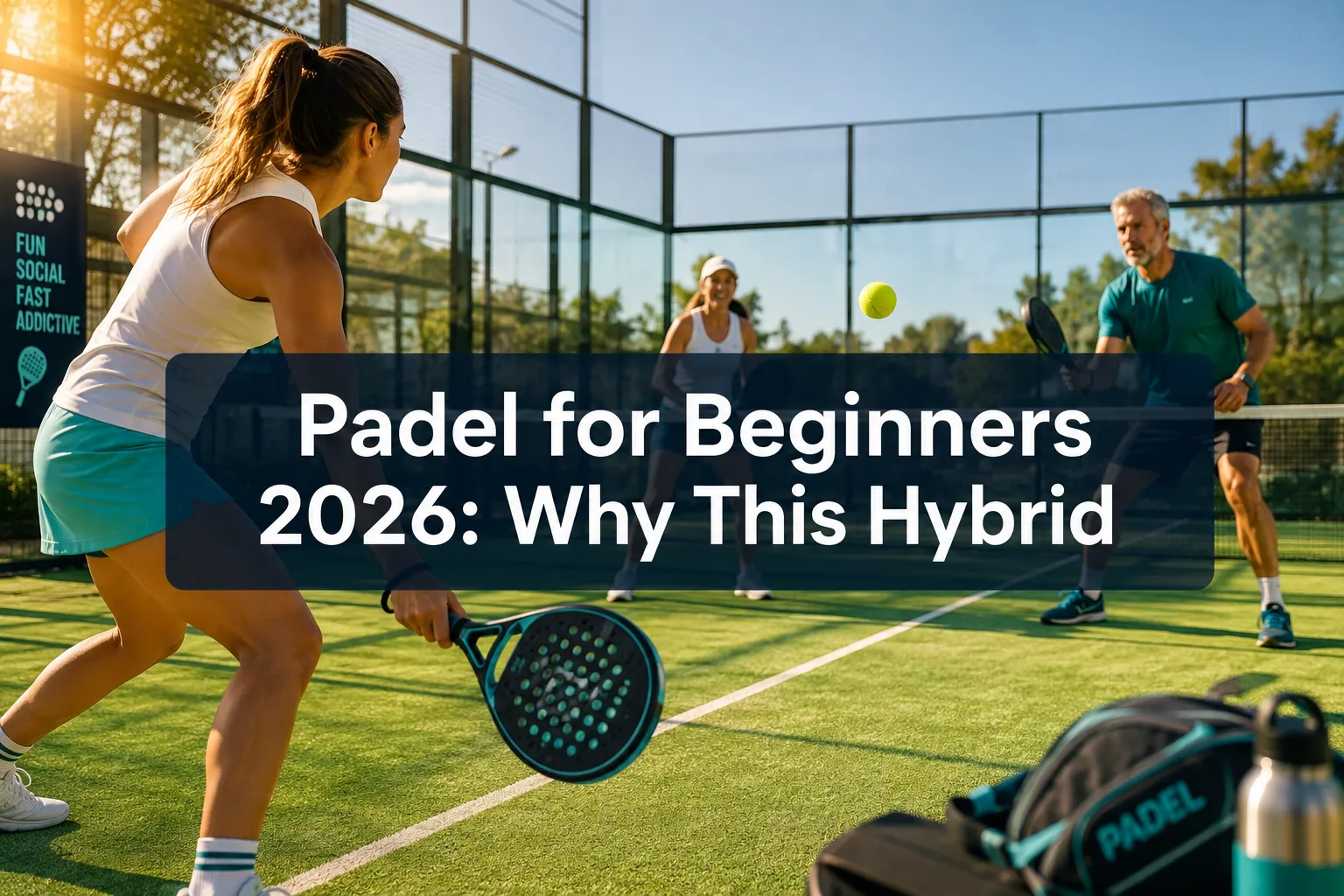
Padel is a doubles racket sport played on a 10m x 20m enclosed court surrounded by glass and metal mesh walls. It uses solid, stringless rackets and scores exactly like tennis, but the walls are in play after the ball bounces, adding a strategic layer that makes rallies longer and more exciting.

Here’s what sets padel apart from regular tennis:
- Court size: A padel court is about one-third the size of a tennis court, so there’s far less running
- Walls: After the ball bounces on your side, it can hit the glass walls and remain in play, similar to squash
- Racket: Solid and perforated (no strings), shorter handle, lighter overall
- Serve: Always underhand, bounced off the ground first, no overhead power serves
- Format: Always played in doubles (four players), which makes it inherently social
- Scoring: Identical to tennis, 15, 30, 40, game, set, match
The enclosed court and underhand serve are the two design choices that make padel so accessible. There’s no intimidating overhead serve to master, and the smaller space means beginners aren’t sprinting across a full court on every point.
Padel vs. tennis in one line: Same scoring, smaller court, glass walls, no string tension, and always doubles.
Is Padel Easier to Learn Than Tennis?
Yes, padel has a noticeably shorter learning curve than tennis. Most beginners can sustain a rally within their first session, and feel ready to play a casual match after two or three outings.
Several design features explain why:
- The underhand serve eliminates one of tennis’s hardest skills to learn
- The smaller court means less ground to cover and shorter reaction times needed
- The solid racket is more forgiving on off-center hits than a strung tennis frame
- Wall rebounds keep the ball in play longer, so rallies don’t die on every mishit
- Average amateur rally length runs around 9-12 shots [11], giving beginners more time to find their footing
Choose padel if: You’ve tried tennis and found the serve or court coverage frustrating. Padel removes both barriers immediately.
For players already in the racket sports community, skills from tennis, squash, or even pickleball transfer well. Footwork, hand-eye coordination, and court awareness all carry over.
Do You Need Experience to Start Playing Padel?
No prior racket sports experience is required to start playing padel. The rules are simple, the serve is easy to learn, and the enclosed court creates a forgiving environment for complete beginners.
That said, any background in racket sports helps. Tennis players adapt quickly to the scoring and footwork. Squash players already understand wall play. Even pickleball players find the social doubles format familiar.
No experience? Here’s what to expect in your first session:
- A brief intro to the court layout and basic rules (10-15 minutes)
- Practice the underhand serve, most people get it within 5-10 attempts
- Start rallying from the back of the court
- Learn when the ball can come off the wall (after it bounces on your side)
- Play a casual game, expect to make mistakes and laugh about them
Working with a certified instructor for even one introductory lesson can cut weeks off your learning curve. Many clubs offer beginner clinics specifically for first-timers.
How Do You Play Padel? A Beginner’s Guide to the Rules
Padel is played as doubles on an enclosed court. The server bounces the ball and hits it underhand into the diagonal service box. From there, play continues until one team fails to return the ball correctly, and the walls are your friend, not your enemy.
Basic rules every beginner needs to know:
- Serve: Bounce the ball below waist height and hit it underhand into the diagonal box. One fault allowed; two faults = point lost
- Wall play: After the ball bounces on your side, it can rebound off the glass walls and still be in play. You can also play the ball off the opponent’s walls after it crosses the net
- Scoring: Exactly like tennis, 15, 30, 40, deuce, advantage, game. Sets go to 6 games (win by 2), matches are best of 3 sets
- Volleys: You can volley (hit before the ball bounces) anywhere except when returning a serve
- Out: The ball is out if it bounces twice, hits the metal fence before bouncing, or lands outside the court lines
Common beginner confusion: Many new players think the walls make the ball “out.” They don’t, walls are part of the game after the first bounce on your side.
For players who also enjoy pickleball, the basic rules of pickleball share some structural similarities with padel’s doubles format and scoring logic.
What Equipment Do You Need to Play Padel?
Three items cover everything a beginner needs: a padel racket, court shoes, and a can of balls. That’s it for your first real game [9].
Beginner equipment breakdown:
| Item | What to Look For | Approx. Cost |
|---|---|---|
| Padel racket | Round shape, soft EVA foam core, 345-365g, low-mid balance | $80-130 |
| Court shoes | Non-marking sole, lateral support, padel or clay-court specific | $80-130 |
| Balls | Pressurized padel balls (slightly lower pressure than tennis) | ~$14/can |
Racket tips for beginners [3]:
- Choose a round-shaped racket, more forgiving sweet spot than diamond shapes
- Soft EVA foam core absorbs vibration and reduces arm strain
- Weight around 345-365 grams, lighter rackets are easier to control
- Brands like Adidas Drive series, Starvie, and Bullpadel offer solid beginner options
Skip for now: Padel-specific gloves, overgrips, and vibration dampeners are nice extras but not necessary on day one.
For more on choosing beginner racket sports gear, the essential equipment guide for beginners covers the decision-making process well.
What Shoes Should You Wear for Padel?
Wear padel-specific or clay-court tennis shoes with a non-marking sole and strong lateral support. Regular running shoes or gym trainers are not suitable, they lack the side-to-side grip needed for quick court movements and can damage the artificial turf surface.
What to look for in padel shoes:
- Non-marking rubber sole (required on most courts)
- Herringbone or omni-directional tread for grip on artificial grass
- Reinforced toe cap, padel involves a lot of short, sharp directional changes
- Snug midfoot fit to prevent sliding inside the shoe on lateral cuts
Avoid: Running shoes (too much heel cushion, poor lateral stability), basketball shoes (too heavy), and regular tennis shoes with hard-court soles (wrong tread pattern for padel turf).
How Much Does It Cost to Play Padel?
Getting started in padel costs roughly $175-275 for gear, plus court hire fees. That’s competitive with most other racket sports and much lower than golf [9].
Typical costs for beginners in 2026:
- Starter gear (racket + shoes + balls): $175-275 one-time
- Court hire: $20-40 per hour per court (split four ways = $5-10 per person)
- Beginner clinic or lesson: $15-30 per session at most clubs
- Club membership: Optional, but can reduce court fees significantly
Many clubs offer free introductory sessions or “come and try” events, so the first time on court often costs nothing. The global padel market is valued at roughly €6 billion in 2026 [10], and that investment is flowing into more beginner-friendly facilities, coaching programs, and affordable equipment options.
Where Can You Find Padel Courts Near You?
Finding a padel court in 2026 is easier than ever. There are now over 58,300 courts worldwide, with nearly 8,000 new courts added in 2025 alone [1][2].
Best ways to find courts near you:
- Playtomic app, the largest padel court booking platform globally, searchable by location
- Google Maps, search “padel courts near me” for local clubs
- National federation websites, the LTA (UK), USPA (US), and FIP list affiliated clubs
- Local tennis clubs, many have added padel courts alongside existing facilities
- Fitness chains, large gym networks in Europe and North America are adding padel courts rapidly
In the US, padel passed 1 million players in 2025 [6], and court availability is growing fast in major cities. In the UK, 860,000 adults and juniors played padel at least once in 2025, more than double the previous year [5].
The growth of padel mirrors what happened with pickleball in North America, grassroots demand driving rapid infrastructure expansion.
Can Kids and Older Adults Play Padel Safely?
Yes, padel is one of the most age-inclusive racket sports available. Kids as young as 6-8 can play on smaller junior courts, and older adults benefit from the sport’s lower physical demands compared to tennis or squash.
Why padel works for older adults:
- Underhand serve eliminates shoulder overhead stress
- Smaller court means less running distance per point
- Doubles format shares physical load across four players
- Glass walls keep rallies alive, reducing the frustration of constant errors
- Lower impact on joints compared to singles tennis
Why padel works for kids:
- Shorter racket and lighter ball suit smaller players
- Enclosed court keeps the ball in play, so rallies are more fun
- Social doubles format builds teamwork skills
- Quick to learn, kids often progress faster than adults
Women make up about 40% of padel players globally, one of the highest female participation rates in any racket sport [4]. That broad demographic mix is part of what makes the sport’s community so welcoming.
For more on how racket sports benefit players of all ages, see how pickleball improves coordination across age groups, many of the same principles apply to padel.
Is Padel Good for Fitness and Cardio?
Padel delivers a solid cardio workout and works the whole body, legs, core, shoulders, and arms, in a format that doesn’t feel like exercise. Because rallies average 9-12 shots and points are frequent, the sport involves repeated short bursts of movement that build aerobic fitness and agility.
Fitness benefits of regular padel:
- Cardiovascular conditioning from continuous short-burst movement
- Leg strength and agility from lateral court coverage
- Core stability from rotational hitting mechanics
- Shoulder and arm conditioning (lower impact than tennis due to the underhand serve)
- Mental sharpness, reading wall angles requires constant spatial awareness
The doubles format also means natural rest intervals between points, making padel manageable for players at varying fitness levels. It’s a genuinely good workout that most people don’t notice because they’re too busy having fun.
What’s the Difference Between Padel and Pickleball?
Padel and pickleball are both beginner-friendly doubles racket sports, but they’re played on different courts with different equipment and distinct rules. Padel uses glass walls and a tennis-style scoring system; pickleball is played on an open court with a wiffle-style ball and its own unique scoring format.
Quick comparison:
| Feature | Padel | Pickleball |
|---|---|---|
| Court | Enclosed glass walls | Open court, no walls |
| Racket | Solid, perforated, no strings | Solid paddle, smaller |
| Ball | Pressurized rubber (like tennis) | Plastic wiffle ball |
| Scoring | Tennis-style (15-30-40) | Rally scoring to 11 |
| Serve | Underhand bounce serve | Underhand drop serve |
| Format | Always doubles | Singles or doubles |
Both sports are exploding in popularity and share a welcoming, community-driven culture. If you enjoy one, you’ll likely enjoy the other. The regional growth of pickleball shows a similar grassroots expansion pattern to what padel is experiencing now.
Common Mistakes Beginners Make in Padel
Most beginner mistakes in padel come from applying tennis habits to a different game. Knowing them in advance saves a lot of frustration.
Top mistakes and how to fix them:
- Ignoring the walls, New players treat walls as “out.” Use them. Play the rebound and you’ll win more points
- Standing too far back, Padel is won at the net. Move forward after your serve and after a good defensive shot
- Hitting too hard, Power matters less than placement. A controlled shot to the corner beats a wild smash every time
- Wrong racket weight, Beginners often pick a heavy racket thinking it adds power. It just tires your arm. Stay in the 345-365g range [3]
- Skipping the lob, The lob is one of padel’s most powerful shots. It forces opponents off the net and buys recovery time
- Playing singles-style, Padel is a team game. Communicate with your partner, move together, and cover each other’s gaps
Edge case: If you come from squash, you may over-rely on the back walls. In padel, the front wall (glass behind the net) is less commonly used, focus on side and back wall play first.
For structured ways to build these skills faster, structuring your practice sessions for skill development offers a practical framework that applies directly to padel training.
FAQ
How long does it take to learn padel? Most beginners can sustain a rally in their first session and feel match-ready after 2-3 sessions. Basic competency comes faster than in tennis because the serve and court size are more forgiving.
Can I play padel alone? No, padel is always played in doubles (4 players). Most clubs can help you find partners if you don’t have three friends to bring.
Is padel the same as paddle tennis? No. Padel and paddle tennis are different sports. Padel uses enclosed glass walls and a pressurized ball; paddle tennis is played on an open depressed court with a depressurized ball. The names cause frequent confusion.
What age can kids start playing padel? Most clubs welcome kids from age 6-8. Junior programs often use smaller courts and lighter equipment to suit younger players.
Do I need to be fit to play padel? No. The smaller court and doubles format make padel accessible to players at most fitness levels. It gets more physically demanding as your skill level rises, but beginners won’t need elite fitness to enjoy the game.
Is padel growing in the United States? Yes, the US crossed 1 million padel players in 2025 [6], with courts expanding rapidly in major cities. The sport is still early-stage in the US compared to Europe, which means now is a great time to get ahead of the curve.
How many players are in a padel game? Always four, two per team. Padel is exclusively a doubles sport.
What’s the best way to find beginner padel lessons? Check local clubs via the Playtomic app or your national padel federation website. Many clubs offer group beginner clinics for $15-30 per session, which is the most cost-effective way to learn.
Can padel be played outdoors? Yes. Padel courts can be indoors or outdoors. Outdoor courts are common in warmer climates; indoor courts dominate in northern Europe and North America.
Is padel expensive compared to tennis? Not really. Court hire split four ways is typically $5-10 per person per hour, and starter gear costs less than a mid-range tennis racket setup. It’s one of the more affordable racket sports to get into.
Conclusion: Ready to Pick Up a Racket?
Padel for Beginners 2026: Why This Hybrid Sport is Perfect for All Ages and Skill Levels isn’t just a catchy phrase, it’s backed by 35 million players, 58,300 courts, and a sport design that genuinely removes the barriers that keep people off other racket sport courts [4][1].
The glass walls keep rallies alive. The underhand serve removes the steepest learning curve in tennis. The doubles format makes every session social. And the smaller court means a 65-year-old and a 25-year-old can share the same court and both have a great time.
Your next steps:
- Find a court, Use Playtomic or Google Maps to locate clubs near you
- Book a beginner clinic, One group lesson covers the rules and saves weeks of confusion
- Borrow or rent gear first, Most clubs rent rackets. Buy your own after your second or third session
- Bring a friend, You need four players, so recruit one more pair and make it a social outing
- Embrace the walls, The sooner you stop treating them as “out,” the faster you’ll improve
The beginner padel tips section at Rally Racket has more drills, gear guides, and strategy breakdowns to keep you progressing once you’ve caught the bug. The racket sports community is welcoming, the sport is genuinely fun, and 2026 is a great year to start.
References
[1] Padel Is Experiencing Unstoppable Growth More Than 58000 Courts Worldwide And 19 4 Million Players – https://www.padeladdict.com/en/padel-is-experiencing-unstoppable-growth-more-than-58000-courts-worldwide-and-19-4-million-players/
[2] World Padel Report – https://worldpadelreport.com/
[3] Best Padel Rackets Beginners – https://padelmarket.com/en-eu/blogs/blog/best-padel-rackets-beginners
[4] Online The FIP World Padel Report 2025 A Comprehensive Analysis Of A Sport In Constant Growth – https://www.padelfip.com/2025/12/online-the-fip-world-padel-report-2025-a-comprehensive-analysis-of-a-sport-in-constant-growth/
[5] LTA Padel Participation 2025 – https://thepadelpaper.com/lta-padel-participation-2025/
[6] Padel Surpasses One Million Players In The United States – https://padelusa.org/padel-surpasses-one-million-players-in-the-united-states/
[7] Padel Market Data 2026 – https://thepadelblueprint.com/blog/padel-market-data-2026
[8] Global Padel Report – https://playtomic.com/global-padel-report
[9] Padel Starter Kit 2026 – https://www.padelbrowser.com/blog/padel-starter-kit-2026
[10] Padel Market Size Growth Statistics 2026 – https://thepadelbrief.com/en/blog/padel-market-size-growth-statistics-2026