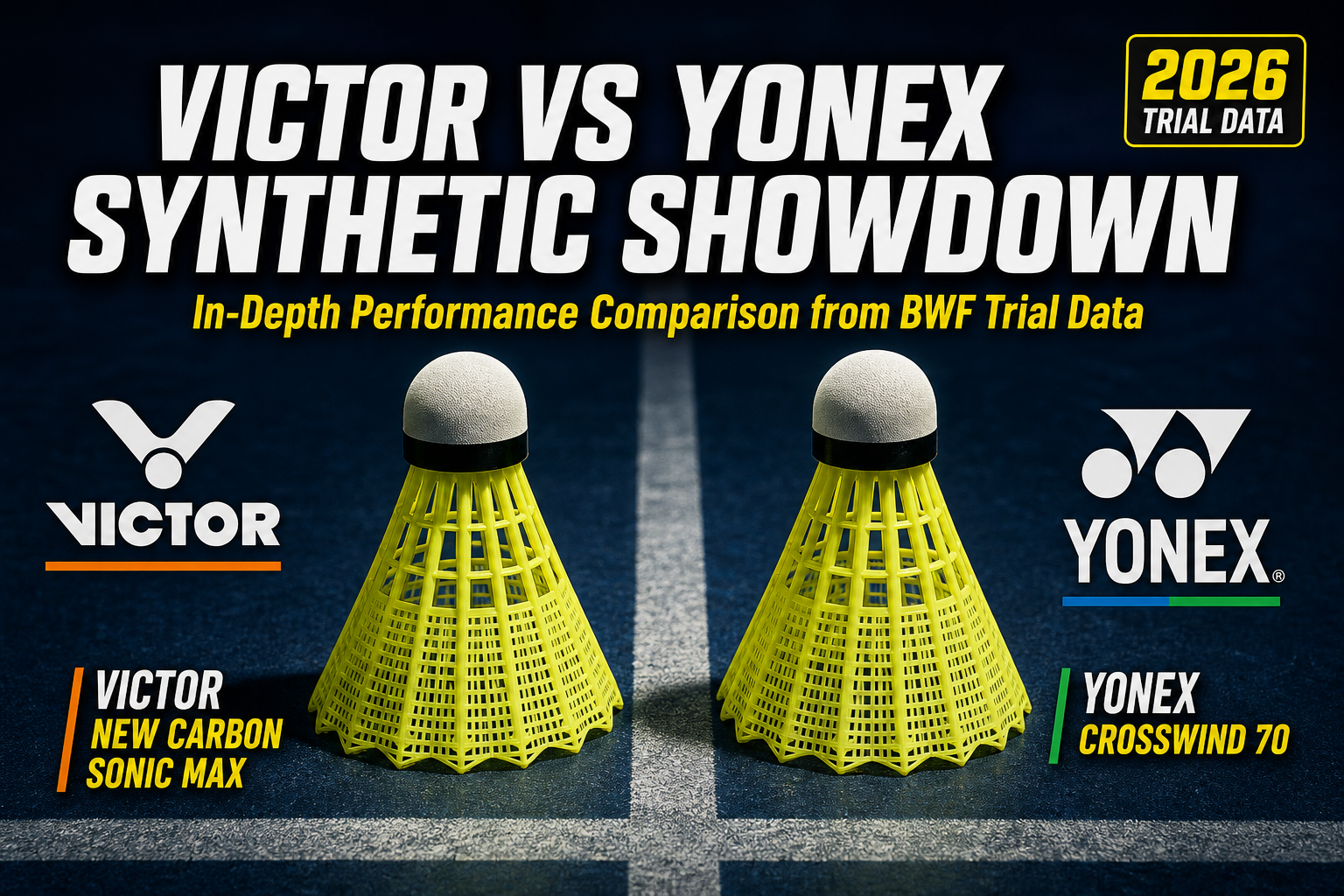
Victor vs Yonex Synthetic Showdown: In-Depth Performance Comparison from BWF Trial Data
Last updated: July 7, 2026
Quick Answer: On April 8, 2026, the BWF approved two synthetic shuttlecocks for Grade 3 and Junior International tournaments: the Victor New Carbon Sonic Max (SC-NCS-MAX-12) and the Yonex Crosswind 70. Early trial data shows the Victor model excels in smash consistency and durability, while the Yonex Crosswind 70 leads in net-play feel and spin response. For recreational players, both offer strong value as feather shuttle prices continue to climb.
Key Takeaways 🏸
- The BWF approved both shuttles in April 2026 to address a global feather shortage that has more than doubled shuttle prices [2]
- Victor’s model uses carbon graphite and foam inserts; Yonex uses a stiffer nylon base, both keep natural cork bases [5]
- Both shuttles are lemon-yellow to distinguish them from traditional white feather shuttles [5]
- Victor’s shuttle earned praise for firm smash trajectories; Yonex’s model was rated higher for net spin response [4]
- Smash speeds are comparable to feather shuttles, but trajectories run slightly flatter at full power [4]
- Victor’s shuttle can feel “heavier in the air” during drop shots compared to feather alternatives [4]
- Both models are being evaluated for flight consistency, durability, and playability across real tournament conditions [3]
- Recreational players stand to benefit most right now, with both models offering better cost-per-tube value than premium feather shuttles
What’s the Difference Between Victor and Yonex Synthetic Badminton Shuttles?
The two approved models differ mainly in their internal construction and how that affects feel. Victor’s New Carbon Sonic Max uses carbon graphite and foam inserts for a firmer, more structured flight path. Yonex’s Crosswind 70 uses a stiffer nylon base that prioritizes spin and touch around the net [5].
Construction at a glance:
| Feature | Victor SC-NCS-MAX-12 | Yonex Crosswind 70 |
|---|---|---|
| Base material | Natural cork | Natural cork |
| Vane material | Carbon graphite + foam | Stiff nylon |
| Color | Lemon-yellow | Lemon-yellow |
| BWF approval level | Grade 3 + Junior International | Grade 3 + Junior International |
| Smash feel | Firm, structured | Slightly softer |
| Net play response | Adequate | Closely mimics feather |
Both shuttles retain natural cork bases, which keeps the weight distribution familiar for players switching from feather [5].
What Did BWF Trials Show About Victor vs Yonex Shuttles?
The BWF’s April 2026 decision to trial these shuttles in competitive play was driven by a real supply crisis, feather prices have more than doubled due to reduced duck and goose populations, especially in China [2]. The trials are ongoing across Grade 3 and Junior International events, with feedback collected from players, technical officials, and event organizers [3].
Key findings from early trial data [4]:
- Smash speeds with both synthetics are comparable to feather shuttles
- Full-power smash trajectories run slightly flatter, which can benefit aggressive baseline players
- Victor’s model delivered consistent smash paths across multiple tube tests
- Yonex’s model was specifically praised for net spin response, historically the hardest quality for synthetics to replicate
- Some players flagged a heavier sensation with Victor’s shuttle during drop shots and slow-play exchanges
💬 “The YONEX CROSSWIND 70 received praise for its net spin response, closely mimicking feather shuttles during net play, a challenging aspect for synthetic alternatives.”, Player feedback from BWF Grade 3 trial events [4]
Which Synthetic Shuttle Is Faster: Victor or Yonex?

Both shuttles produce smash speeds comparable to feather alternatives, so neither has a clear speed advantage over the other [4]. The more relevant difference is trajectory shape: both synthetics fly slightly flatter at full power compared to feather shuttles, which can feel faster even if raw speed is similar.
- Choose Victor if you play a power-heavy baseline game and want predictable smash arcs
- Choose Yonex if you rely on net play, deception, and touch shots where spin matters more than raw pace
The flat trajectory of both models may take 1-2 sessions to adjust to, especially for players used to the steep drop of premium feather shuttles.
How Do Victor Synthetic Shuttles Perform Compared to Yonex in Real Play?
Victor’s New Carbon Sonic Max performs best in fast, power-oriented rallies. The carbon graphite construction gives it a firm feel off the strings, and players reported consistent smash trajectories across repeated hits [4]. It’s a strong choice for players who prioritize predictability in attacking play.
Yonex’s Crosswind 70 performs better in technical, touch-based rallies. Its net spin response closely mimics feather shuttles, which is a significant achievement for any synthetic [4]. Players who rely on net deception, tight lifts, and spinning drops will feel more at home with the Yonex model.
Common complaint about Victor: The “heavier in the air” sensation during drop shots and slow exchanges [4]. This doesn’t affect smash play much, but it can disrupt rhythm for players who rely on soft game variety.
Yonex Synthetic Shuttle Durability vs Victor: Which Lasts Longer?
Durability data from the BWF trials is still being compiled, but early feedback suggests both models outlast standard feather shuttles in typical recreational conditions. Synthetic vanes don’t split or fray the way natural feathers do, which is one of the main selling points for club and recreational use.
- Victor’s carbon graphite vanes are structurally rigid, which resists deformation over time
- Yonex’s nylon vanes are flexible but resilient, handling off-center hits well
- Both models are expected to survive multiple full matches before performance degrades noticeably
Practical tip: In humid or outdoor-adjacent conditions (like poorly ventilated halls), synthetic shuttles generally hold their shape better than feather ones. This makes both models worth considering for club environments where shuttle rotation is high.
How Much Do Victor Synthetic Shuttles Cost vs Yonex?
Exact retail pricing varies by region and distributor, but both models are positioned as premium synthetic options, priced above budget synthetics but below top-tier feather shuttles like the Yonex AS-50 or Victor Gold. Given that feather shuttle prices have more than doubled in 2026 due to the global shortage [2], both approved synthetics now represent genuine value for regular players.
General cost guidance:
- Both models are priced in the mid-range synthetic tier
- Cost-per-match is significantly lower than feather shuttles when durability is factored in
- Club buyers purchasing in bulk (tubes of 12) will see the clearest savings
For recreational players and club coordinators, the economics now clearly favor synthetics for training sessions and Grade 3-level competition.
Are Victor Synthetic Shuttles Better for Beginners or Advanced Players?
Victor’s New Carbon Sonic Max suits intermediate to advanced players more than beginners. The firm feel and consistent smash trajectory reward players who already have developed technique. Beginners may find the slightly heavier drop-shot feel disorienting early on [4].
Yonex’s Crosswind 70 is more accessible across skill levels because its net play behavior is closer to feather shuttles. For beginners learning proper net technique, the Yonex model provides more realistic feedback.
Decision rule:
- Beginner or developing player? → Start with Yonex Crosswind 70
- Intermediate to advanced power player? → Victor New Carbon Sonic Max fits your game better
If you’re also exploring other racket sports, check out tips for improving racket sports skills to build a well-rounded foundation across games.
Which Synthetic Shuttle Has Better Flight Consistency: Victor or Yonex?
Flight consistency is where the Victor vs Yonex synthetic showdown gets most interesting from a BWF trial data perspective. Victor’s carbon graphite construction produced more repeatable smash trajectories in trial feedback [4]. Yonex’s model showed stronger consistency specifically in net-play scenarios and spin-dependent shots.
So the answer depends on which part of the court matters most to you:
- Backcourt consistency (smashes, clears): Victor edges ahead
- Forecourt consistency (net shots, drops, spins): Yonex leads
Neither shuttle showed major flight irregularities during the trials, both passed BWF’s baseline consistency standards to earn approval [3].
Are Victor Synthetic Shuttles Good for Outdoor Play Compared to Yonex?
Neither shuttle is officially rated for outdoor play, and the BWF trials are conducted in indoor tournament conditions [3]. That said, both synthetic models handle air movement better than feather shuttles because their vanes don’t deform in humidity or light airflow.
For semi-outdoor or poorly ventilated venues, synthetics in general are a better choice than feather. Between the two, Victor’s stiffer carbon vanes may hold their shape slightly better in variable air conditions, but this hasn’t been formally tested in the BWF trial framework.
Bottom line: If outdoor or semi-outdoor play is your main use case, either synthetic is a reasonable choice over feather, but don’t expect tournament-level performance in genuine outdoor wind conditions.
Can You Use Victor and Yonex Synthetic Shuttles in the Same Match?
No, and this is an important practical point. Mixing shuttle models within a match is not permitted under BWF tournament rules, and it’s also not recommended for recreational play. The two models fly differently enough (especially in drop shots and net play) that switching mid-match would disrupt consistency for both players [4].
For club and recreational use:
- Pick one model per session and stick with it
- If your club wants to trial both, run separate sessions with each model
- Keep tubes clearly labeled since both shuttles share the same lemon-yellow color [5]
Why Would You Choose Victor Synthetic Over Yonex (or Vice Versa)?
Here’s a straightforward breakdown for different player types:
Choose Victor New Carbon Sonic Max if you:
- Play an aggressive, smash-heavy style
- Want maximum consistency on power shots
- Prioritize durability and structural rigidity
- Are an intermediate or advanced player
Choose Yonex Crosswind 70 if you:
- Rely on net play, touch, and deception
- Are newer to the sport and want feather-like feedback
- Play in a club environment with mixed skill levels
- Want the closest synthetic approximation of feather shuttle feel
The broader context matters too. The global feather shortage driving these trials isn’t a short-term blip, it’s a structural supply issue [2]. Building familiarity with a synthetic model now puts you ahead of the curve as the sport adapts.
For players across multiple racket sports who want to understand how equipment shapes play, exploring the evolution of racket sports gear offers useful perspective on how materials innovation changes the game.
FAQ: Victor vs Yonex Synthetic Showdown
Q: When did the BWF approve synthetic shuttles for competition? A: April 8, 2026. The BWF approved both the Victor New Carbon Sonic Max and Yonex Crosswind 70 for use in Grade 3 and Junior International tournaments [1].
Q: Why did the BWF start trialing synthetic shuttles? A: Feather shuttle prices more than doubled due to a global shortage of duck and goose feathers, particularly from China. The trials aim to find a sustainable, cost-effective alternative [2].
Q: Do synthetic shuttles feel the same as feather shuttles? A: Not exactly. Smash speeds are comparable, but trajectories are slightly flatter. Victor’s model feels firmer; Yonex’s model is closer to feather in net play [4].
Q: What color are the approved synthetic shuttles? A: Both are lemon-yellow, making them visually distinct from traditional white feather shuttles [5].
Q: Are these shuttles available for recreational purchase? A: Both models are available through badminton equipment retailers, though availability varies by region. They’re positioned as premium synthetics in the mid-price range.
Q: Which shuttle is better for club training sessions? A: Yonex Crosswind 70 is generally more accessible for mixed-skill club sessions because it behaves more like a feather shuttle across different shot types.
Q: Do both shuttles have natural cork bases? A: Yes. Both approved models retain natural cork bases, which preserves familiar weight distribution for players transitioning from feather shuttles [5].
Q: Is the Victor shuttle approved for professional-level BWF events? A: Currently, both synthetics are approved for Grade 3 and Junior International events only, not for top-tier Super Series or World Championships [1].
Q: What’s the main complaint about Victor’s synthetic shuttle? A: Players reported a “heavier in the air” sensation during drop shots compared to feather shuttles, which can disrupt soft-game rhythm [4].
Q: Will synthetic shuttles eventually replace feather shuttles entirely? A: The BWF is still in the evaluation phase. The trials are collecting data from players, officials, and organizers before any broader rollout decision is made [3].
Q: Can beginners use these shuttles? A: Yes, though Yonex’s Crosswind 70 is the better starting point for beginners due to its more natural net-play feel. Victor’s model suits players with more developed technique.
Q: Are synthetic shuttles more sustainable than feather? A: Yes. Synthetic shuttles reduce reliance on animal products and lower the carbon footprint associated with transporting natural feathers globally [5].
Conclusion: What Should You Do Right Now?
The Victor vs Yonex synthetic showdown from BWF trial data tells a clear story: both shuttles are genuinely competitive, but they suit different playing styles.
If power and smash consistency define your game, Victor’s New Carbon Sonic Max is the stronger pick. If you live at the net and need that feather-like spin response, Yonex Crosswind 70 is worth the investment.
Actionable next steps:
- Try both models in separate practice sessions before committing to one for club use
- Buy a single tube of each to compare feel firsthand, don’t rely only on trial reports
- Talk to your club coordinator about bulk purchasing options now that both are BWF-approved
- Adjust your drop-shot technique if switching to Victor, since the heavier feel in slow exchanges takes a session or two to calibrate
- Follow BWF trial updates, the evaluation is ongoing, and performance data will sharpen as more tournaments report in [3]
The feather shortage isn’t going away. Getting comfortable with a quality synthetic now means you won’t be caught off-guard when availability shifts further. Both Victor and Yonex have delivered genuinely playable options, and that’s good news for the whole badminton community. 🏸
Want to keep improving across all your racket sports? Explore more badminton tips and racket sports equipment reviews at Rally Racket.
References
[1] BWF Approves Synthetic Shuttlecocks Victor Yonex Tournaments – https://indianexpress.com/article/sports/badminton/bwf-approves-synthetic-shuttlecocks-victor-yonex-tournaments-10625439/?utm_source=openai
[2] BWF Synthetic Shuttlecocks Trial 2026: Badminton’s Answer to Feather Shortage Crisis – https://www.businessupturn.com/sports/badminton/bwf-synthetic-shuttlecocks-trial-2026-badmintons-answer-to-feather-shortage-crisis/?utm_source=openai
[3] Synthetic Shuttlecocks Will Be Used at Selected Tournaments: BWF – https://newzville.com/2026/04/09/synthetic-shuttlecocks-will-be-used-at-selected-tournaments-bwf/?utm_source=openai
[4] Synthetic Shuttle Trials in Action: Player Feedback from BWF Grade 3 Tournaments in April 2026 – https://rallyracket.com/synthetic-shuttle-trials-in-action-player-feedback-from-bwf-grade-3-tournaments-in-april-2026/?utm_source=openai
[5] BWF Synthetic Badminton Shuttles April 2026 – https://www.peakmocks.com/current-affairs/bwf-synthetic-badminton-shuttles-april-2026?utm_source=openai